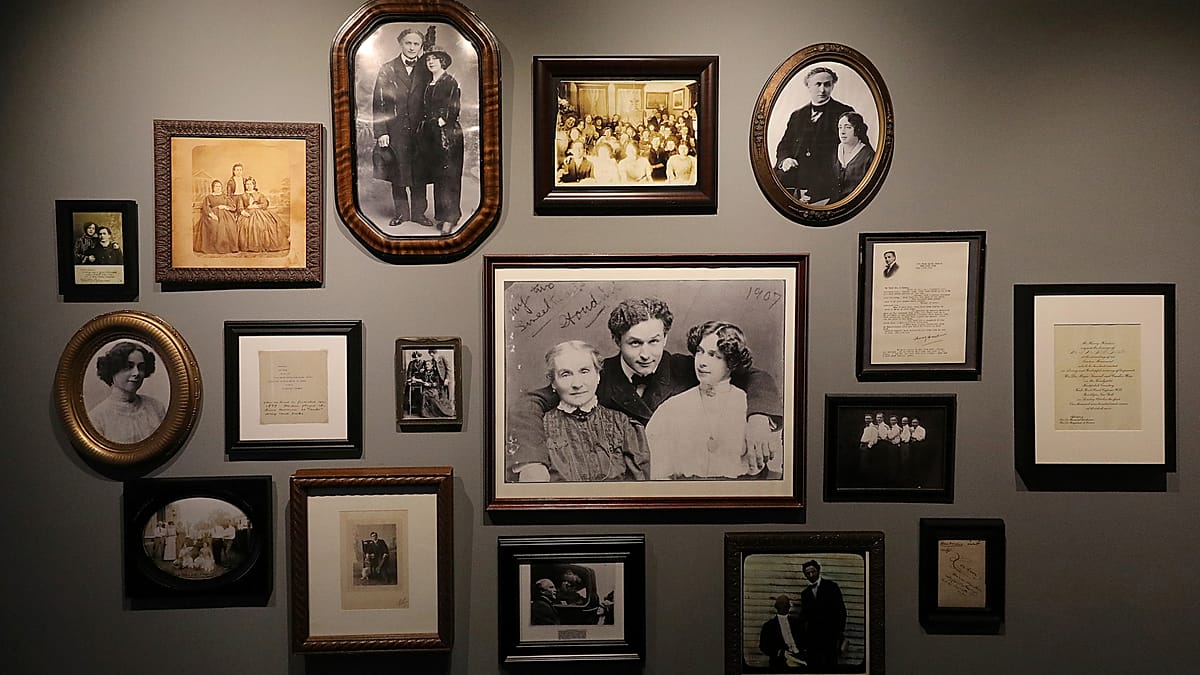
Budapest is paying tribute to one of its most famous sons, Harry Houdini, with a series of events marking the centenary of the escape artist's death. The four-day programme, part of the broader Houdini 100 series, began in the Hungarian capital on Thursday, bringing together magicians, historians, and the only living descendant of the legendary illusionist.
George Hardeen, the grandson of Houdini's brother, travelled from the United States for the occasion. He was joined by Gay Blackstone, a television producer from the renowned Blackstone family of magicians and former president of the Academy of Magical Arts, which operates Hollywood's Magic Castle. Also present was Péter Gloviczki, a world champion magician and vascular surgeon.
The programme includes the unveiling of a memorial plaque at Houdini's birthplace on Csengery Street, a magic auction, and a night-time show. A film festival and circus performances are also part of the tribute, which is being held in collaboration with the Houdini House, a museum in Buda Castle dedicated to the illusionist's legacy.
A Hungarian-born legend
Harry Houdini was born Erik Weisz on 24 March 1874 in Budapest, the son of a rabbi. Four years later, the family emigrated to the United States, settling briefly in Appleton, Wisconsin, before moving to New York in 1882. As a boy, Erik sold newspapers and shined shoes, and at the age of nine he made his stage debut as the "prince of the trapeze". He ran away from home at 12 to join a travelling circus, but later returned to help his parents.
His career as a magician began at 17 with card tricks, but he soon turned to escape acts. He adopted the stage name Houdini in honour of the French magician Jean-Eugene Robert-Houdin, and in 1893 he married Wilhelmina Rahner, who became his stage assistant under the name Bess Houdini.
In 1899, impresario Martin Beck advised Houdini to focus on escape acts, and he quickly gained fame as the Handcuff King. After freeing himself from Scotland Yard's handcuffs, he secured a six-month contract in Europe, where local police often assisted his acts with locks, handcuffs, and prison cells. He was frequently stripped and searched, yet always managed to break free.
By 1908, with imitators copying his chain and straitjacket escapes, Houdini shifted to breaking out of locked spaces. His first such act was escaping from a giant milk churn filled with water and hermetically sealed, a stunt he promoted with the slogan "Failure means death by drowning". He went on to escape from water-filled tanks, coffins, prison cells, pits filled with earth, and even the stomach of a beached whale.
His success was built on extraordinary physical strength, flexibility, and skill in opening locks and knots. He could hold his breath for up to four minutes, yet often fainted after freeing himself. He devised most of his tricks himself and revealed the solutions only to his four assistants, leaving many of his methods a mystery to this day.
Beyond his performances, Houdini wrote books, attempted to fly, and made films. His first film, The Grim Game, long thought lost, resurfaced in March 2015. He also worked to organise magicians, serving as president of the Society of American Magicians from 1917.
Despite his fame, Houdini was a vocal critic of spiritualism and fraud. He attended séances in disguise and exposed charlatans, writing two books on the subject: Miracle Mongers and Their Methods and A Magician Among the Spirits. He and his wife made a pact that whoever died first would try to contact the other, but his widow's attempts were unsuccessful.
Houdini died on 31 October 1926 in Detroit, officially from peritonitis caused by a ruptured appendix. The centenary events in Budapest are a fitting tribute to a man who, despite spending most of his life in America, never forgot his Hungarian roots. As David Merlini, founder of the Houdini House, noted, the celebrations have drawn visitors from around the world to the city where Houdini's remarkable journey began.