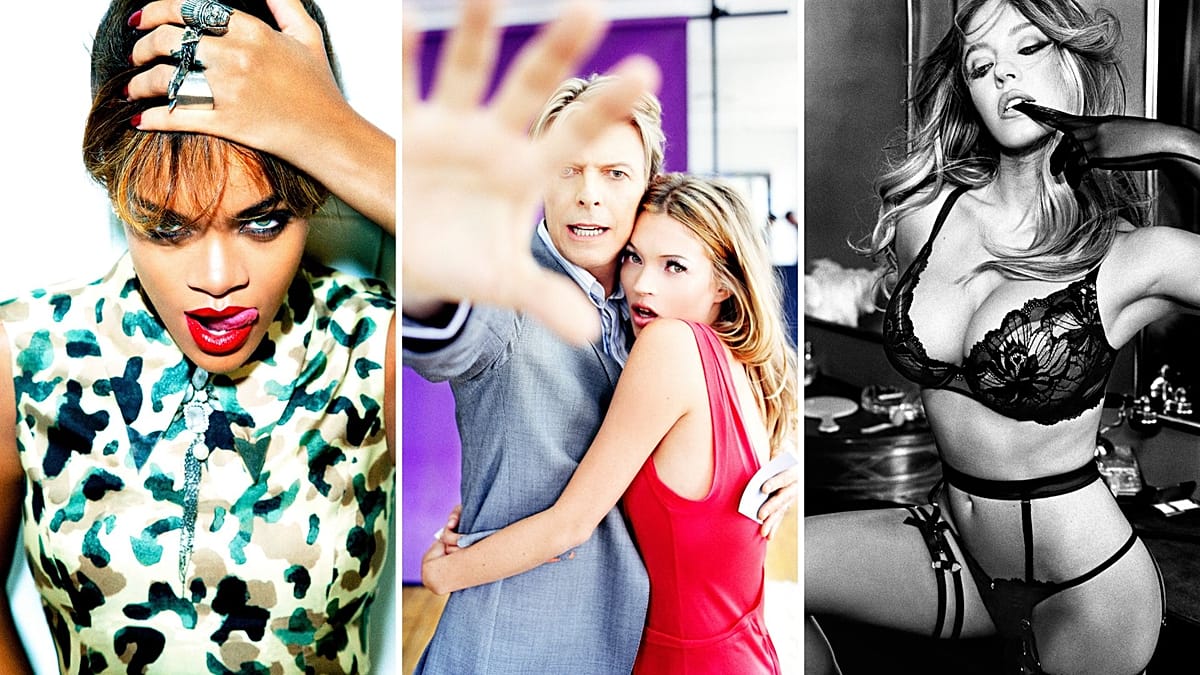
If you have ever seen a fashion photograph where a woman appears to be getting away with something—running in heels, laughing in lingerie, or commandeering a car in a ballgown—you have likely encountered the work of Ellen von Unwerth. The German photographer, who has been a defining force in the industry for over three decades, has built a career on images that are at once glamorous, mischievous, and deeply human.
Von Unwerth recently sat down with Euronews Culture to discuss her contribution to the 2027 Toiletpaper calendar, a project by Maurizio Cattelan and Pierpaolo Ferrari, as well as her unique approach to fashion photography and the stories behind some of her most iconic images. The conversation offered a rare glimpse into the mind of an artist who has not only captured fashion but helped shape it.
From model to photographer
Von Unwerth's path to the camera was unconventional. She spent ten years as a fashion model, a period she describes as frustrating. "I always wanted to express myself in front of the camera, move, be silly and show my personality," she recalls. "Photographers were always saying, 'No, no, no, don't move. Look to the left, to the right, and just pose.'"
Her escape came when her boyfriend at the time handed her a camera with a simple instruction: "There's a plus, a circle and a minus. When the circle lights up, you push the button." That crash course sparked a passion. She began photographing her model friends, dressing them in vintage finds from flea markets and doing their makeup. "Quickly, I noticed that we had a great connection, and they behaved differently. They felt free and were playful," she says. She set up a darkroom in her tiny apartment and became obsessed, printing images all night and covering her bathroom walls with them.
The female gaze and its evolution
Von Unwerth's work has been widely credited with pioneering the 'female gaze' in fashion photography, shifting who gets to be sexy and, crucially, who decides. She has never shied away from sensuality, but her images are always imbued with a sense of agency and joy. "I never objectified women," she insists. "That was my subject."
When asked about recent controversies, such as the Sydney Sweeney advertising campaign she shot, von Unwerth is pragmatic. "Sydney Sweeney decides what she wants to do, and that's what she wants to do. She doesn't care, and I kind of think that's great," she says. "Of course, not everybody is happy about it, but she lives her life, and that's how it should be."
Technology and the art of the image
Despite the digital revolution, von Unwerth remains a champion of film. "I was maybe one of the last people to switch to digital because I loved film," she admits. "I still love it, and I'm actually shooting more and more with film again." She values the grain and quality that film provides, which cannot be replicated digitally. Yet she also acknowledges the creative possibilities of modern tools, from RAW files to the iPhone. "It's great, but it's also more difficult to find your style," she notes, reflecting on the sheer volume of images that now flood our screens. "There's an overload of images, and people just scroll, scroll, scroll."
Von Unwerth's contribution to the Toiletpaper calendar is a testament to her enduring relevance. The project, known for its surreal and provocative aesthetic, aligns perfectly with her playful sensibility. Her work continues to challenge conventions, reminding us that fashion photography can be both art and entertainment.
As she looks back on a career that has spanned decades, von Unwerth remains as passionate as ever. "I still love capturing life and those moments that are real and spontaneous," she says. "It's such a great connection that I reach with people in that way."
For those who have followed her journey, the message is clear: Ellen von Unwerth has not just documented fashion; she has redefined it, one playful, sensual image at a time.