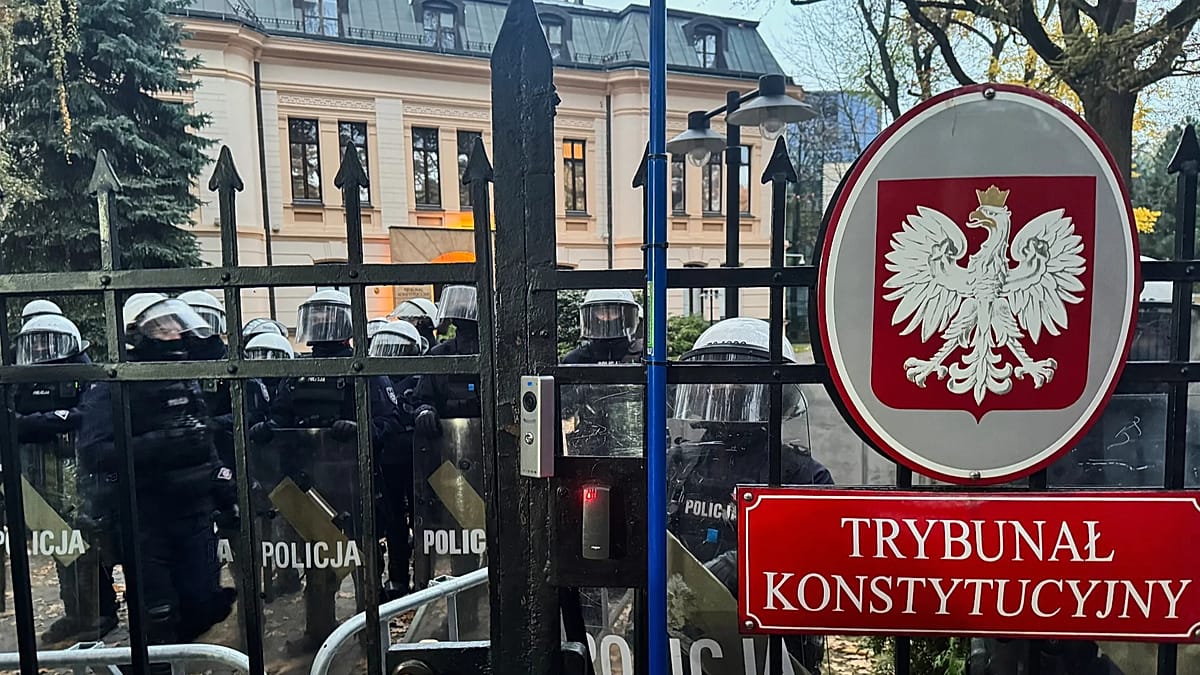
The European Commission has weighed in on Poland's escalating constitutional crisis, affirming that the Sejm, the lower house of parliament, holds the constitutional authority to appoint judges to the country's Constitutional Tribunal. The statement, issued on Saturday, came after a dramatic confrontation outside the tribunal building in Warsaw on Friday night, broadcast live on national television, which has thrust a decade-old dispute back into the heart of European political debate.
A Commission spokesperson told Euronews that Brussels is closely monitoring the situation and that it is for Polish authorities to ensure the tribunal can function in line with the Polish constitution and the relevant case law of the Court of Justice of the European Union. The spokesperson added that the appointment of eight new members of the tribunal lies within the constitutional power of the Sejm, a clear endorsement of the government's position.
The Commission also pointed to a ruling by the European Court of Human Rights, which on 5 May 2026 issued interim measures requiring Polish authorities to refrain from hindering the taking up and exercise of judicial duties by judges appointed by the Sejm in March 2026. This legal backing adds weight to the government's argument that the appointments are legitimate and must be allowed to proceed.
Tusk's response: calm without lawlessness
Prime Minister Donald Tusk addressed the nation on Saturday evening in his first major response to the crisis. He described Friday's events as “scandalous incidents” and expressed hope that such scenes would never be repeated in Poland. Tusk stressed that restoring calm cannot mean accepting lawlessness or violence, and he vowed to restore conditions for independent justice and the rule of law.
“A democratic state has to be strong and capable of enforcing justice,” Tusk said, adding that the rule of law would prevail over violence. His remarks came after President Karol Nawrocki attempted to enter the tribunal building amid a deadlock over the appointment of new judges. Police surrounded the building as the confrontation unfolded live on television, highlighting the growing stand-off between the president and the government over the composition of the country's top court.
The Tusk government says it is pushing ahead with long-needed reforms to restore the rule of law after years of what it describes as interference in the judiciary by the Law and Justice (PiS) party. The opposition, however, accuses Tusk's government of attempting a coup, a charge that has intensified political divisions across the country.
European conservatives rally behind president
The co-chairs of the European Conservatives and Reformists (ECR) group in the European Parliament condemned the Polish government's actions on Saturday, describing them as a violation of the rule of law and backing President Nawrocki. Nicola Procaccini, ECR co-chair, said in a statement: “The Tusk government's actions constitute a clear and grave violation of the rule of law. We condemn this attack on judicial independence and Poland's constitutional safeguards. No government stands above the law.”
Procaccini added that European institutions “must not avert their eyes” and that respect for national sovereignty and judicial independence must remain a matter of principle, “unaffected by political alliances”. The ECR's intervention underscores how the Polish crisis has become a flashpoint in broader European debates about the balance between national constitutional traditions and EU legal norms.
The tribunal's legitimacy has been contested for more than a decade, with the dispute dating back to 2015 when the then-governing Civic Platform and the opposition Law and Justice party clashed over the appointment of five judges. That original conflict has since evolved into a deeper institutional battle, with each side accusing the other of undermining the rule of law.
As the standoff continues, the European Commission's clear statement in favour of the Sejm's role may further inflame tensions with Warsaw's conservative opposition, but it also provides legal cover for the government's reform agenda. The coming weeks will be critical in determining whether Poland can navigate this crisis without further erosion of public trust in its judicial institutions.