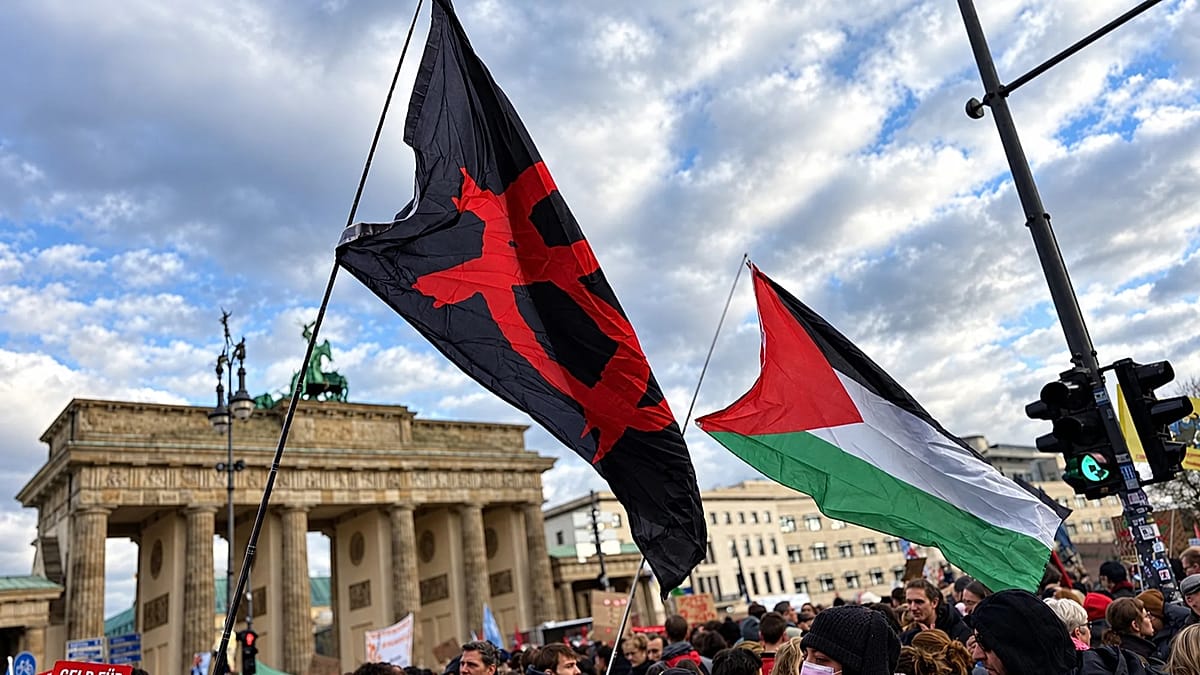
On Saturday, an estimated 5,000 demonstrators gathered at Berlin's Brandenburg Gate for a rally organized by the youth initiative "Gen Z regelt," with organizers later claiming 11,000 participants. The protest, which began at 2 p.m., focused on demands for increased investment in education, climate protection, affordable living costs, and opposition to compulsory military service. While organizers pledged a peaceful event, the atmosphere was charged with a strong pro-Palestinian presence, and several shops along Unter den Linden, Friedrichstraße, and Kurfürstendamm boarded up their windows as a precaution.
Pro-Palestinian symbols and slogans dominate
At the entrance to the Brandenburg Gate, activists distributed flyers, including a man wearing a jumper in the colors of the Palestinian flag. Nearby, representatives of the daily newspaper Junge Welt, which Germany's domestic intelligence service classifies as far-left extremist, offered brochures. Across the square, Palestinian flags flew alongside anarchist and Antifa banners. Signs mixed education and military themes, with slogans like "Flunked the PISA test but passed the military medical" and "Money for social causes instead of war." Others were more explicit, reading "German weapons kill children in Palestine" and "Stop the genocide in Gaza."
Many attendees, mostly young men and women, wore the traditional Palestinian kufiya scarf, either around their necks, heads, or draped over their shoulders. The visual impact was unmistakable, blending the rally's core demands with a broader geopolitical message.
Youth voices: education underfunded, militarism overblown
Speaking to Euronews, a group of young women aged 19 to 20, who are doing a voluntary social year (FSJ), said they came to show solidarity with protests across Europe, particularly in France, but also to express frustration that politicians ignore young people. "There is constant militarisation and rearmament, and there is simply not a single cent left for education and social spending," one said. Two of the women wore kufiyas, and when asked about the connection to the Middle East, one replied: "It has to do with the fact that we as young people, or as people in Germany in general, also have to take responsibility for the fact that weapons are produced here that are used to kill civilians and children in Palestine, in Gaza and in the West Bank." She added, "I do not think I could ever live with myself if I never paid any attention to this."
A chemistry student from Freie Universität (FU) Berlin, where pro-Palestine occupations have occurred in recent years, said he joined because universities face budget cuts while rents rise, forcing students to work. "At some point it simply becomes impossible," he said. He wore the kufiya because FU has eleven cooperation projects with Israel, which he claims indirectly support war research. "I do not want our universities to exist to build war products. I do not want FU to support a genocide," he said.
Part of a wider European wave
The Berlin rally is part of a broader youth-led protest movement across Europe. In France, demonstrations that began as a high school student movement have expanded to include labour unions and others opposed to President Emmanuel Macron, with rallies also reported in the Netherlands, Italy, and Spain. The French government's response has included deploying tens of thousands of police, reflecting the tensions.
However, critics in Germany point to the presence of radical left-wing groups at the Berlin demonstration. Alongside Antifa flags, the youth organisation Linksjugend ['solid], the youth wing of the Left Party, was present in smaller numbers. The group has faced accusations of antisemitism, particularly its Neukölln branch, which has made headlines for anti-Israeli resolutions. The Revolutionäre Linke also had a stand; in early 2023, some members split to form the separate organisation Jugend für Sozialismus, citing conflicts with the leadership over political direction and internal democracy.
The organisation criticises the trend of more money for the Bundeswehr and less for hospitals and other social services. This echoes a broader debate in Germany about military spending versus social investment, a theme that resonates with student movements elsewhere in Europe, such as in Serbia, where students have recently won concessions.
The rally's mix of legitimate youth concerns with extremist elements highlights a challenge for organisers and authorities alike. While the core demands—education funding, climate action, affordable housing—are shared by many young Europeans, the visible presence of groups with radical agendas risks overshadowing the message. As protests continue across the continent, the line between peaceful advocacy and extremist mobilisation remains a point of contention.