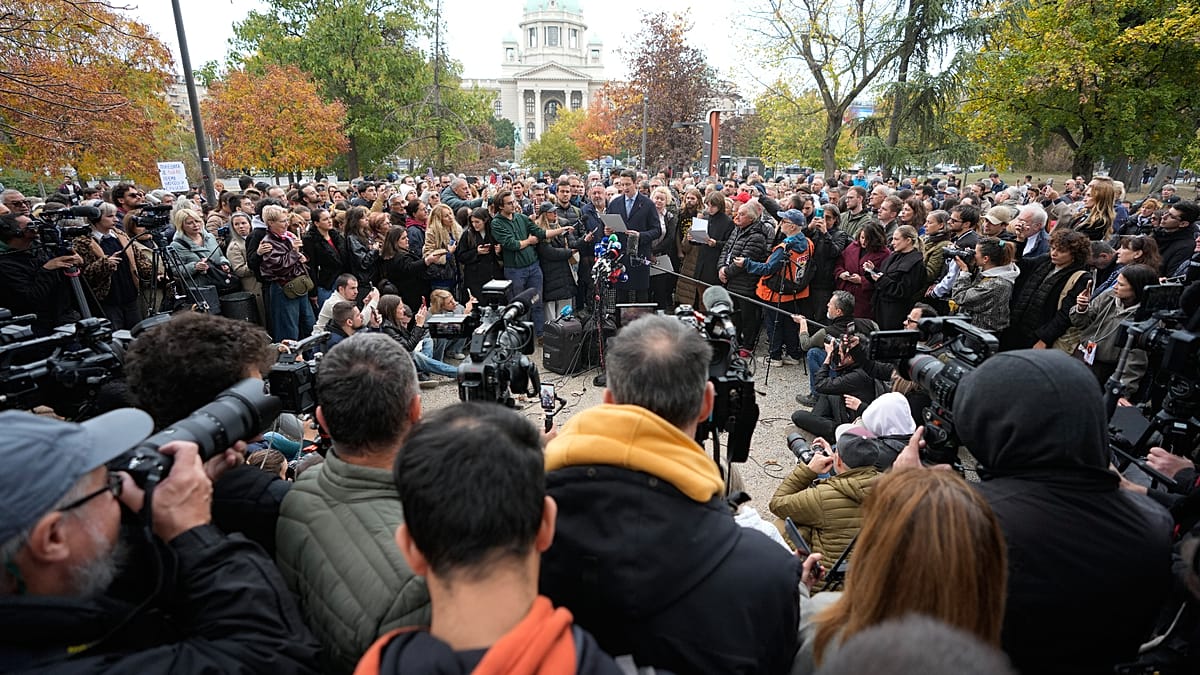
Serbia's political landscape has been transformed by the victory of the Student List, a movement born from two years of protests. Yet the very ambiguity that proved an electoral asset—no conventional party structure, no single leader, and a deliberately vague plan for governance—now threatens to become a liability as the movement prepares to take power.
The new government's foreign policy orientation is under intense scrutiny from Brussels, Moscow, Beijing, and the wider region. Early signals from the Student List's leadership suggest continuity rather than rupture, particularly on the most sensitive issues.
Russia: no sanctions, but what else?
One of the clearest positions to emerge is on Russia. Jovo Bakić, a sociologist and prominent figure on the Student List, has stated unequivocally that a new government would not impose sanctions on Moscow. He argued that Serbia, as a small country, would have little practical impact while incurring significant symbolic costs, and described Russia as a historically important partner.
Radomir Saičić, a professor at the University of Belgrade's Faculty of Chemistry and a member of the Serbian Academy of Sciences and Arts, echoed this in an interview with RIA Novosti: "As we stated in our programme, the Students' List does not advocate imposing sanctions against Russia." He added that Serbia itself has been a target of sanctions and that such measures do not resolve problems. "Problems should be resolved through dialogue, negotiations and agreements, not sanctions," Saičić said.
Dejan Šoškić, a candidate on the "Students Win" list and a potential prime minister, has spoken of improving relations with Croatia and the European Union, but remained non-committal on Russia. In an interview with Index.hr, he stressed the importance of good-neighbourly ties with Zagreb while acknowledging that differing interpretations of the 1990s wars will persist.
On Kosovo, Šoškić was firm: "The Students' List advocates full respect for the legal framework in Serbia, including international law. The Constitution states that Kosovo and Metohija is an autonomous province of Serbia. Key documents of the international legal framework, such as UN Security Council Resolution 1244, also affirm this."
Regarding EU membership, Šoškić was more cautious: "I believe that Serbia will certainly be in a position to fulfil the EU criteria much more easily and quickly. Whether it will join the European Union at some point after fulfilling all the conditions will depend, among other things, on whether the EU offers Serbia full membership, as well as on whether, in a referendum at the end of that process, the citizens of Serbia decide in favour of that option."
Brussels sends a clear message
The European Commission has already signalled that a change of government in Belgrade does not alter the fundamental requirements for EU accession. Enlargement Commissioner Marta Kos, after speaking with Ilija Srdanović, the Student List's lead candidate, stressed that alignment with EU foreign and security policy is non-negotiable. "Serbia will not be able to make significant progress towards EU accession unless it aligns its foreign and security policy with Brussels, including its position on Russia and the sanctions imposed on Moscow over the war in Ukraine," Kos said.
She was blunt about the consequences of non-alignment: "It will probably not be possible for a country that does not align with us on strategic interests—namely foreign and security policy, or our joint opposition to Russia, particularly in the context of Russia's war in Ukraine—to make progress. It will be very, very difficult."
This stance directly contradicts the warnings of former President Aleksandar Vučić, who had argued during the campaign that a Student List victory would lead to a dramatic shift in Serbia's Russia policy, including the imposition of sanctions. For now, there is no indication of such a change. The new authorities appear set to continue the status quo, maintaining Serbia's military neutrality and rejecting NATO membership.
On Kosovo, the Student List's position is indistinguishable from that of the previous government: opposition to Kosovo's unilateral declaration of independence and to its membership in international organisations. As one analyst put it, "You could search with a magnifying glass for any difference in policy towards Kosovo between old and new power in Belgrade, and you would not find one."
This suggests that while the tone of diplomatic relations with the West may soften—with less harsh rhetoric and fewer threats—the fundamental positions remain unchanged. The arrival of a new government in Belgrade should not be interpreted as a geopolitical realignment in the traditional sense. As Professor Saičić remarked, "For us, Kosovo is a temporarily occupied territory. Russia has done more to defend Serbia's territorial integrity..."
The Student List's victory has opened a new chapter in Serbian politics, but the challenges of governance are only beginning. The movement must now translate its electoral mandate into a coherent policy agenda, balancing domestic expectations with the pressures of international diplomacy. The coming months will reveal whether the ambiguity that served it so well in opposition can be transformed into effective leadership.