The Abu Dhabi Grand Slam drew to a close with a final day built around the heaviest categories, where experience, technique and a little patience decided the medals. Teddy Riner, the Frenchman whose name has defined the sport for more than a decade, watched from the stands — a reminder that judo's centre of gravity now stretches well beyond its European heartland.
Riner, a triple Olympic champion and twelve-time world titleholder, was generous about the setting. He said he was glad to return to the Emirati capital, describing each visit as a fresh occasion, and credited the country's leadership with investing in athletes and in bringing top-level judo to new audiences.
A Bulgarian veteran turns back the clock
The -90kg final paired Bulgaria's Ivaylo Ivanov with Mihail Latisev of Moldova, and it produced the day's most striking result. Ivanov, long established on the circuit, had to come from behind before securing his second Grand Slam victory — his first having arrived eleven years earlier.
Speaking afterwards, he was candid about the road back. He said he felt good because injuries had disrupted his previous season, and that he still enjoyed competing. He also hinted at a possible appearance in Los Angeles, without committing to anything firm. Nureddin Sehweil, chairman of the International Development Group, presented the medals.
Host nation celebrates as Lytvynenko delivers
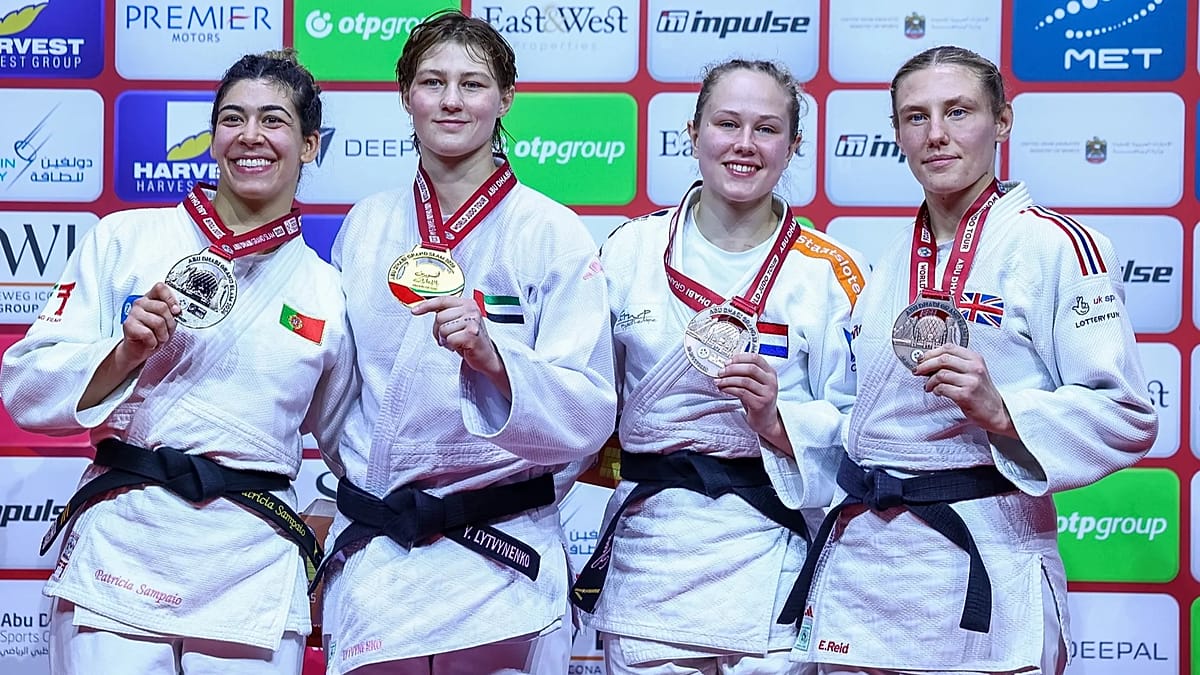
At -78kg, the newly crowned world champion Yelyzaveta Lytvynenko of the United Arab Emirates faced Patricia Sampaio of Portugal. Lytvynenko, competing for the first time with the red backpatch that marks a world titleholder, produced a decisive counter-attack to take gold — a result of real significance for the host federation.
Mohammed Bin Tha'aloob Al Derie, president of the UAE Judo Federation, awarded her the medal. Her win followed earlier successes for the region at the same tournament, including Azerbaijan's breakthrough on the opening day and further firsts on day two for Morocco and Moldova.
Groundwork decides the -100kg contest
France's Aurelien Diesse met Idar Bifov in the -100kg final, and the Russian's mat work proved the difference. Bifov worked the position patiently before locking in an armlock to force the submission, a finish that underlined how often the decisive moment in modern judo arrives on the ground rather than in the throw.
Riner himself placed the medals around the athletes' necks, a neat passing of the torch from one generation of heavyweights to the next.
Croatian tactics and a Georgian double
In the +78kg category, Raz Hershko of Israel took on Helena Vukovic of Croatia. Vukovic fought a controlled, tactical contest to claim the gold, managing the tempo and the grip exchanges rather than chasing a spectacular finish. Armen Bagdasarov, head referee director at the International Judo Federation, presented the awards.
The +100kg final brought together Ushangi Kokauri of Azerbaijan, a world silver medallist, and Irakli Demetrashvili of Georgia. Demetrashvili threw his opponent and then held him to complete the win — his second Grand Slam gold of the year, and a further sign of Georgia's enduring strength in the sport's heaviest division.
What the results say about the wider picture
For European judo, the weekend offered a mixed but encouraging read. Bulgaria, Croatia, France and Georgia all reached finals, while Moldova and Portugal pushed deep into the draw. The medals were shared across the continent rather than concentrated in the traditional powers, and the presence of a world champion competing under the UAE flag shows how quickly the sport's map is being redrawn.
The Grand Slam circuit now moves on, with athletes weighing the demands of qualification and the long build towards the next Olympic cycle. For Ivanov, the reward was a reminder that longevity still counts for something. For Lytvynenko, it was confirmation that a world title can be backed up. And for the spectators in Abu Dhabi, it was a final day that delivered on its billing.