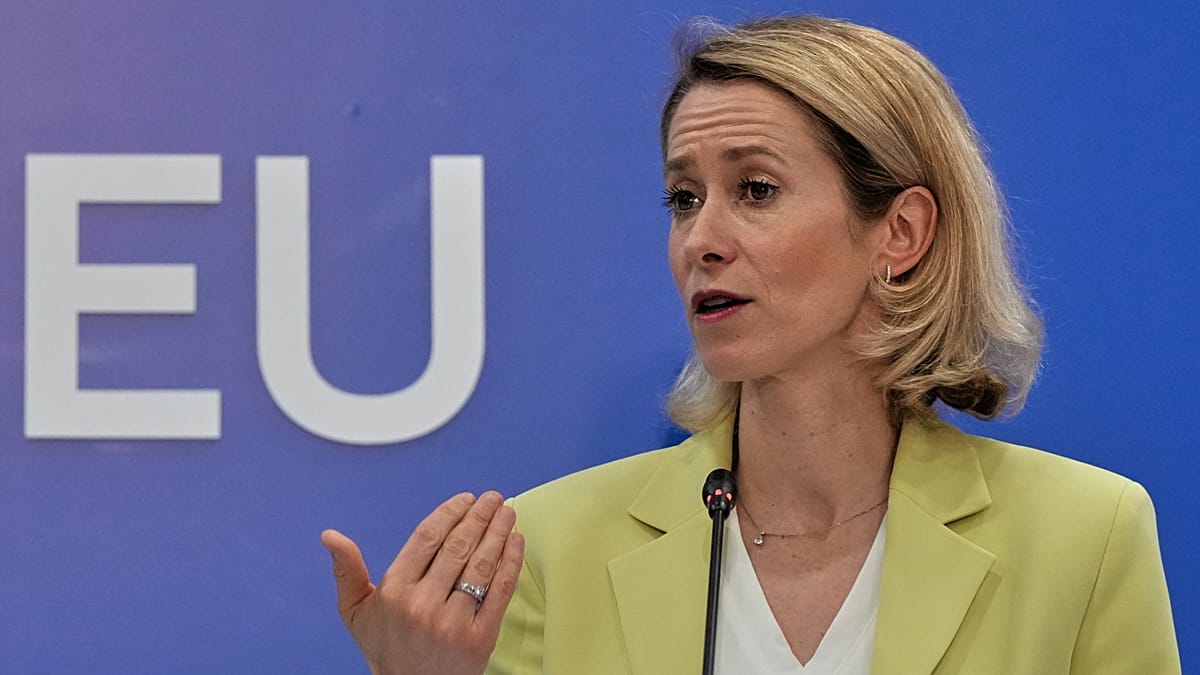
This week, the European External Action Service (EEAS) found itself at the center of a quiet but consequential power struggle. Reports emerged that European capitals, led by Paris, are circulating informal proposals to fundamentally reshape the EU's diplomatic arm—potentially stripping High Representative Kaja Kallas of much of her authority. As I reported alongside my colleague Luca Bertuzzi, the situation is more nuanced than a simple coup, but the stakes are unmistakable.
The French document, still unofficial, outlines three possible futures for the EEAS, which was established only 15 years ago. The first scenario would see the European Commission, under Ursula von der Leyen, absorb the service, cementing her already expansive role in foreign affairs. Von der Leyen has increasingly stepped onto Kallas's terrain, positioning the Commission as the EU's geopolitical voice. A second option would hand operational control to the European Council, meaning EU leaders themselves would steer foreign policy directly. While this could accelerate decision-making, it risks exposing deep national divisions in public. A third scenario—still vague—would preserve the status quo but with adjustments.
For Kallas, the timing could hardly be worse. She has been under fire for months, with critics pointing to structural flaws in the EU's foreign policy machinery. The Estonian former prime minister has defended the EEAS as essential for coherence, but the push from Paris suggests that patience is wearing thin. As one diplomat familiar with the document told me, the proposal is not intended to kill a sacred cow—at least not yet. But the message is clear: member states want more control, and they are willing to challenge the EU's top diplomat to get it.
Budget Battles and the Italian Paradox
Meanwhile, negotiations over the next Multiannual Financial Framework (MFF) are heating up. The usual dynamics are at play: wealthier nations like Germany and the Netherlands want to cap spending, arguing they pay too much into the common pot. Less wealthy states—Central and Eastern European countries, plus southern members—insist on preserving agricultural subsidies and cohesion funds. And then there is Italy.
As I discussed with my friend Paola Tamma between press conferences in Luxembourg, Rome is perceived as part of the group of quelli che non pagano (those who don't pay) because it behaves like one—demanding that agriculture money remain untouched. Yet Italy is a net payer to the EU budget. This paradox explains why Prime Minister Giorgia Meloni told the Italian parliament this week that the rebate system—discounts on contributions enjoyed by Germany, the Netherlands, and others—must be scrapped entirely, or Italy will demand its own rebate. Her comments signal that next week's European summit will be contentious from the start.
The urgency is driven by the 2027 deadline, with French presidential elections looming. A victory for Marine Le Pen (whose political future hinges on an appeals court decision) or Jordan Bardella (spotted at the Monaco F1 Grand Prix with his Italian girlfriend) could complicate negotiations. For diplomats, it is better to secure a deal now than risk a far-right government at the table.
IMF's Georgieva: Spend Together, Spend Wisely
In Luxembourg, I also spoke with Kristalina Georgieva, the IMF's managing director, who briefed EU finance ministers. Georgieva, a Bulgarian who previously served as EU Budget Commissioner, brings a global perspective tempered by European experience. She told me that budget negotiations will be rough, as always, but the EU must keep a bigger goal in mind: boosting competitiveness and productivity. She reiterated her call for collective investment and borrowing to fund common priorities like energy and defence. “You can't spend money you don't have, and the money you have, you should spend wisely,” she said, adding that joint borrowing makes financial sense based on IMF calculations. In private, I was told, she was even more forceful.
The broader context is a Europe grappling with its own sovereignty. The budget fight and the EEAS overhaul are two sides of the same coin: member states want to retain control, but the EU needs to act collectively to be effective on the global stage. As the G7 summit in Évian approaches, hosted by Emmanuel Macron—now the most senior G7 leader—the French president will likely use the stage for a coup d'éclat. With Donald Trump attending, and Iran possibly signing a deal in Europe, Macron's last dance will be a show. But for Kallas, the real drama is in Brussels, where her resurrection as a credible foreign policy chief hangs in the balance.