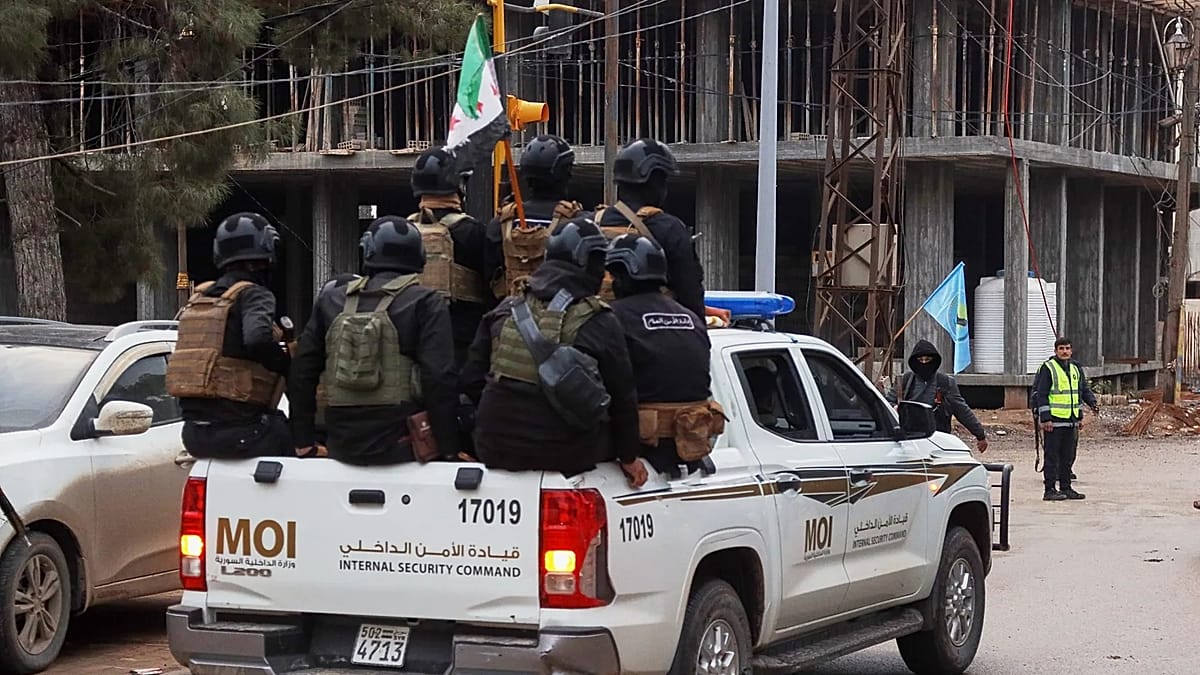
Syrian authorities announced on Tuesday that security forces had killed two individuals suspected of involvement in the March 2025 attacks on the country's coast, and separately arrested several members of the Islamic State group (IS) in operations across Aleppo and its countryside.
Brigadier General Abdulaziz al-Ahmad, head of Internal Security in Latakia province, said forces lured one of the suspects, identified as Sergeant First Class Bilal Adnan Dawood — also known as Abu Yaqub — into an ambush on the outskirts of the village of Falsqo in the Jableh countryside. Dawood was travelling with Mohsen Ahmad Mansour, described by authorities as a commander in the Saraya al-Kummit militia. Both men were killed after opening fire and throwing grenades at the security force following repeated calls to surrender, al-Ahmad said.
Dawood was accused of orchestrating the planting of explosive devices targeting security forces and the Syrian army in the rural areas of Jableh and Tartus, and of leading one of the attacking units during the assault on the 107th Brigade in the village of Zama on 6 March 2025, an event Damascus describes as a "failed coup attempt". A third man suspected of links to previous bombings was arrested during the same operation. Investigations are continuing, according to authorities.
March attacks and their aftermath
The March 2025 attacks on the Syrian coast killed more than 1,000 people, according to Syrian and international human rights monitors, and were carried out by fighters loyal to former al-Assad-era security structures in the Alawite heartland of Latakia and Tartus. The Syrian transitional government described them as an armed insurrection, while critics accused security forces of reprisal killings against civilians in Alawite communities in the aftermath. The UN called for an independent investigation, a call echoed by UN chief António Guterres during his recent visit to Damascus.
In a separate operation in Aleppo and its countryside, the Internal Security Forces and the General Intelligence Directorate arrested several IS members and dismantled cells in the cities of Aleppo and al-Bab. Weapons depots, ammunition and explosive materials were seized. Authorities did not disclose the identities of those detained or the quantity of material confiscated.
The operations are part of a sustained security campaign across Syria. On 9 June 2025, the Ministry of Interior announced the arrest of 235 people on terrorism-related charges and said the Counter-Terrorism Directorate had foiled seven planned IS attacks over a three-month period in coordination with the General Intelligence Directorate. In June 2025, the ministry also released figures showing it held detained officers and soldiers from the former regime's forces, ranging from generals to rank-and-file personnel, totalling several thousand individuals.
The IS or Daesh terrorist group, which once controlled large areas of Syria and Iraq and unilaterally declared a self-styled caliphate in 2014, has been significantly degraded but retains a network of sleeper cells in parts of Syria and Iraq. The group has been responsible for a series of bombings and ambushes in Syria since the fall of Bashar al-Assad's regime in December 2024, targeting both the new security forces and civilians.
For European observers, the ongoing instability in Syria carries direct implications. The country's fragmentation has fueled migration flows toward Europe, and the presence of IS sleeper cells raises concerns about potential attacks on European soil. The EU has maintained sanctions on Syria, though Guterres has called for their immediate end to facilitate reconstruction and stability. Meanwhile, the revival of Syria's economy, including its textile industry, is seen as a key step toward normalisation, as Aleppo recently hosted its first major trade fair in years.