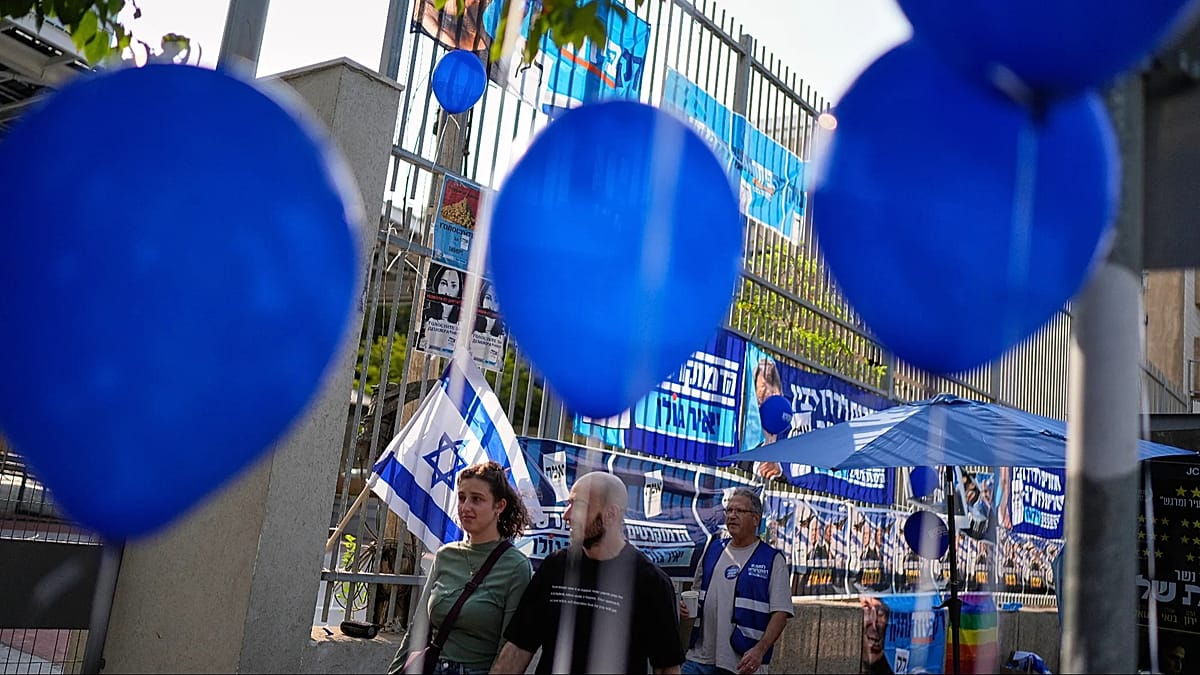
Israel's legislative election on Tuesday ended in a statistical tie, according to exit polls, with neither Prime Minister Benjamin Netanyahu nor his main rival, former military chief Gadi Eisenkot, securing a clear path to a governing majority. The result sets the stage for weeks of coalition negotiations and potential political paralysis in a country already grappling with regional instability.
Turnout reached 74.3%, according to Israel's Central Elections Committee, the highest in decades, reflecting the high stakes of a vote that many Israelis framed as a judgment on Netanyahu's handling of the war that began with Hamas's attacks on 7 October 2023. The election was the first since those attacks, which killed around 1,200 people in Israel and triggered a devastating military campaign in Gaza.
Netanyahu spent election day urging supporters to vote, describing the election as a "matter of life and death" in a series of social media posts and public appearances. His Likud party, according to exit polls, is projected to win 31 seats in the 120-seat Knesset, while Eisenkot's National Unity party is projected to win 30 seats. Neither bloc appears to have reached the 61-seat threshold needed to form a government.
The deadlock leaves the country in a familiar position: a fragmented parliament where smaller parties hold the balance of power. Analysts note that Netanyahu may still have an advantage in coalition arithmetic, as he has historically been adept at courting ultra-Orthodox and right-wing factions. However, the narrow margin means that even a slight shift in final results could alter the outcome.
Europe watches closely
The election has drawn significant attention in European capitals, where officials are concerned about the potential for further escalation in the Middle East. The European Union has repeatedly called for a ceasefire in Gaza and has urged both Israel and its neighbors to avoid actions that could destabilize the region further. A prolonged political crisis in Israel could delay diplomatic efforts, including negotiations over a potential normalization of ties with Saudi Arabia, a priority for both Washington and Brussels.
European leaders are also mindful of the humanitarian situation in Gaza, where the death toll has surpassed 40,000, according to local health authorities. The EU has been a major donor of aid to the Palestinian territories, and any new Israeli government will face pressure to allow more humanitarian access.
For many in Europe, the election is a reminder of the deep divisions within Israeli society, not only over the war but also over Netanyahu's leadership and his ongoing corruption trial. The prime minister has denied all charges, but the legal proceedings have cast a shadow over his political career.
As the vote count continues, both Netanyahu and Eisenkot have declared victory, a common practice in Israeli elections that often precedes lengthy coalition talks. The final results are expected within days, but the process of forming a government could take weeks, if not months.
In the meantime, the Israeli military remains on high alert, with tensions with Iran and its proxies, including Hezbollah in Lebanon, at their highest in years. The uncertainty in Jerusalem is unlikely to reassure European partners who are already grappling with the fallout of the war on energy prices and migration flows.
The election outcome will also be closely watched by the Jewish diaspora, particularly in France and Germany, where concerns about antisemitism have risen since the October 7 attacks. European Jewish communities have expressed solidarity with Israel, but many also worry that the ongoing conflict is fueling extremism at home.
For now, the focus is on the ballot boxes. As the votes are tallied, the world waits to see whether Israel will chart a new course or remain on its current trajectory. For Europe, the stakes are clear: a stable and predictable Israeli government is essential for any hope of de-escalation in the region.