Kazakhstan is turning to artificial intelligence to narrow the persistent gap between urban and rural education, as part of a broader push to build a digital economy. President Kassym-Jomart Tokayev has ordered the government to deliver an AI-in-education roadmap by 1 July, with a pilot programme set to launch in 500 understaffed rural schools this September.
The initiative, running until May 2027, will equip those schools with high-speed internet and modern digital infrastructure. Some of the country's most experienced teachers will then deliver live and recorded lessons remotely to students in small rural communities. “Our primary mission is to make the country's best educators available to all children, regardless of whether they live in a major city or a small rural community,” said Sergei Companiec, Kazakhstan’s Vice-Minister of Enlightenment.
AI as a Classroom Assistant
Alongside the connectivity push, a national AI platform will analyse student performance, flag those who need extra help, and give teachers real-time feedback. Officials stress that AI is meant to support, not replace, teachers—freeing up time for personalised instruction. If a student struggles with a topic, the system offers additional explanations and exercises; those ahead of the curriculum receive more advanced tasks. Teachers remain responsible for in-class support and guiding students through the material.
Saltanat Zhumabayeva, Director of the Ybyrai Altynsarin National Academy of Education, explained: “In any classroom, students are very different. To make learning truly effective with AI, we can approach each student individually—giving some more advanced tasks and others more structured assignments depending on their needs.” The government expects AI to cut teachers’ administrative workload by around 30%, allowing more time for mentoring and student development.
A separate ethical framework is being prepared to prevent overreliance on technology. Educators emphasise that students must still think independently, analyse information, and form their own conclusions. “When a teacher provides information, the student’s main task is to form their own viewpoint, compare and analyse,” Zhumabayeva said.
Teacher Training and Curriculum Overhaul
Teacher training is central to the plan. More than 350,000 teachers have already completed AI training, and over 100,000 have access to OpenAI’s GPT-edu platform for classroom use. “We have developed a dedicated training programme for teachers taking part in the pilot project in small rural schools,” Companiec said. By 2029, the government hopes the programme will reduce the number of underperforming students and expand personalised learning across the system.
Kazakhstan also plans to introduce AI as a dedicated subject. From grades one to four, students will study Digital Literacy and Artificial Intelligence; from grades five to eleven, the curriculum includes Informatics and Artificial Intelligence, focusing on responsible and effective use of AI tools. “We do not see these two approaches as mutually exclusive. At the same time, we must acknowledge that artificial intelligence has become a field of knowledge in its own right,” Companiec said.
Pilot in Astana Shows Early Results
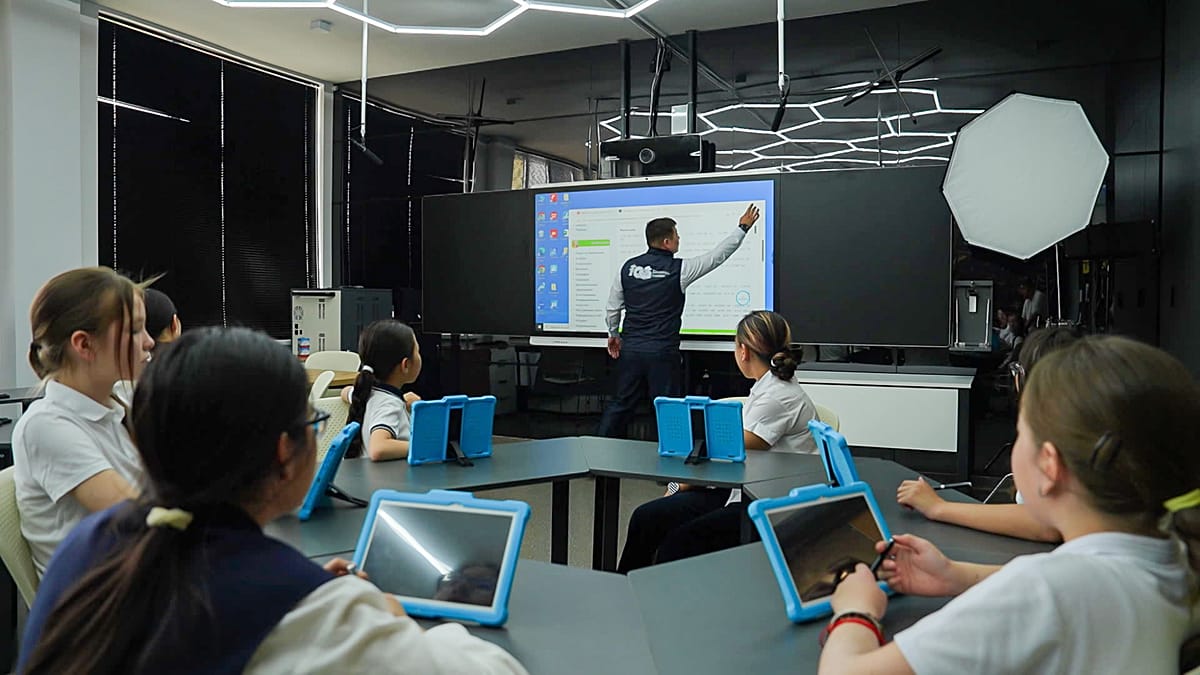
A pilot is already running at public school No. 101 in Astana. AI tracks learning progress in real time via classroom cameras, audio systems, and tablets. Students also use high-performance computers, 3D printers, 3D pens, and drones to develop practical digital skills. “The goal is for pupils to use AI and the available equipment to create innovative projects,” said Aitzhan Abilmazhinov, the school’s deputy head for digitalisation.
Beyond academics, AI monitors student wellbeing and helps identify potential bullying. The school has tested a video analytics platform that detects behaviour associated with bullying. “When an incident is detected, an eight-second video clip is generated and an alert is sent immediately to the school’s disciplinary team,” Abilmazhinov said. School officials say the system allows for faster intervention.
Kazakhstan’s AI-in-education push comes as the country deepens ties with the European Union. During a recent visit to Brussels, President Tokayev signed deals worth €10 billion, covering energy, the Middle Corridor trade route, and AI cooperation. The rural pilot will serve as a test case for how technology can support teaching, personalised learning, and student wellbeing before a nationwide rollout.