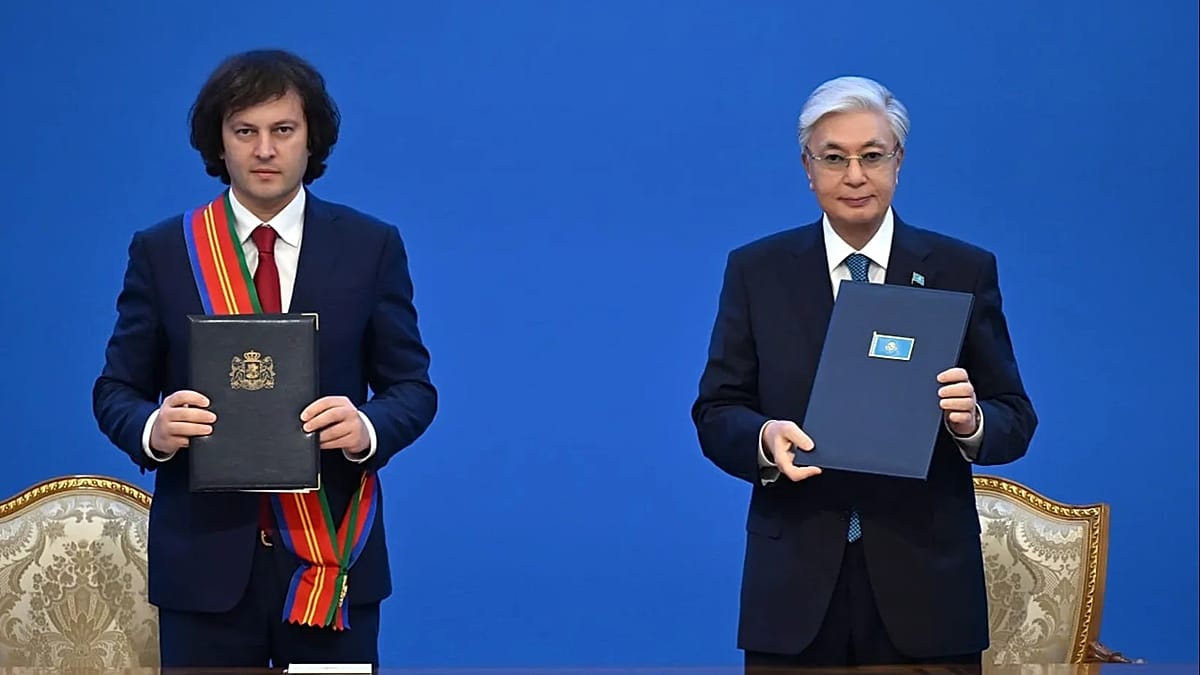
Kazakhstan intends to ramp up oil exports via the Baku-Tbilisi-Ceyhan (BTC) pipeline following high-level discussions in Astana between President Kassym-Jomart Tokayev and Georgian Prime Minister Irakli Kobakhidze. The move is part of a broader effort to diversify export routes through the Trans-Caspian International Transport Route (TITR), also known as the Middle Corridor, which links China with Europe via Kazakhstan, the Caspian Sea, Azerbaijan, and Georgia.
Transit volumes along the Middle Corridor have surged nearly fourfold over the past five years. By 2029, Kazakhstan expects up to 3,000 container trains to operate annually on this route, underscoring its growing importance as an alternative to traditional northern corridors through Russia.
Strengthening Energy and Logistics Ties
“We plan to increase oil shipments through the Baku-Tbilisi-Ceyhan pipeline. Work is already underway within the intergovernmental commission on trade and economic cooperation, and I hope today’s meeting will help set new priorities for the future,” Tokayev said during the talks.
Astana is also expanding its logistics footprint on Georgia’s Black Sea coast. Beyond the Batumi oil terminal, which is owned by Kazakhstan’s KazTransOil, a new multimodal terminal opened last year in Poti with Kazakh investment. Officials identified the future deep-sea port of Anaklia as another promising project for further collaboration.
These developments align with Kazakhstan’s broader strategy to reduce reliance on Russian pipelines and strengthen ties with European markets. The country has already signed significant deals with the EU, including a €10 billion package during Tokayev’s visit to Brussels.
Growing Economic Partnership
Bilateral trade between Kazakhstan and Georgia reached $184.5 million in 2025, with trade during the first four months of 2026 totalling $53 million. More than 600 companies with Georgian participation operate in Kazakhstan, while 14 organisations are registered at the Astana International Financial Centre.
“Trade and investment remain the foundation of Kazakhstan-Georgia relations. Despite global uncertainty, bilateral trade still has significant room for growth,” Tokayev noted. He added that Kazakhstan has invested over $500 million in Georgia’s economy, making it one of the largest investors in the country.
The two sides agreed to develop a bilateral roadmap focusing on energy, transport, investment, agriculture, digitalisation, and tourism. Agricultural trade has been a particular bright spot, growing by 77% in 2025 to exceed $116 million. Kazakhstan aims to increase exports of grain, flour, vegetable oils, pasta, meat, dairy products, chocolate, and confectionery to Georgia.
Digital and Cultural Cooperation
Beyond energy and trade, the talks covered digital technologies and artificial intelligence. Officials pledged to exchange expertise in e-government services, GovTech solutions, and digital public services. Kazakhstan also welcomed participation by Georgian start-ups and technology companies in Astana Hub and other regional innovation initiatives.
Tourism is another growing area of cooperation. Around 180,000 Kazakh tourists visit Georgia annually, with direct flights from Almaty, Astana, Shymkent, Aktau, and Atyrau to Tbilisi, Batumi, and Kutaisi. Tokayev proposed organising reciprocal cultural festivals to deepen exchanges between the two countries.
“Kazakhstan is a very important partner for Georgia. We welcome the establishment of a strategic partnership between our countries and look forward to expanding cooperation across all areas,” Kobakhidze said.
The deepening ties between Astana and Tbilisi reflect a broader trend of Central Asian and Caucasus nations seeking to integrate more closely with European supply chains and digital ecosystems, even as geopolitical uncertainties persist.