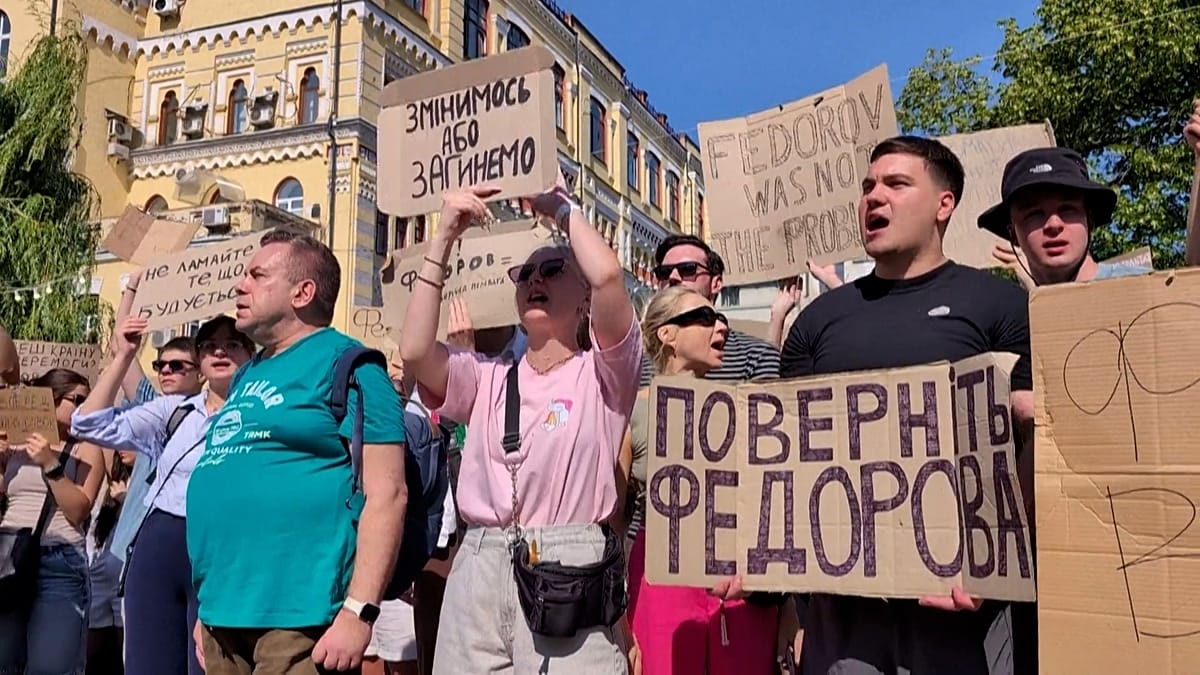
Hundreds of demonstrators took to the streets of Kyiv on Wednesday after President Volodymyr Zelenskyy dismissed Defence Minister Oleksii Fedorov, a reformer widely credited with modernising Ukraine's military and slowing Russia's advance. The protest, which drew a diverse crowd of civilians and veterans, signals growing unease over wartime leadership changes.
Why Fedorov's Dismissal Matters
Fedorov, who had held the defence portfolio since September 2023, was seen as a key figure in Ukraine's efforts to overhaul its Soviet-era military structures. Under his tenure, the ministry accelerated the adoption of NATO-standard procedures, improved logistics, and pushed for greater transparency in procurement. His removal, announced late Tuesday without a detailed public explanation, has sparked speculation about internal power struggles and shifting priorities in Kyiv.
“He was one of the few who actually got things done,” said a protester in Maidan Nezalezhnosti, the central square that has become a symbol of Ukrainian civic activism. “If they sack people like him, what message does that send to our soldiers and our allies?”
The timing is particularly sensitive. Ukraine is facing renewed Russian offensives in the east and south, while Western partners—including the European Union and the United States—are scrutinising Kyiv's governance and anti-corruption efforts as they prepare further aid packages. The reshuffle comes just weeks after the EU launched formal accession negotiations with Ukraine, a process that demands institutional stability and reform momentum.
Zelenskyy has not yet named a permanent successor. In the interim, Deputy Defence Minister Ihor Zhovkva will oversee the ministry. The president's office has framed the change as part of a routine cabinet refresh, but critics argue it risks disrupting continuity at a critical juncture.
“This is not the time for experiments,” said Mykhailo Podolyak, a senior adviser to the president, in a statement. “But the president has the constitutional right to adjust his team to meet the challenges of the moment.”
The protest in Kyiv was largely peaceful, though some demonstrators carried signs reading “Defend the Defenders” and “No to Political Games.” Police reported no arrests. Similar, smaller rallies were held in Lviv and Dnipro, reflecting broader concern across the country.
The dismissal also resonates beyond Ukraine's borders. European defence officials have watched Fedorov's reforms closely, seeing them as a model for how post-Soviet militaries can integrate with NATO. The EU's military mobility plan, which aims to streamline troop and equipment movement across the continent, has drawn lessons from Ukraine's wartime logistics innovations.
Meanwhile, the reshuffle has revived debate about the concentration of power in Zelenskyy's office. Since the start of the full-scale invasion in February 2022, the president has accumulated significant authority under martial law, including the power to dismiss ministers without parliamentary approval. Some opposition MPs have called for greater oversight, though no formal challenge has been mounted.
“Ukraine needs unity, but it also needs checks and balances,” said Kira Rudik, a member of parliament from the Holos party. “We cannot afford to lose competent people because of opaque decisions.”
Fedorov himself has not commented publicly since his dismissal. In his final social media post as minister, he thanked the armed forces and urged continued support for Ukraine's defence. “The work continues,” he wrote. “Victory is our only option.”
The protest in Kyiv is a reminder that, even in wartime, Ukrainian civil society remains vigilant. As the war enters its third year, the public's tolerance for political manoeuvring appears to be thinning. Whether Zelenskyy's next defence pick can restore confidence—and maintain the momentum Fedorov helped build—remains an open question.