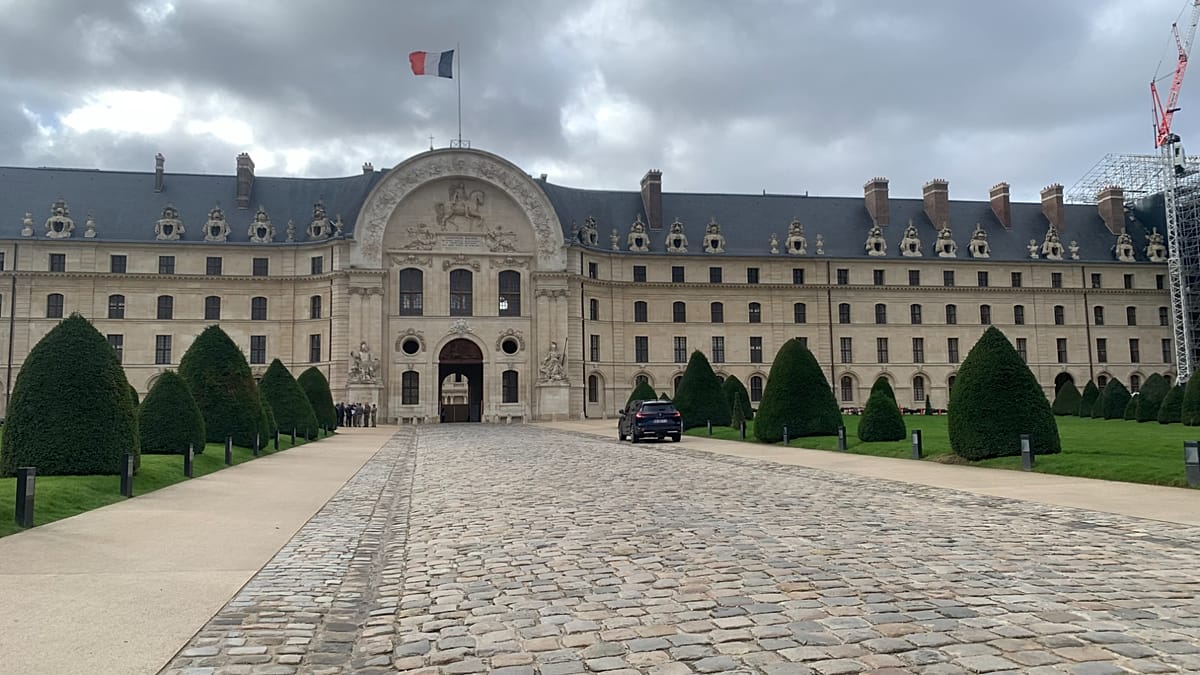
Every year, over a million visitors pass through the gates of Les Invalides in Paris, drawn by its gilded dome and the tomb of Napoleon Bonaparte. Yet behind this monumental façade lies a quieter, more enduring mission: a home and hospital for wounded soldiers and victims of war. Founded by Louis XIV in the 1670s, the institution has now served France for 350 years, evolving from a royal gesture of gratitude into a modern medical facility with a unique social role.
A Royal Vision, a State Commitment
General Christophe de Saint Chamas, the military governor of Les Invalides, explains the dual significance of the site. “The first is that King Louis XIV had it built, and as the king’s tool, it had to be magnificent. It was a communication tool for the whole world, so that they would know that Louis XIV was building something for his old soldiers,” he says. The second reason, he adds, is that it was built “for people who deserved it.” This made it the first social initiative of the French state, taking over from religious communities that had previously cared for the wounded. “The State said: ‘I’ll look after them for the rest of their lives, until they die’,” de Saint Chamas notes.
The institution welcomed its first former soldiers in 1674, and its mission has continued uninterrupted ever since. Today, 64 residents live within its walls, including Holocaust survivors and civilian victims of conflict or terrorist attacks. Among them is Ginette Kolinka, 101, a well-known survivor of Auschwitz-Birkenau. Another resident, Esther Senot, 98, was deported from Paris to the Mauthausen camp in Austria in 1943. “Only two of us came back,” she recalls. After 17 months, she returned to France weighing just 32 kilograms, having lost seventeen family members. She chose Les Invalides to be near her brother, a veteran of the 2nd French Armoured Division who lived there for a decade.
Care for the Severely Disabled
The facility operates as a specialist hospital for severe disabilities, with expertise in prosthetics and rehabilitation. Its medical teams have treated victims of the Bataclan attacks in 2015. The institution also conducts research to improve mobility for amputees and wheelchair users. Master Corporal Mikaele Iva, injured in a parachuting accident in Gabon in 2021, is one of the current residents. “This really has become our second family,” he says. “We share happy and difficult times.” He now practices fencing, archery, and golf with the Invalides sports club and represents the institution at national ceremonies.
Mustapha Nachet, nursing coordinator since 2014, describes the dedication of the staff: “We devote ourselves to them body and soul. It’s the nation’s way of giving thanks for everything they’ve done.”
New Challenges: The Psychological Wound
General Sylvain Ausset, Director of the Institution nationale des Invalides, observes how each conflict leaves its mark. “In 1914, the ‘gueules cassées’ (broken faces) appeared. They already existed before that; they just didn’t survive. During the Second World War, people with spinal cord injuries, paraplegics, and quadriplegics began to survive. During the recent conflicts in the Middle East, Iraq, and Afghanistan, multiple amputations appeared on a scale never seen before. The current signature is the psychological wound,” he says.
The institution is now undergoing a major renovation funded by the state, estimated at €100 million. The work aims to modernize ageing facilities while preserving the historic character of the site. General de Saint Chamas emphasizes the enduring commitment: “This allows troops on active service to deploy in the knowledge that if something happens to them, France will be there.”
Les Invalides remains a living symbol of the nation’s duty to its defenders, a place where history and humanity converge under a golden dome.