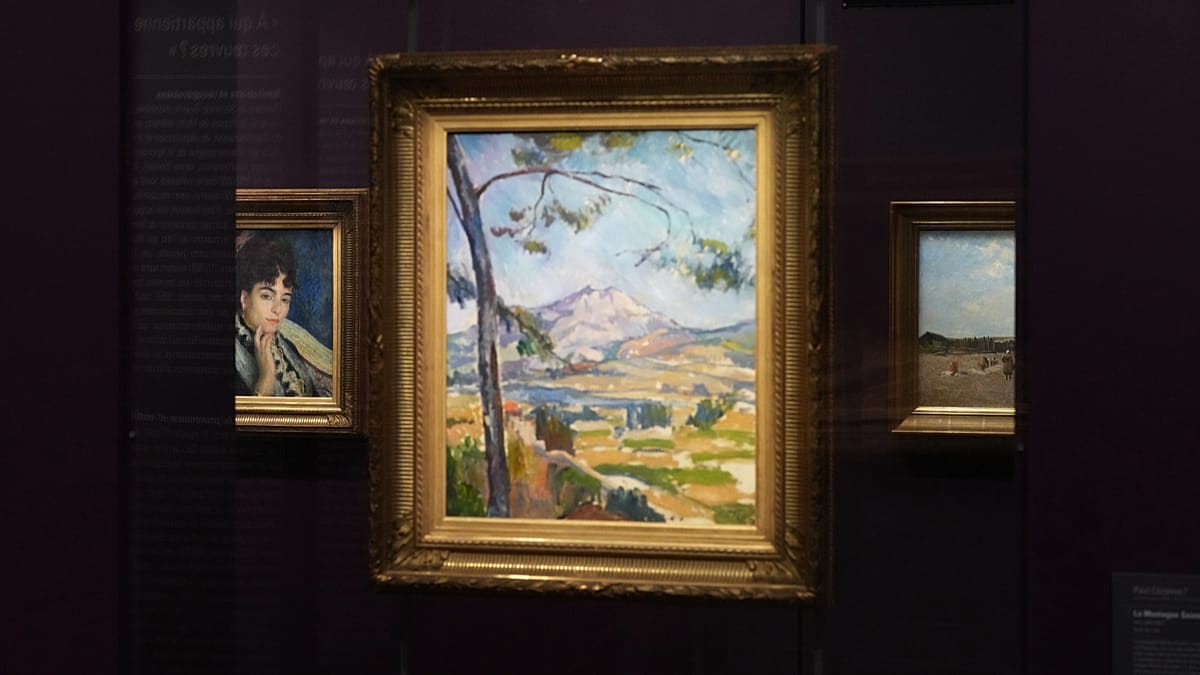
Paris's Musée d'Orsay has opened a new permanent gallery that confronts one of the most sensitive chapters in European cultural history: the systematic looting of art by the Nazi regime during the Second World War. The space, located within the former railway station on the Left Bank, displays works whose ownership histories remain incomplete or actively contested, placing the unresolved legacy of Nazi-era displacement at the centre of the museum's narrative.
A Space for Unfinished Stories
The gallery does not present a sanitised version of history. Instead, it foregrounds the legal and moral ambiguities that still surround many pieces in French public collections. Some works carry labels noting that their provenance is unknown or that they were seized from Jewish families between 1940 and 1944. Others are shown with documentation of restitution claims that have stalled or failed. The museum's curators have chosen to treat these gaps as part of the object's story rather than as a flaw to be hidden.
This approach reflects a broader shift in European museology. Institutions across the continent, from the Kunsthistorisches Museum in Vienna to the Rijksmuseum in Amsterdam, have begun to publish provenance research online and to create dedicated spaces for looted art. The Musée d'Orsay's initiative is notable because it embeds these questions within the permanent collection rather than relegating them to a temporary exhibition.
France has long struggled with the restitution of cultural property taken during the Occupation. Estimates suggest that tens of thousands of artworks were stolen from French Jews, and while some were returned after the war, many remain in state museums under the category of "Musées Nationaux Récupération" (MNR). The new gallery at the Musée d'Orsay includes several MNR pieces, making visible the bureaucratic category that has for decades kept these objects in legal limbo.
The opening comes amid renewed pressure on French institutions to act. In 2023, the French government passed a law facilitating the restitution of looted art to heirs, but implementation has been slow. Critics argue that the burden of proof still falls too heavily on families, and that museums have been reluctant to part with prized works. The Musée d'Orsay's gallery does not resolve these tensions, but it does make them public.
Visitors will encounter paintings by artists such as Gustave Courbet, Édouard Vuillard, and Pierre Bonnard, whose works were among those seized from collectors like the Rothschilds and the Bernheim-Jeune family. The gallery also includes sculptures and decorative arts, reflecting the breadth of the Nazi plunder. Each object is accompanied by a detailed label that explains its provenance, including the names of the original owners when known, and the circumstances of its seizure.
The museum has also partnered with the Commission pour l'Indemnisation des Victimes de Spoliations (CIVS) to provide visitors with information on how to pursue restitution claims. This practical dimension is unusual for a fine arts institution and signals a desire to move beyond symbolic gestures.
For an informed European audience, the gallery raises questions that extend beyond France. The Nazi looting network operated across the continent, and many of the works that passed through Paris ended up in German, Austrian, or Swiss collections. The Musée d'Orsay's decision to display these objects with their contested histories invites a pan-European conversation about ownership, memory, and justice.
The gallery is part of a wider trend in which European museums are rethinking their role in post-colonial and post-conflict restitution. As other institutions watch closely, the Musée d'Orsay's experiment may set a precedent for how to handle the difficult legacy of Nazi-era displacement in a transparent and educational manner.