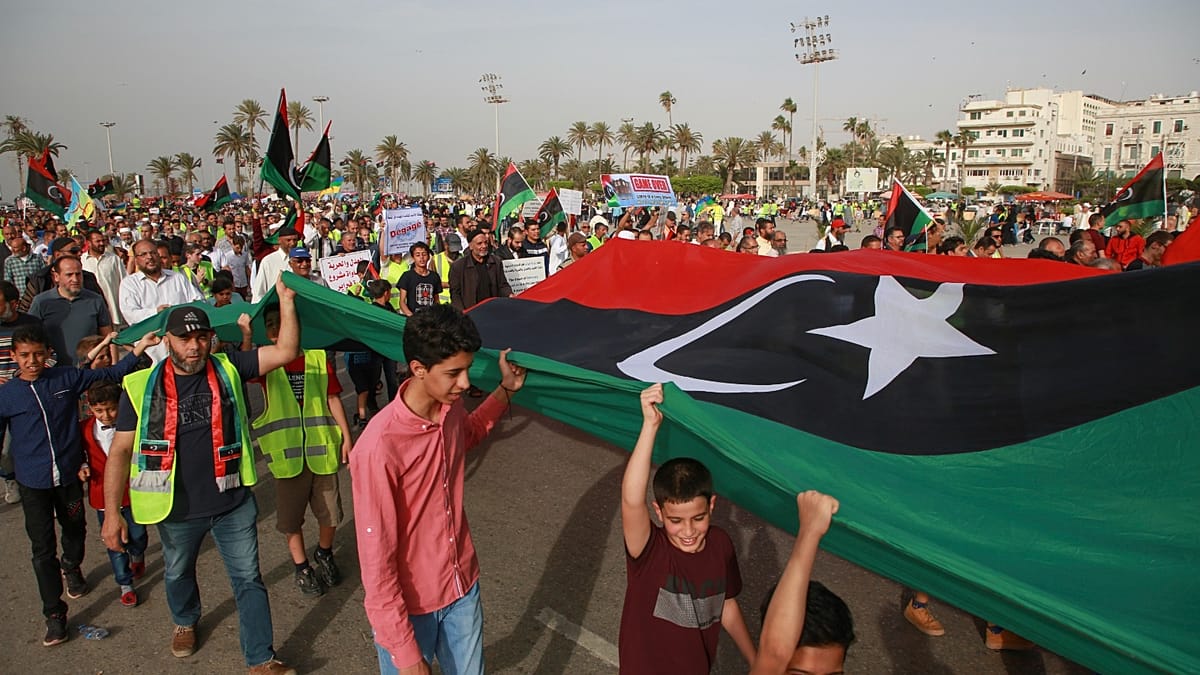
Mass protests erupted across Tripoli on Sunday night and Monday, triggered by severe electricity shortages that have left residents without power for up to 14 hours a day during a brutal heatwave. Demonstrators blocked major roads, sealed off government buildings, and shut down state institutions, including the Ministry of Foreign Affairs, the National Broadcasting Corporation, and the headquarters of the telecommunications holding company.
The protests, which began as a response to the electricity crisis, rapidly broadened into a direct challenge to Libya's political establishment. Chanting slogans such as "The people want justice that punishes those who squander the people's money" and "Electricity — where have the billions gone?", demonstrators called for the removal of both Prime Minister Abdulhamid Dbeibah's Government of National Unity (GNU) in the west and the rival government led by Osama Hammad in the east.
Heatwave and grid collapse fuel anger
Temperatures in parts of Libya have reached between 45 and 50 degrees Celsius, pushing electricity demand far beyond what the country's battered grid can supply. Years of underinvestment, widespread theft from the network, and a bitter dispute over the management of oil revenues have left the power sector in a state of paralysis. The conflict between Dbeibah and Mohamed al-Mashey, chairman of the General Electricity Company of Libya, has further crippled the sector's ability to respond.
In Tripoli, protesters burned tyres at the Nabras roundabout, roughly two kilometres from the Prime Minister's Office, and sealed off the Ghiran roundabout, a key western entrance to the capital. Lorries dumped earth barriers in front of the Audit Bureau and the Libya National TV channel. Branches of the Central Bank and offices of the Libyana and Almadar telecom companies in the Souq al-Jumaa district were forced to close.
The Souq al-Jumaa Movement, which has been organising against the GNU since mid-2025, announced a campaign of civil disobedience that would focus on shutting state institutions without blocking roads or targeting civilians. The Sons of Tajoura Movement said actions would continue until "the governments in the east and west of the country are brought down."
Protests spread south to Ain Zara and across Tajoura, Souq al-Jumaa, Serraj, Janzour, Zawiyat al-Dahmani, and Dahra. Demonstrators also gathered outside the West Tripoli power station, and the unrest reached the city of Zawiya. In Misrata, an armed group opposed to Dbeibah staged a show of force, with convoys of military vehicles driving through the city, raising fears that the protests could reignite rivalries between armed factions.
In Janzour, local reports said an armed group affiliated with the government opened fire on a gathering of protesters. No official information on casualties or the circumstances of the shooting has been released.
Acting Interior Minister Imad al-Trabelsi ordered security agencies across Tripoli to raise their readiness to the maximum level. The Prime Minister's Office Protection and Security Force warned that "anyone who seeks to undermine the country's security or target state institutions will be dealt with firmly in accordance with the law," while urging citizens not to be drawn into "calls aimed at stirring chaos."
Libya has been split between rival administrations since the collapse of the UN-brokered Government of National Accord in 2021. The internationally recognised GNU, led by Dbeibah, administers western Libya from Tripoli, while the House of Representatives-appointed government under Osama Hammad controls the east and most of the south from Benghazi. The country has not held a national election since 2014, and multiple UN-led roadmaps to organise a vote have failed. Libya's oil wealth — the largest proven reserves in Africa — has been repeatedly weaponised by rival factions rather than used to repair crumbling infrastructure.
This is not the first wave of protests over electricity and corruption. In May 2025, crowds gathered in Tripoli's Martyrs' Square demanding Dbeibah's removal, but those demonstrations dispersed without producing political change. The current unrest, however, appears more coordinated and widespread, with organised movements and armed groups signalling their readiness to escalate.
The crisis in Libya echoes similar blackout-driven protests elsewhere in the region, such as Tunisia's deadly power cuts that have fuelled political tensions. For Europe, which has long sought stability in North Africa to manage migration flows and energy partnerships, the collapse of Libya's electricity grid and the resurgence of mass protests are a stark reminder of the fragility of the post-2011 order. The European Union's efforts to support a unified Libyan government and organise elections have so far yielded little, and the current crisis may further complicate those ambitions.