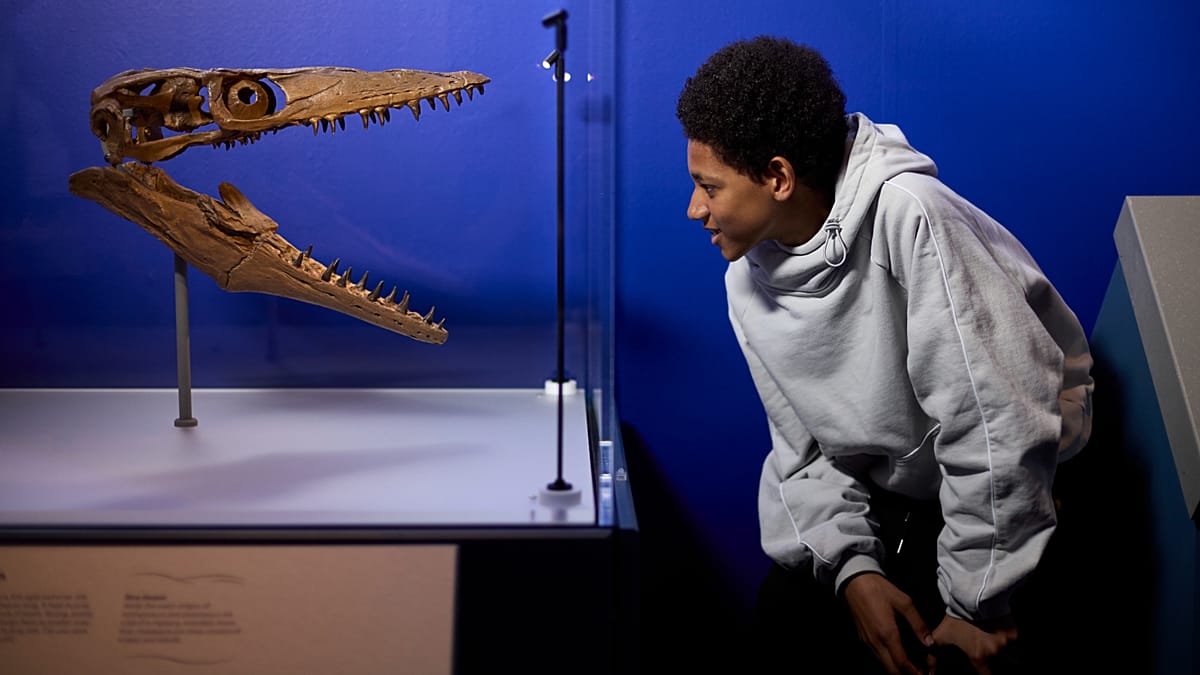
While dinosaurs dominated the land, a different class of apex predators ruled the seas. London's Natural History Museum (NHM) is now exploring this submerged world in its latest exhibition, Jurassic Oceans: Monsters of the Deep, which runs through early 2025.
The show transports visitors roughly 200 million years into the past, when enormous marine reptiles patrolled the waters. Among the centrepieces is a full-scale plesiosaur model, a long-necked creature that could reach 12 metres in length. Dr. Marc E.H. Jones, the museum's curator of fossil reptiles and amphibians, explains that the plesiosaur used four wing-like flippers in coordinated motion to 'fly through the ocean.' It was an air breather, meaning it surfaced frequently—a detail that underscores the vulnerability of these animals to changes in their environment.
Another highlight is an ichthyosaur skull cast, which visitors are invited to touch. Ichthyosaurs, which resembled modern dolphins, were among the most successful marine reptiles of the Mesozoic era. The exhibition also includes fossils of long-extinct ammonites and other creatures that thrived in the warm, shallow seas that once covered much of Europe.
Fossil Records and Modern Climate Warnings
Beyond the spectacle, the exhibition carries a sobering message. Researchers at the NHM have used the fossil record to trace how climate shifts contributed to mass extinctions millions of years ago. Dr. Jones notes that even relatively slow changes in climate—far slower than what humanity is experiencing today—had profound effects on marine ecosystems. 'In the last 200 years we've added over 2,000 gigatons of CO2 to the atmosphere,' he says. 'That's going to have an impact on how much energy the Earth retains and is slowly warming the average temperature of the Earth and the oceans, which puts pressure on those ecosystems.'
The exhibition draws direct parallels between the Jurassic extinctions and the current crisis. As oceans absorb more carbon dioxide, they become more acidic, threatening calcifying organisms like corals and shellfish. Warmer waters also reduce oxygen levels, creating 'dead zones' that can devastate marine life. The NHM's curators argue that understanding past extinction events can help policymakers and the public grasp the stakes of inaction.
This is not the first time the museum has linked its palaeontological collections to contemporary issues. In recent years, it has hosted exhibitions on biodiversity loss and the Anthropocene. Jurassic Oceans continues that tradition, using the deep past to illuminate the present.
The exhibition also touches on the broader European context. The fossils on display were collected from sites across the continent, including the famous Jurassic Coast in Dorset, England, and the Solnhofen limestone in Bavaria, Germany. These deposits have yielded some of the best-preserved marine reptiles in the world, offering a window into a time when Europe was largely submerged under a warm, shallow sea.
For visitors, the exhibition offers a rare chance to see these ancient predators up close. But the takeaway is clear: the oceans that once teemed with plesiosaurs and ichthyosaurs are now under threat from a warming climate. As Dr. Jones puts it, 'The fossil record shows that even slow climate change can have a big impact. What we're doing now is much faster.'
Jurassic Oceans: Monsters of the Deep is open at the Natural History Museum in London until early 2025. Tickets are available on the museum's website.