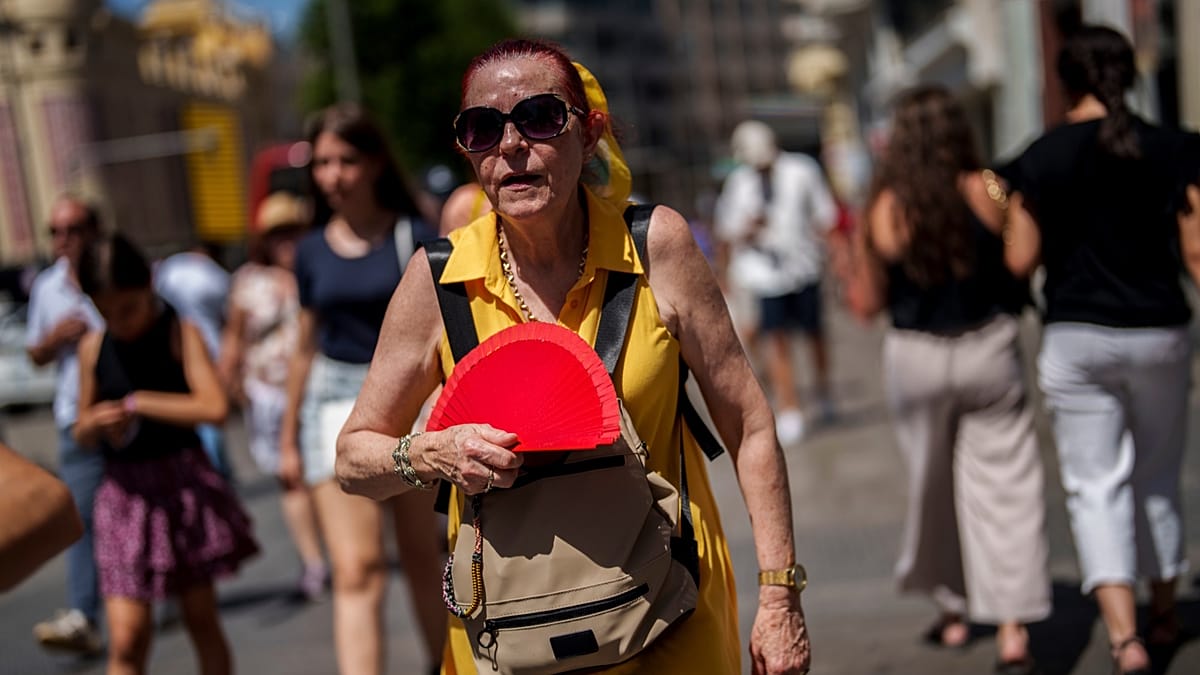
Large swaths of Europe are bracing for an intense heat spike this Pentecost weekend, with temperatures in parts of Spain expected to reach 38°C and the United Kingdom potentially breaking its May temperature record. The event has renewed debate about whether European cities are equipped to handle heat that arrives weeks earlier than historical norms.
Spain's national meteorological agency, AEMET, has warned of "exceptionally high temperatures for this time of year" across the Iberian Peninsula. General maximums of 34°C are forecast in the main valleys, while the Guadiana and Guadalquivir valleys could hit 38°C. Along the Cantabrian coast, highs of 30°C are expected, rising to 34°C inland. Tropical nights—where the mercury does not dip below 20°C—are predicted for the Guadiana, Guadalquivir, Tagus, Ebro, and lower Duero valleys. AEMET notes that while these conditions do not yet meet the official definition of a heatwave, they are typical of midsummer rather than late May.
In the United Kingdom, the Met Office forecasts that temperatures will climb through the weekend, especially in the south. Saturday could see 30°C, Sunday 32°C, and Monday—the Bank Holiday—may reach 33°C in southern England and the Midlands. "It is likely that the May and spring UK temperature records will be broken," said Met Office meteorologist Steve Kocher, pointing to the existing record of 32.8°C. The country can expect abundant dry and sunny weather.
Germany is also set for a warm Pentecost, with widespread highs of 22–28°C and peak values of up to 31°C along the Upper Rhine, in the Rhine-Main region, and towards Brandenburg, according to weather expert Dominik Jung. Paris is forecast to hit 33°C this weekend and into next week, while Rome will see a slightly cooler average of 31°C. Lisbon will reach 31°C on Friday, then 28°C on Saturday and 27°C on Sunday.
Is this the new normal?
Climate models indicate that June heatwaves in Europe are now roughly ten times more likely than in pre-industrial times, and a similar shift is becoming evident for May. "Germany is a useful illustration: a 30°C day around Pentecost, once considered an oddity, has shifted from a rare occurrence in the 1980s to something the country now experiences regularly," said Ionna Vergini, founder of weather forecasting platform WFY24. "That kind of shift in the underlying distribution is what 'new normal' actually means. It isn't about one extreme event, it's the temperature curve itself moving."
Vergini warns that infrastructure, agriculture, and public health systems remain "calibrated to the old calendar," leaving countries unprepared for high temperatures so early in the year. "A 38°C day in southern Spain in mid-May lands on a country whose tourism, energy and hospital systems are not yet in summer mode." The Mediterranean basin—Italy, Greece, Portugal, Spain, and southern France—remains the epicentre of this issue, having experienced deadly heatwaves, drought, and wildfires last year.
However, extreme heat is also hitting cooler nations whose housing stock, transport networks, and hospitals were never designed for such conditions. "A 32°C afternoon in Helsinki disrupts more than a 40°C afternoon in Seville," Vergini noted. "The UK fits the same pattern. May temperatures in the low 30s sit well above the historical norms for this point in spring, and the country's building stock and rail network still struggle each time it happens."
A major report released on 20 May by the UK's Climate Change Committee warned that air-conditioning will soon be "unavoidable" to protect vulnerable populations in care homes, hospitals, and schools from unbearable summer heat.
Researchers at Imperial College London and the London School of Hygiene & Tropical Medicine examined 854 European cities and found that climate change was responsible for 68% of the estimated 24,400 heat-related deaths last summer, having raised temperatures by up to 3.6°C. The hardest-hit countries during a single heatwave last July were Romania, Bulgaria, Greece, and Cyprus, where around 950 heat deaths occurred in temperatures up to 6°C above average—roughly 11 daily deaths per million people.
Warmer air also increases the risk of flooding, as the atmosphere can hold about 7% more moisture for every 1°C rise in temperature, leading to more intense rainfall. Last year's deadly heat has spurred more discussion on how Europe can adapt. "The countries that will fare best in the coming decade are not the ones with the most money—they are the ones that treat heat as a public health emergency rather than a weather story," Vergini argued. "Athens, Barcelona and Seville have moved in that direction. Most of the rest of Europe has not yet started."
In Spain, climate shelters—cool public spaces such as libraries, parks, and air-conditioned municipal buildings—are spreading in heat-scorched cities. But across much of the continent, the gap between rising temperatures and preparedness remains wide.