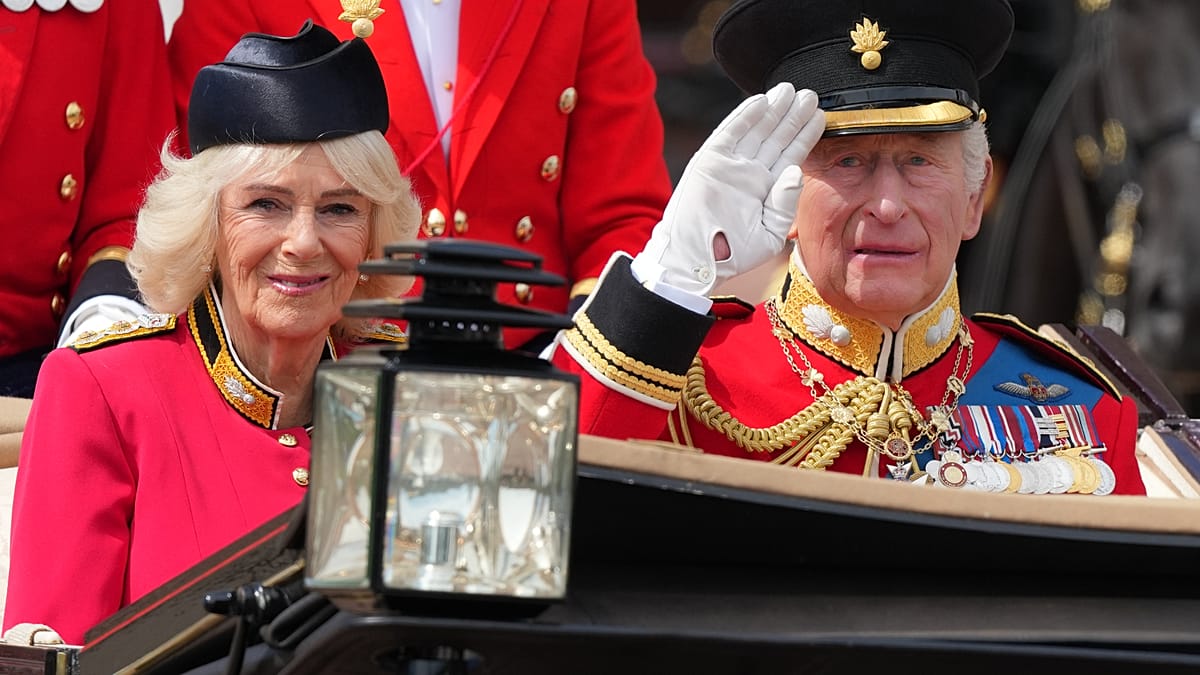
On Saturday, thousands of people from across the United Kingdom and beyond converged on central London for the annual Trooping the Colour parade, marking King Charles III’s official birthday. The event, a fixture of the British ceremonial calendar, saw the monarch and Queen Camilla travel by horse-drawn carriage along The Mall, greeting well-wishers before the Royal Family assembled on the balcony of Buckingham Palace to watch a military flypast. Four fighter jets left a trail of red, white, and blue vapour across the sky, a traditional tribute to the crown.
Royal Attendance and Absences
The balcony gathering included senior members of the royal family, but notably absent were Prince Harry and his wife Meghan, Duchess of Sussex, who did not attend. The parade itself is a display of pageantry rooted in centuries of British tradition, but it also drew a vocal contingent of critics. A group of anti-monarchy protesters positioned themselves in front of Buckingham Palace, holding placards reading “not my king.” They also displayed images of Prince Andrew, the king’s brother, who was stripped of his royal titles and military affiliations in 2022 following his association with convicted sex offender Jeffrey Epstein.
The protests highlight a persistent undercurrent of republican sentiment in the UK, even as the monarchy retains broad public support. Similar demonstrations have occurred at other major royal events, including the coronation of King Charles III in 2023. The presence of Prince Andrew’s image at the protest underscores ongoing public scrutiny of the royal family’s handling of past controversies.
Trooping the Colour, which dates back to the 18th century, is one of the most visible symbols of the British monarchy’s role in national life. For many attendees, it remains a celebration of heritage and continuity. “It’s a wonderful tradition that brings people together,” said one spectator from Manchester, who had travelled to London with her family. “We come every year.”
The event also drew international visitors, including tourists from across Europe. A couple from Berlin noted that they had planned their trip around the parade. “We wanted to see something uniquely British,” they said. “It’s impressive how many people turn out.”
Security was tight, with police officers stationed along the route and barriers in place to manage the crowds. No major incidents were reported. The Metropolitan Police confirmed that a small number of protesters were monitored but did not disrupt the proceedings.
The flypast included aircraft from the Royal Air Force, including Typhoon jets and a Lancaster bomber, which performed a coordinated pass over the palace. The red, white, and blue vapour trail was a deliberate nod to the Union Jack, the national flag of the United Kingdom.
While the monarchy’s role in modern Britain is debated, events like Trooping the Colour continue to draw significant public engagement. The parade also serves as a reminder of the UK’s distinct constitutional arrangements within Europe, where most countries are republics. For now, the British monarchy remains a fixture of national identity, even as critics call for reform.