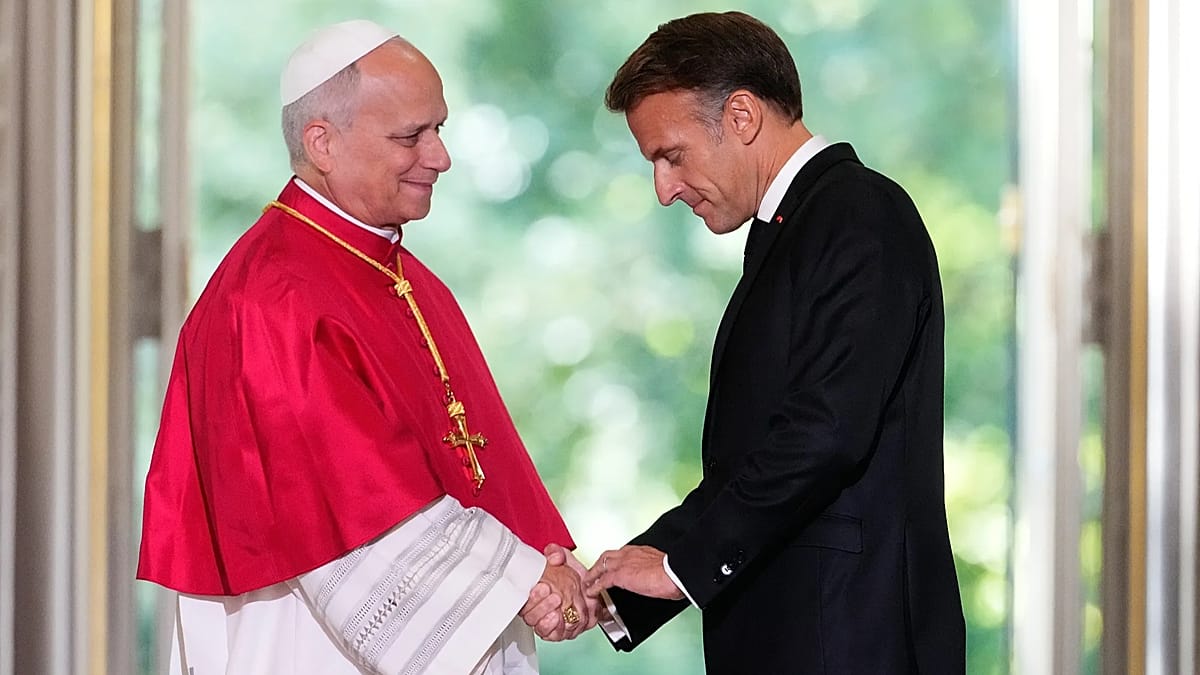
French President Emmanuel Macron has decided to attend the closing mass of Pope Leo XIV's four-day visit to France, held this Monday at Saint-Étienne Cathedral in Metz. The Élysée Palace confirmed the schedule change late on Sunday, saying Macron had "rearranged his schedule" to be present for the service and the official farewell ceremony.
Initially, the president was only expected to attend the Pope's morning address on Europe and peace in Metz, a city in northeastern France close to the borders with Germany and Luxembourg. The last-minute addition means Macron will now join the pontiff for the afternoon mass, a decision that underscores the delicate balance between state protocol and personal diplomacy.
Macron had notably been absent from Friday's mass at Notre-Dame de Paris and Saturday's open-air service along the Champs-Élysées and Place de la Concorde. Instead, First Lady Brigitte Macron and Prime Minister Sébastien Lecornu represented the French state at those events. The president's decision to skip the Paris gatherings had fueled speculation about tensions between the Élysée and the Vatican.
According to Le Parisien, the Holy See declined several proposals from Macron's team, including a meeting with the artisans who rebuilt Notre-Dame after the devastating fire in 2019. The reported friction adds context to Macron's earlier decision to stay away from the cathedral service, though the Élysée has not commented on the specifics.
A delicate balancing act with laïcité
Macron's engagement with the Pope has always been politically sensitive in France, where the principle of laïcité—strict separation of church and state—is a cornerstone of public life. In 2023, his attendance at a mass led by Pope Francis in Marseille drew sharp criticism from opponents who argued it blurred the line between personal faith and presidential duty.
Despite the controversy, Macron and Leo XIV have maintained a working relationship. They met several times on Friday, including a private conversation at the Élysée and a joint address to French officials and the diplomatic corps. Sources at the Élysée say the president's decision to attend the Metz mass also reflects his desire to continue what he sees as a productive dialogue with the pontiff.
The Pope's visit has been framed as an opportunity to highlight Europe's Christian heritage and the continent's post-war reconciliation. The morning programme at the Robert Schuman Conference Centre in Metz includes an interfaith meeting and a session titled "At the Roots of Europe for Peace and Unity," where Leo XIV will address representatives of EU member states. Macron will introduce the Pope, and the event is designed to pay tribute to Robert Schuman, the French statesman and founding father of European integration, whose house in nearby Scy-Chazelles is now a museum.
Invitations were extended to leaders of all 26 other EU member states, as well as to representatives of European institutions. Luxembourg's Prime Minister Luc Frieden confirmed his attendance, noting that the event "will serve as a reminder of the need for the European project, which emerged in the aftermath of the Second World War from the determination of six founding countries—including Luxembourg—to build lasting peace through cooperation."
Other confirmed attendees include Prince Albert II of Monaco, Grand Duke Guillaume of Luxembourg, and former European Commission President Jean-Claude Juncker. Germany will be represented by Anke Rehlinger, the Minister-President of Saarland, the federal state bordering France.
The choice of Metz is symbolic: Lorraine has been a crossroads of European conflict and cooperation for centuries. The Vatican reportedly requested the location to emphasise the cross-border dimension of the visit, a theme that resonates with Macron's own push for a more sovereign and united Europe. The president's last-minute decision to attend the mass may also be seen as an attempt to smooth over any perceived snubs earlier in the visit.
As the Pope prepares to depart France, Macron will be at his side—a gesture that speaks to the enduring, if sometimes uneasy, relationship between the French Republic and the Holy See.