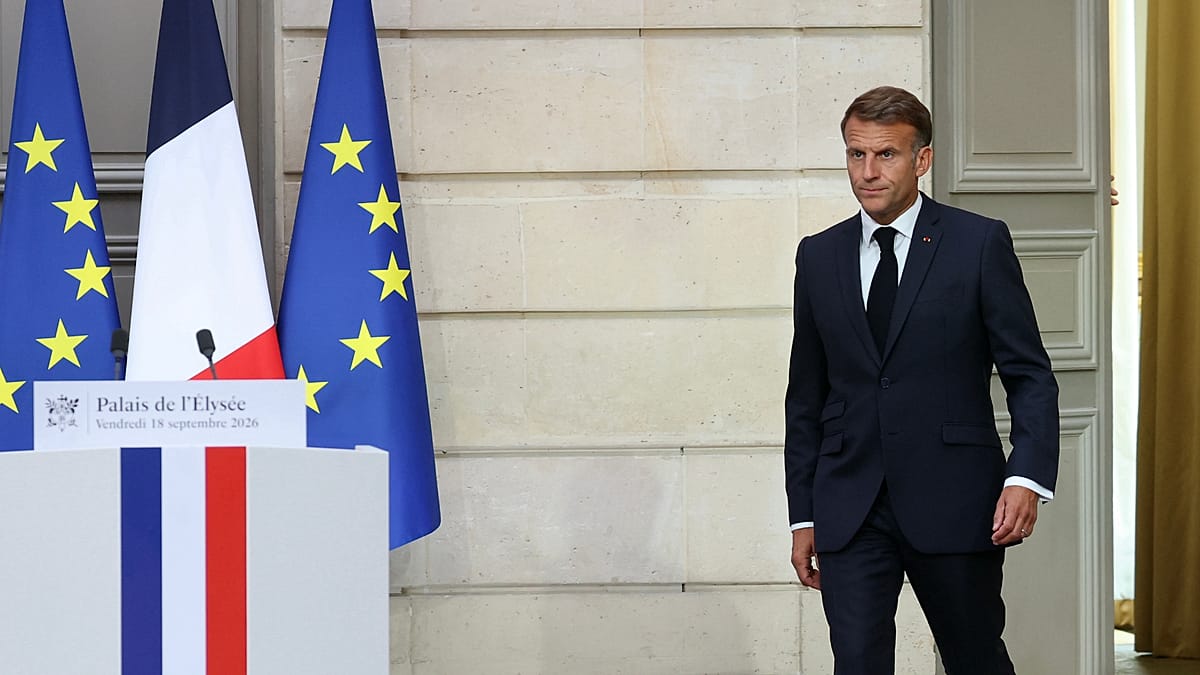
Emmanuel Macron has asked the European Commission to adopt emergency measures that would allow the continent's refineries to squeeze more diesel and jet fuel out of the crude still available to them, warning that the prolonged closure of the Strait of Hormuz and renewed strikes on Middle Eastern energy infrastructure risk tipping global oil markets into a fresh squeeze.
In a letter sent to Commission President Ursula von der Leyen on 18 September and seen by Euronews, the French president argued that Europe has so far been cushioned by a combination of higher refinery runs, soft Asian demand, redirected trade flows and the drawdown of existing stockpiles. That cushion, he cautioned, is thinning quickly. According to the French government, 14% of the country's filling stations were reporting shortages or near-shortages by 9am on 22 September.
"In recent weeks, international supply has deteriorated once again, driven by the combined impact of the targeting of energy infrastructure — in Russia and the Middle East — and the recovery of consumption in Asia," Macron wrote.
Why Paris is worried
The Élysée's central concern is the Strait of Hormuz, the chokepoint through which a substantial share of the world's crude and refined products normally passes. If the waterway remains effectively shut and Saudi Arabia's East-West pipeline does not come back online, Macron warns that the depletion of Saudi stocks could strip at least another 4 million barrels a day from global crude supply — a shortfall that could trigger another sharp jump in prices. Global oil inventories have already fallen by more than 500 million barrels, according to the letter.
Europe's exposure is uneven but acute in specific products. Macron notes that 36% of the bloc's jet fuel imports and 18% of its diesel imports originate in the Middle East, making aviation and road freight particularly vulnerable to any further disruption. The wider picture is one of escalating Red Sea risk compounding the Hormuz problem.
Unlocking refinery capacity
Brussels cannot conjure crude that has been lost to the market, but Macron argues it can maximise the fuel produced from what remains. He wants the Commission to temporarily relax certain EU fuel-quality specifications — covering parameters such as density, volatility and desulphurisation — so that refineries can lift output of diesel and jet fuel. Depending on the plant, such changes could raise yields by roughly 5% to 20%.
The proposal would require the Commission to work with carmakers to establish which standards can be safely loosened without damaging engines or fuel infrastructure, while keeping health and safety requirements intact. Paris points to the precedent set during the Covid-19 crisis, when the Commission temporarily eased fuel specifications. Macron also wants greater latitude for B10 diesel, which contains up to 10% biodiesel, instead of the standard B7 blend, with temporary limits agreed with manufacturers to determine which engines can safely run on the higher biofuel mix.
"France-based players in the oil logistics sector report increasing difficulties in confirming deliveries for the coming weeks. Furthermore, several member states are seeing gas storage fill levels that are lower than those recorded in recent years," Macron wrote.
Taken together, the measures are designed to increase Europe's effective fuel supply without waiting for the geopolitical crisis around Hormuz to subside.
A pause for methane reporting
The letter also takes aim at the EU's methane regulation, which member states adopted in May 2024 as the bloc's first framework for measuring, reporting and verifying emissions of one of the most potent greenhouse gases. Macron argues that the reporting obligation itself could expose importers of crude oil and natural gas to additional legal uncertainty at a moment when supply conditions are deteriorating.
Paris wants Brussels to postpone by one year, until 1 January 2028, the requirement for importers to transmit information under the methane rules. The Commission has already recommended delaying financial penalties by three years, to the end of 2029, but France contends that the underlying reporting duty — not just the fines — is the problem. "It is also important not to weaken European production capacities while preparing for long-term supply difficulties," Macron wrote.
Rethinking joint purchasing
Macron also wants the Commission to reassess the EU's joint gas purchasing mechanism, created after Russia's full-scale invasion of Ukraine forced a sudden decoupling from Russian pipeline gas. He suggests examining whether the same collective-buying approach could be extended to diesel and jet fuel, potentially giving the bloc greater leverage in securing refined products on global markets.
The proposals land at a delicate moment for European energy policy, with governments juggling immediate supply anxieties against the bloc's longer-term climate commitments and the fiscal pressures captured in debates such as France's rising public debt. Whether von der Leyen's Commission is willing to reopen fuel-quality rules and methane timelines — even temporarily — will test how far the EU is prepared to bend its green agenda when the pumps run dry.