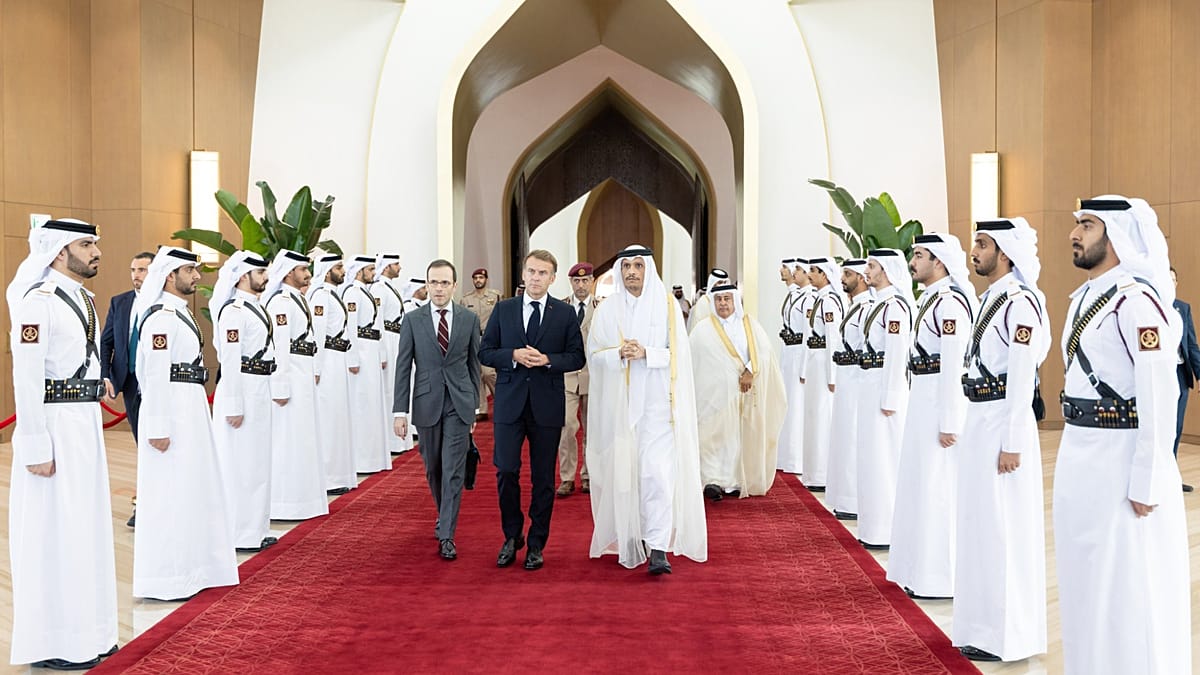
French President Emmanuel Macron wrapped up a two-day state visit to Qatar on Wednesday with a stark warning about the fragile security situation in the Gulf, urging “extreme caution” to prevent a renewed conflict. Speaking in Doha after talks with Emir Sheikh Tamim bin Hamad Al Thani, Macron noted that upcoming elections in Israel and the United States could heighten tensions, and stressed that “efforts and initiatives must be doubled” to avoid a slide back into war.
The visit, the first by a French president to Qatar, was dominated by energy security and defence cooperation. Macron announced that France had secured a critical liquefied natural gas (LNG) deal with Qatar, covering the equivalent of two terawatt-hours per month for the winter period. “Our objectives are achieved because we received guarantees on volumes where we had pre-existing uncertainties,” he told reporters, adding that the agreement would help “reduce pressure on prices from November” and avert the shortfalls predicted by some energy operators.
The gas deal is part of a broader effort by Paris to ease the cost-of-living crisis that has sparked violent protests across France. Macron's Gulf tour also yielded commitments for an additional 200,000 tonnes of diesel per month from the United Arab Emirates and Bahrain. The French president was accompanied by the chief executives of TotalEnergies and Engie, France's largest energy companies, both of which have significant interests in the region. TotalEnergies is already a partner in Qatar's North Field East LNG expansion project, one of the world's largest.
Defence ties and regional mediation
Beyond energy, Macron and Sheikh Tamim discussed Qatar's mediation efforts in regional conflicts, particularly regarding Iran. Macron said he expected “Iran's answer” in the coming hours or days on ongoing negotiations with the United States, though he declined to comment on specific measures. The two leaders also addressed the security of shipping through the Strait of Hormuz, where transport costs have multiplied by ten due to a lack of insured vessels. France and Gulf states are working on a mechanism to diversify infrastructure and reduce dependence on the strait.
Defence cooperation was a highlight of the visit, with Qatar's Rafale fighter jets escorting Macron's plane on arrival. France has been a key defender of Qatar during the Iran war, and Macron announced new agreements to supply Qatar with fifth-generation Rafale jets, radars, air-defence systems, and armoured vehicles. “All the countries in the region are looking for more autonomy and to develop their own capacity for defence,” he said.
After leaving Doha, Macron made a surprise stop in Saudi Arabia, a show of support for Riyadh's efforts against the Houthis in Yemen. He said France has been working with Saudi Arabia in a “defensive capacity” to secure global energy supplies disrupted by the conflict.
Qatar's Emir praised the “fruitful” talks, saying the two leaders explored ways to strengthen their strategic partnership and expand cooperation in investment, energy, defence, education, healthcare, and technology, including artificial intelligence and cybersecurity. Qatar's foreign ministry called the visit “historic,” confirming a strong partnership and a shared will to coordinate on regional and international issues.
Macron's Gulf tour comes as his government faces domestic pressure over rising living costs, a challenge that has also drawn criticism from foreign leaders. The French president has been rebuking foreign leaders for exploiting the unrest, while his administration seeks to stabilise energy markets. The Qatari gas deal is a key step in that direction, though analysts note that long-term solutions will require broader diversification and investment in renewables.
As Europe grapples with energy security, France's bilateral deals with Gulf states underscore the continent's continued reliance on external suppliers. The agreements also highlight the delicate balance between securing immediate needs and addressing the geopolitical risks that come with dependence on a volatile region.