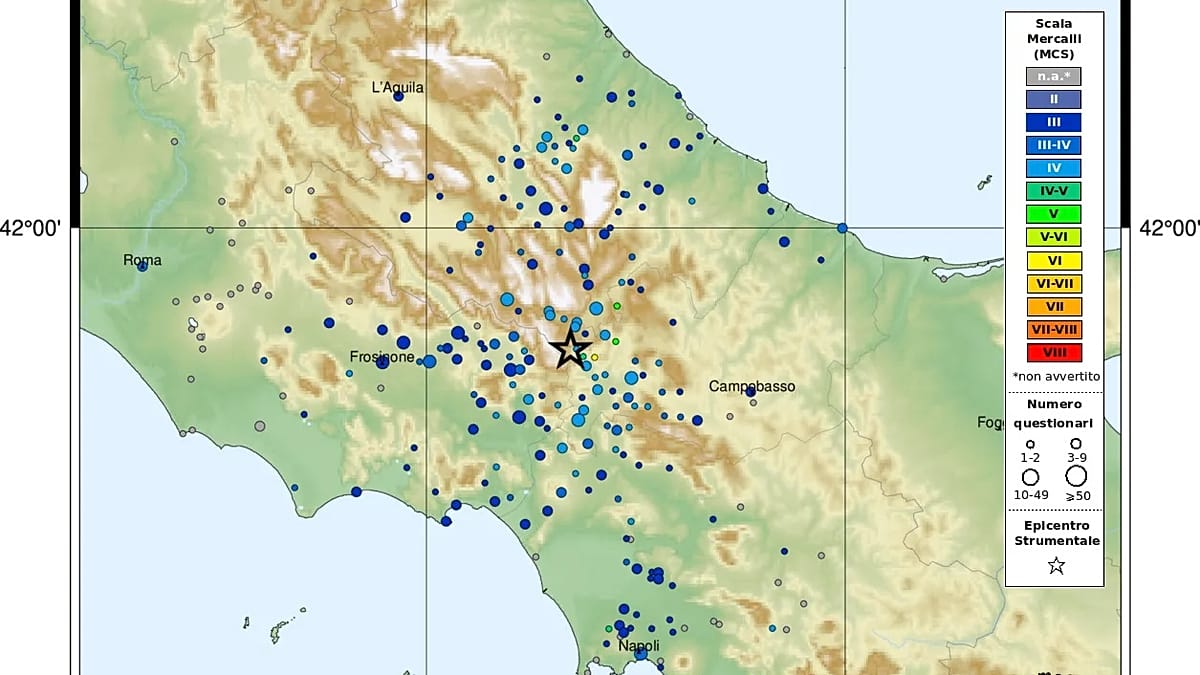
Just after midnight on Saturday, a magnitude 4.1 earthquake shook the province of Isernia in the Molise region of central Italy, prompting many residents to rush into the streets. The quake, recorded by Italy’s National Institute of Geophysics and Volcanology (INGV), had its epicentre near the town of Pizzone at a depth of roughly 10 kilometres.
The tremor was felt across a wide area, including the cities of Chieti, L’Aquila and Caserta. In Pizzone, a small town of fewer than 1,000 inhabitants, the sudden shaking caused widespread alarm. Many people remained outdoors for hours, anxious about possible aftershocks.
No damage, but lingering anxiety
Pizzone’s mayor, Vincenzo Di Cristofano, told local media that initial inspections by civil protection teams found no injuries or structural damage. “People stayed out in the streets until late, mainly because of the state of anxiety that developed,” he said. A second tremor, of magnitude 2.2, was recorded at 3:41 am at a depth of 9 kilometres, adding to the unease.
The province of Isernia is no stranger to seismic activity. Two magnitude 2.5 tremors were recorded in the same area last January. While these events are relatively modest on the Richter scale, they serve as a reminder of Italy’s vulnerability to earthquakes. The country sits on the boundary between the Eurasian and African tectonic plates, and major quakes have devastated regions such as L’Aquila (2009) and Amatrice (2016).
Italy has invested heavily in seismic monitoring and building codes since those disasters. The INGV’s rapid reporting and the local civil protection’s swift response this time helped reassure residents. Still, the psychological impact of even a moderate quake can be significant, especially in communities with recent traumatic memories.
This event comes amid a broader European focus on disaster preparedness. Cross-border initiatives in environmental monitoring and emergency response are increasingly common, though each member state retains primary responsibility for civil protection. In Italy, the national system coordinates regional agencies like Molise’s Protezione Civile.
For now, life in Pizzone returns to normal, but the episode underscores the importance of continued investment in early warning systems and public education. As climate change and geological risks evolve, Europe’s diverse regions must remain vigilant.