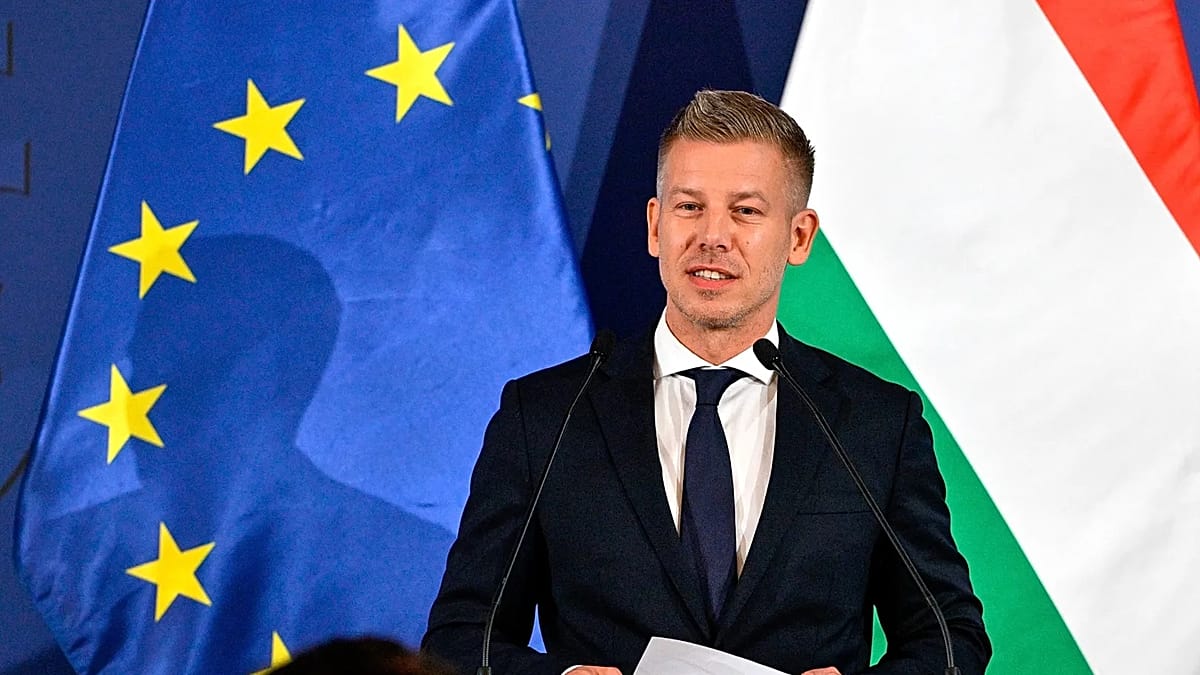
At the Bled Strategic Forum in Slovenia, Hungarian Prime Minister Péter Magyar delivered a blunt assessment of the European Union's current trajectory, arguing that the bloc is suffering from a leadership vacuum and must make fundamental choices about its future. Speaking alongside Slovenian, Croatian, and Czech counterparts, Magyar framed the debate in stark terms: the EU must decide whether it wants to merely survive or to win.
“There is a lack of political leadership, to be honest, in the European Union,” Magyar said, pointing to the EU's bureaucracy as a major obstacle to decisive action. He recounted advice from a member of the European Council: “Do not deal at all with the bureaucracy, do not reply to them, because they will kill initiatives. They will eat them. And it's not a good sign. I think we should concentrate again on the reality.”
Magyar's remarks come at a time when the EU is grappling with internal divisions, external pressures, and a rapidly shifting global landscape. He warned that while Brussels remains preoccupied with institutional questions, other global players are moving ahead. “China is preparing to fund nuclear plants and car factories in Europe,” he noted, suggesting that the EU's inward focus is leaving it vulnerable to being overtaken.
A call for strategic clarity
The Hungarian leader, who belongs to the same centre-right European People's Party as European Commission President Ursula von der Leyen, urged the EU to move beyond bureaucratic debates and focus on competitiveness and strategic autonomy. “There is a feeling already in Brussels as well that we should change, and in my view we should decide whether the European Union would only like to survive or to win,” he said.
His comments echo broader concerns across the continent about the EU's ability to act decisively on issues ranging from defence to industrial policy. The Bled Strategic Forum, an annual gathering of regional leaders, has become a platform for discussing these challenges, particularly in the context of the Western Balkans and Central Europe.
Magyar's participation alongside Janez Janša of Slovenia, Andrej Plenković of Croatia, and Andrej Babiš of the Czech Republic highlighted the growing influence of Central European voices in shaping the EU's agenda. Their discussions focused on regional cooperation and competitiveness, areas where many feel the EU has lagged behind global rivals.
Migration fines under fire
Magyar also used the forum to criticise the European Commission's financial penalties against Hungary over migration policy. In 2024, Brussels imposed a lump sum of €200 million plus a daily penalty of €1 million on Hungary, following a 2020 European Court of Justice ruling that found Hungary had breached EU law by failing to guarantee asylum seekers the right to fair treatment.
“It's quite difficult to explain to Hungarians why Hungary is treated so unfairly in Brussels on these issues,” Magyar said. “We have a court ruling; we have to pay €1 million a day just for defending the common European borders. It's not fair, and nobody is ready to resolve this issue.”
Under the previous government of Viktor Orbán, Hungary erected a border fence with Serbia and required asylum seekers to lodge applications at its consulate in Belgrade, leading to the rejection of the vast majority of claims. The fines have accumulated to nearly €1 billion, a significant financial burden for Budapest.
Magyar's criticism of the fines is notable given his promise during the election campaign to reset relations between Budapest and its Western allies in the EU and NATO. His stance suggests a continuity with Hungarian positions on border protection, even as he seeks to repair ties with Brussels.
The issue of migration remains a contentious one across the EU, with member states divided over how to manage external borders and asylum procedures. While some see Hungary's approach as a necessary defence of the bloc's external frontier, others view it as a violation of fundamental rights and EU law.
Magyar's remarks at Bled underscore the broader challenges facing the EU as it navigates a period of geopolitical uncertainty. With the war in Ukraine ongoing, energy prices volatile, and global competition intensifying, the bloc's ability to act cohesively is under scrutiny. Whether the EU can move beyond bureaucratic inertia and make the strategic decisions needed to thrive remains an open question.
As the EU looks to the future, leaders like Magyar are pushing for a more assertive and competitive Europe. The debate over survival versus winning is not merely rhetorical; it reflects real choices about how the EU allocates its resources, asserts its values, and positions itself in a multipolar world.