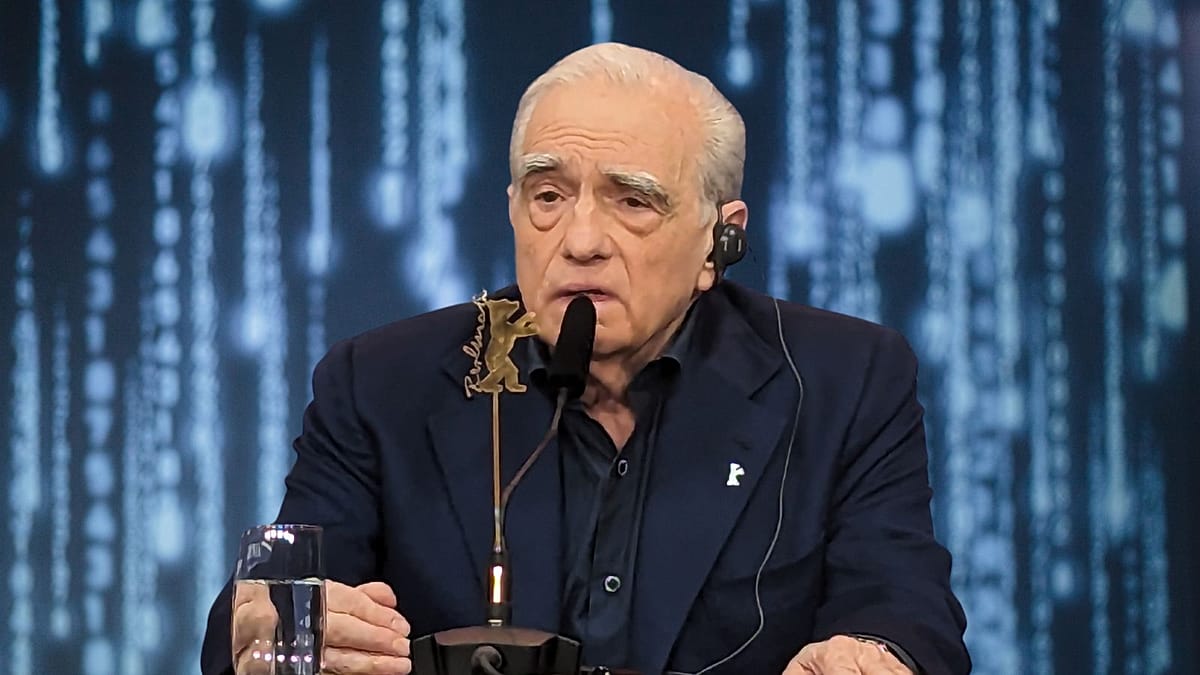
Martin Scorsese, the 83-year-old director behind Taxi Driver, Raging Bull, and Killers of the Flower Moon, has waded into one of the most contentious debates in contemporary cinema: the role of artificial intelligence in filmmaking. His endorsement of an AI tool developed by the German company Black Forest Labs has drawn sharp criticism from artists and industry observers across Europe and beyond.
Black Forest Labs, a Tübingen-based startup that describes itself as “the frontier AI research lab for visual intelligence,” announced Scorsese as an advisor for its FLUX image generation program. In a promotional video, the director explained how the technology helps him communicate his visual ideas more efficiently during pre-production. “For 70 years, I’ve been creating my own storyboards,” Scorsese said. “There’s always been this problem of how do you communicate what you see in your head to your cast and crew. Now, with this tool, I can share what I’m visualising more clearly and efficiently to my creative team.” He added that the ability to generate and share storyboards instantly was “creatively freeing” and allowed his team to “move faster without sacrificing quality or craft.”
A familiar pattern of technological embrace
Scorsese’s openness to new tools is not new. He previously used 3D technology for Hugo and de-aging techniques for The Irishman. At the 2024 Berlin Film Festival, he argued that cinema is “not dying — it’s just transforming,” and urged audiences not to “let the technology scare us.” Yet the AI endorsement has struck a different nerve, particularly among European creatives who see generative AI as an existential threat to their professions.
The backlash has been swift and pointed. Karla Ortiz, a storyboard artist who worked on Marvel films including Avengers: Endgame and Black Panther, wrote on social media: “He throws every single storyboard artist he’s ever worked with under the bus, as he demolishes their livelihoods with models that are likely trained on those storyboard artist’s same works. To use his legacy and power for this is just so disgusting.” Filmmaker Boots Riley speculated that Scorsese may have been motivated by financial considerations for his family, adding: “If that’s not the case, extra fuck him.”
Some observers have pointed to an apparent contradiction: Scorsese, who famously dismissed Marvel films as “not cinema,” now aligns himself with a technology that many argue threatens the very craft he champions. Others, however, defended the director, arguing that using AI for pre-production visualisation is a practical application that does not replace human artistry. “He is not using AI to replace cinema,” one supporter wrote. “He is using it to visualize ideas faster in pre-production, which is exactly where this kind of tool makes sense.”
Scorsese joins a small but notable group of filmmakers exploring AI. James Cameron joined the board of Stability AI in 2024, arguing that the technology could double the speed of visual effects work without layoffs. Darren Aronofsky’s studio has used AI to recreate historical scenes, and Steven Soderbergh employed it in his documentary John Lennon: The Last Interview. Guillermo del Toro, by contrast, has remained emphatically opposed.
The debate over AI in the arts is particularly acute in Europe, where cultural industries are heavily subsidised and protected. The European Union is currently negotiating the AI Act, which aims to regulate high-risk applications including those used in creative fields. The controversy around Scorsese’s endorsement underscores the tension between technological innovation and the preservation of human-centred craftsmanship — a tension that European policymakers are grappling with as they seek to balance competitiveness with cultural values.
For now, Scorsese’s partnership with Black Forest Labs has left a bitter taste among many in the film community. Whether it marks a genuine shift in his approach or a pragmatic adaptation to changing tools, the episode has reignited a fundamental question: can cinema embrace AI without sacrificing the human voice that Scorsese himself has long defended?