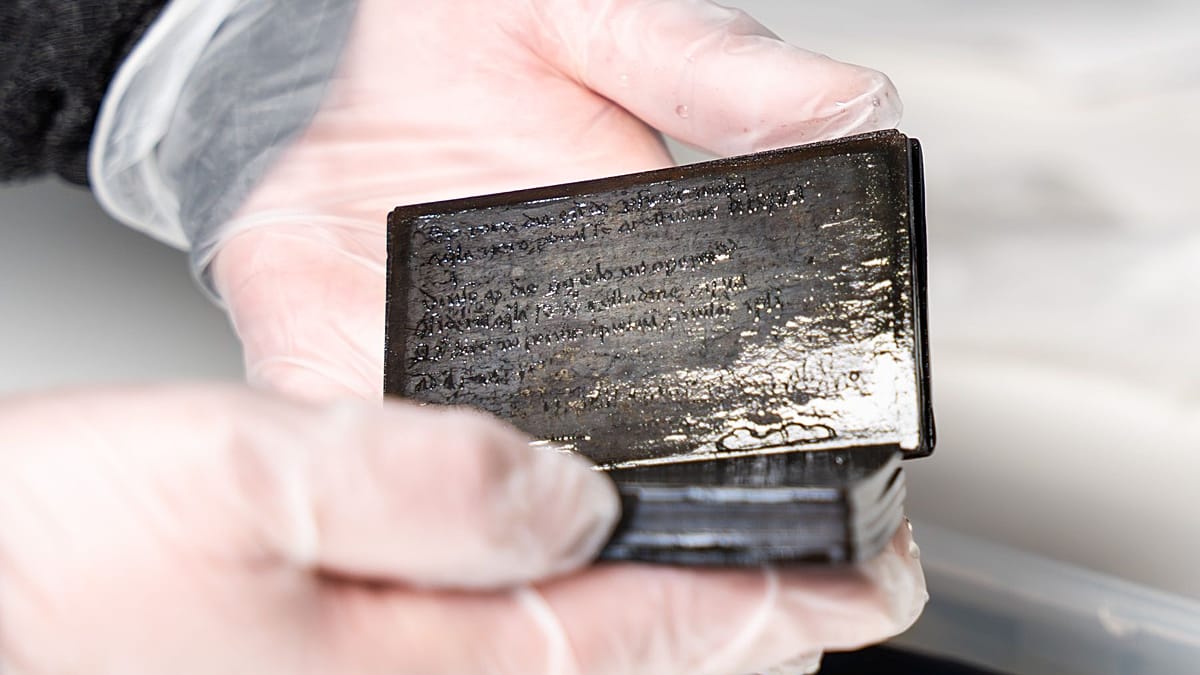
Archaeologists working on a construction site in Paderborn, North Rhine-Westphalia, have uncovered a rare medieval notebook in what was once a latrine. The find, dating from the 13th or 14th century, is remarkably well preserved and could offer new insights into the everyday lives of the city’s medieval inhabitants.
The excavation was carried out ahead of the construction of a new administrative building. During the work, a team supervised by the Regional Association of Westphalia-Lippe (LWL) discovered the notebook in one of five medieval latrines exposed at the site. Dr Barbara Rüschoff-Parzinger, head of cultural affairs at the LWL, noted that while it may seem unusual, latrines are often treasure troves for archaeologists because of their sealed, low-oxygen environments.
A Tiny, Portable Record
The notebook measures just 10 by 7.5 centimetres and consists of ten wooden tablets coated with wax, bound together and protected by a leather cover embossed with a lily motif. In the Middle Ages, such objects were used as reusable notebooks: a stylus would scratch notes into the wax, which could later be smoothed over and rewritten. Eight of the ten pages are inscribed on both sides, all in Latin and apparently by a single hand.
According to the archaeologists, the centre of medieval Paderborn was home mainly to wealthy citizens and merchants. Traders were among the few members of society who could read and write, making it likely that the notebook belonged to a literate merchant or a cleric. The presence of silk fabric remnants in the same latrine—possibly used as toilet paper—further underscores the high social status of the users.
Preserved by Waste
Paradoxically, the notebook owes its survival to the very place it was discarded. The hermetically sealed, damp, and low-oxygen conditions of the latrine prevented the organic materials—wood, leather, and wax—from decaying. LWL restorer Susanne Bretzel described the initial discovery: “Encased in a lump of wet soil and hardly recognisable at first, the object only became visible during cleaning in our restoration workshop in Münster. Even after so many centuries in the ground, the latrine find still smelled distinctly unpleasant.”
The pages had been tightly pressed together, protecting the wax layers from dirt and deformation. Bretzel added that the wooden tablets had not warped, so the writing remains easily legible. The conservation work is expected to take up to a year, during which researchers will analyse the materials—including the wax, possible resin components, pigments, and types of wood used. Until the analyses are complete, the organic components will be stored in distilled water.
Deciphering the Past
Once the conservation and analysis are finished, the researchers plan to decipher the content of the notes. The Latin text may reveal details about trade, daily life, or even personal correspondence from the medieval period. Such finds are extremely rare; most medieval wax tablets have not survived due to the fragility of their materials.
This discovery adds to a growing body of archaeological evidence from urban centres across Europe that is reshaping our understanding of medieval literacy and commerce. Similar finds have been made in other German cities, but the Paderborn notebook is notable for its completeness and the clarity of its inscriptions.
The excavation and restoration are part of ongoing efforts by the LWL to document and preserve the region’s cultural heritage. As Dr Rüschoff-Parzinger emphasised, “Unusual as it may sound, latrines are often extremely rich sources of material for archaeologists.” This particular latrine has certainly lived up to that reputation.