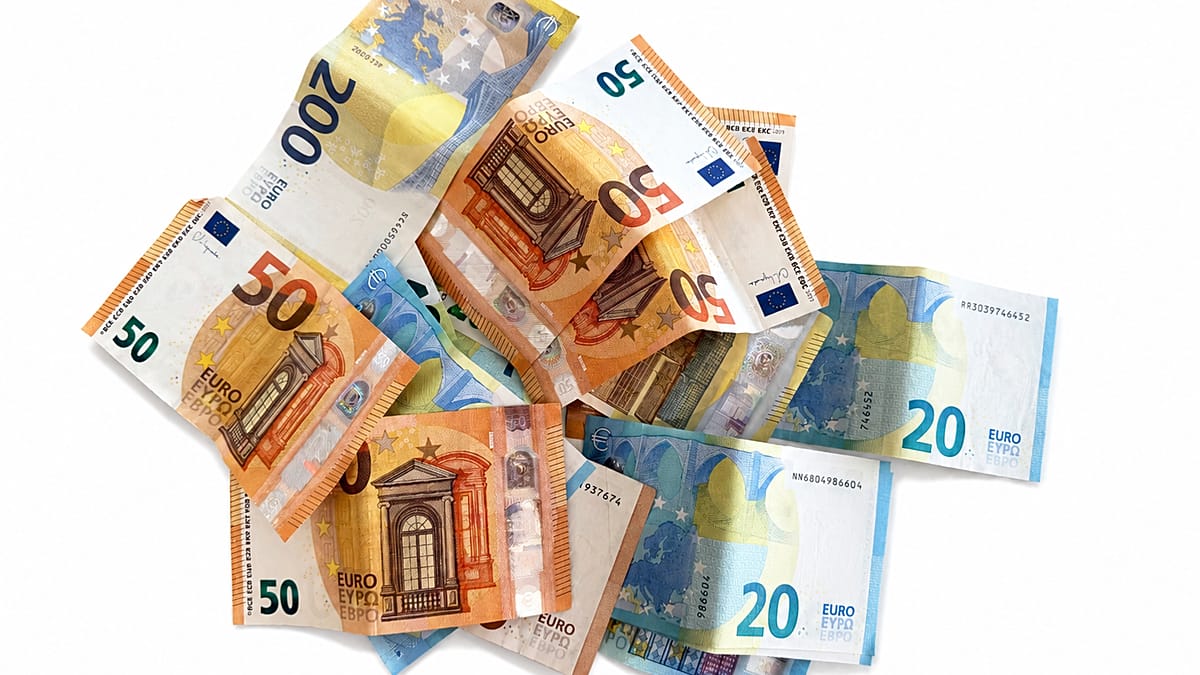
New Eurostat data for July 2026 reveals that only eight of 29 European countries increased their gross minimum wage between January and July, while consumer inflation in the euro area reached 3.2% over the same period. This means that in several countries, particularly those with high inflation, minimum wage earners have seen their real income fall.
In nominal terms, Luxembourg continues to offer the highest gross monthly minimum wage in Europe at €2,771. Within the EU, Bulgaria has the lowest at €620, but when candidate countries are included, Ukraine's €169 is the lowest. Five countries pay more than €2,000 a month, nine fall between €1,000 and €2,000, and fifteen are below €1,000—though seven of those are EU candidates.
Purchasing power tells a different story
When adjusted for purchasing power standards (PPS), the rankings change significantly. PPS is an artificial currency that equalises what money can buy across countries, providing a fairer comparison of living standards. In PPS terms, minimum wages range from 705 in Albania to 2,164 in Germany. Luxembourg (2,108), the Netherlands (2,023), Belgium (1,922) and Ireland (1,756) round out the top five, while France, Slovenia, Spain and Poland all exceed 1,500 PPS.
Within the EU, Estonia has the lowest minimum wage in purchasing power terms at 935 PPS, closely followed by Latvia at 938. Turkey and Bulgaria also fall below 1,000 PPS. Notably, some candidate countries outperform several EU member states: North Macedonia (1,142 PPS) and Serbia (1,094 PPS) rank higher than Malta, Slovakia, Hungary and Czechia.
Romania and North Macedonia gain most
Comparing nominal and PPS rankings across 27 countries, Romania and North Macedonia are the biggest winners. Romania climbs from 20th to 12th, and North Macedonia from 24th to 16th, each gaining eight places. Serbia rises five places, while Croatia and Bulgaria each move up three. The biggest loser is Estonia, which drops from 16th to 26th, with Latvia, Czechia and Cyprus each falling four places.
Only eight countries raised minimum wages in local currency terms between January and July 2026: North Macedonia (6.9%), Romania (6.8%), Estonia (6.8%), Belgium (5.8%), Greece (4.5%), Luxembourg (2.5%), France (2.4%) and the Netherlands (1.9%). In all other countries, wages remained frozen, hitting hardest where inflation was high. Eurostat estimates inflation at 8.2% in Malta, 5.4% in Cyprus and 4.7% in the Netherlands over the period.
Turkey stands out as a special case. With inflation around 17.8% between December 2025 and June 2026—the highest in Europe and among the highest globally—and the minimum wage now updated only once a year, Turkish workers are losing purchasing power rapidly. Turkey also has the highest share of minimum wage earners, at nearly 40% of the workforce, although the government has raised the nominal wage significantly in recent years.
The data underscore a broader challenge for European policymakers: nominal wage floors can mask real declines in living standards. As expat rankings for 2026 show, affordability varies widely across the continent. For minimum wage earners, the gap between what they earn and what they can actually buy is widening in several countries, even as others see gains.
With inflation expected to remain elevated in parts of southern and eastern Europe, the debate over how often to adjust minimum wages—and whether to index them to prices—is likely to intensify. The European Commission has long encouraged member states to strengthen collective bargaining and wage-setting mechanisms, but the pace of change remains uneven.