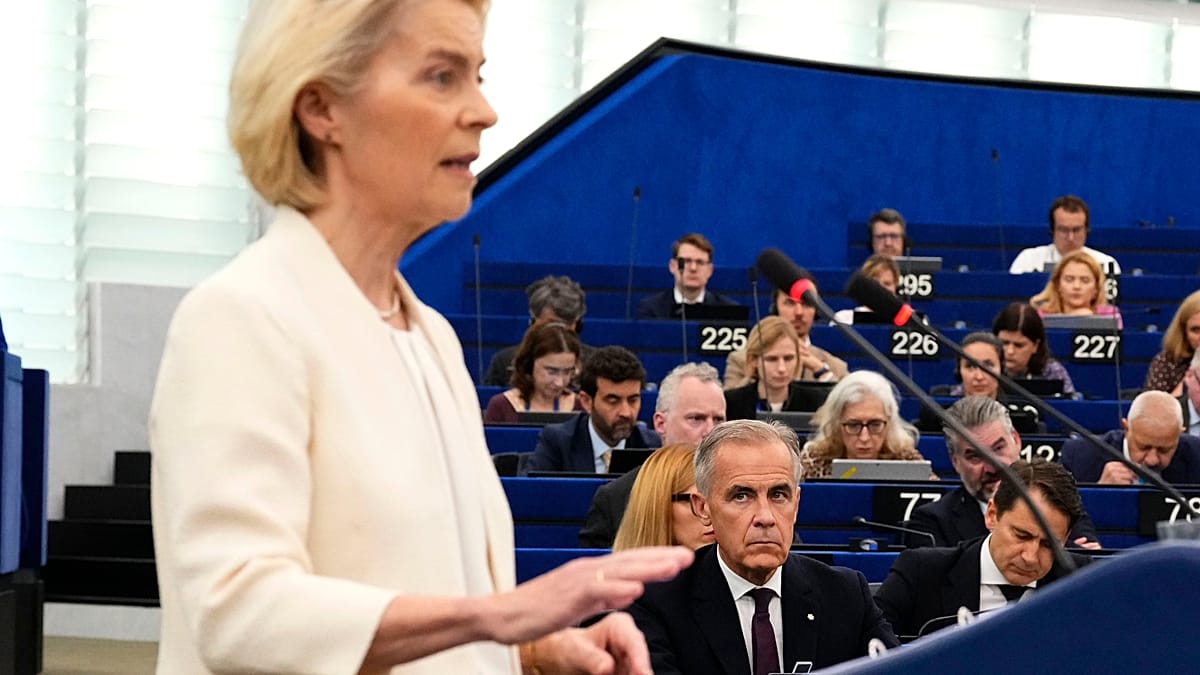
In a move that could reshape the European Union's place in the world, Brussels has opened the door to a new kind of partnership with Canada—one that goes beyond traditional trade deals and stops short of full membership. The proposal, announced by European Commission President Ursula von der Leyen on Wednesday, would make Canada the first "associate member" of the EU, an unprecedented status that has yet to be fully defined.
The idea was first floated by German Chancellor Friedrich Merz as a way to integrate Ukraine, but it was rejected by President Volodymyr Zelenskyy. Now, with Canada, the EU is exploring a model that could attract other democracies seeking closer ties without the commitment of membership.
A new model for global alliances
Canadian Prime Minister Mark Carney, who championed the concept of an alliance of middle powers in his Davos speech earlier this year, told the European Parliament on Thursday: "A Canada-EU alliance would create a beacon for other democracies. An alliance not defined by what we oppose, but about what we are for: freedom, solidarity, prosperity, sustainability."
The EU treaties do allow for association agreements with third countries, but the scope of this new status is still unclear. Carney proposed deep cooperation across strategic areas, including critical minerals, defence industrial capacity, artificial intelligence, energy security, space, and payments.
The announcement has already drawn international attention. Australian Trade Minister Don Farrell told the Sydney Morning Herald: "We are on the same page. We will take great interest in what Carney does." European Parliament President Roberta Metsola suggested that Australia and New Zealand might follow Canada's path, while Austria's Foreign Minister Beate Meinl-Reisinger called for the model to be extended to Norway, Iceland, Japan, South Korea, and New Zealand.
For the UK, the news has stirred unease, with some in London feeling that Brussels is prioritising its relationship with Ottawa over closer ties with Britain.
Strategic realignment
The EU-Canada partnership is seen as a step towards Carney's vision of an alliance of middle powers, designed to strengthen sovereignty in a shifting geopolitical landscape. "I want to be precise about what I am not proposing. I am not proposing a third bloc in order to become a great-power rival, only with better manners," Carney said. "We do not seek power to dominate others. On the contrary, we are pursuing resilience so that no one can control our open markets, impair our sovereignty, threaten our territorial integrity, or undermine our freedoms, our democracies, our rule of law."
In Brussels, officials argue that while individual member states may be middle powers, the EU as a whole is a convening power. "We are by definition a convening power of middle powers in the way we function. I think that makes us actually attractive to many other middle powers, because the EU, like no other global player, has in its DNA leveraging small and middle powers without trampling on their interests," said MEP Tobias Cremer (Germany/S&D).
The move is also being watched in Washington, where President Donald Trump has threatened tariffs in response. The EU has sought to reassure the US that the partnership is not a hostile act, but the tension underscores the broader realignment of democratic nations.
Concerns from candidate countries
However, the new format has unsettled countries in the Western Balkans that have been waiting for EU membership for decades. They have seen a succession of initiatives—growth plans, reverse enlargement, gradual integration—and now a tiered form of membership that may push their own bids further down the agenda.
Despite these concerns, the EU-Canada partnership is likely to proceed, with both sides eager to define a framework that could serve as a model for other democracies. As the world watches, the success of this experiment could determine whether the EU becomes the centre of a new international alliance, or whether it remains a regional project with global ambitions.