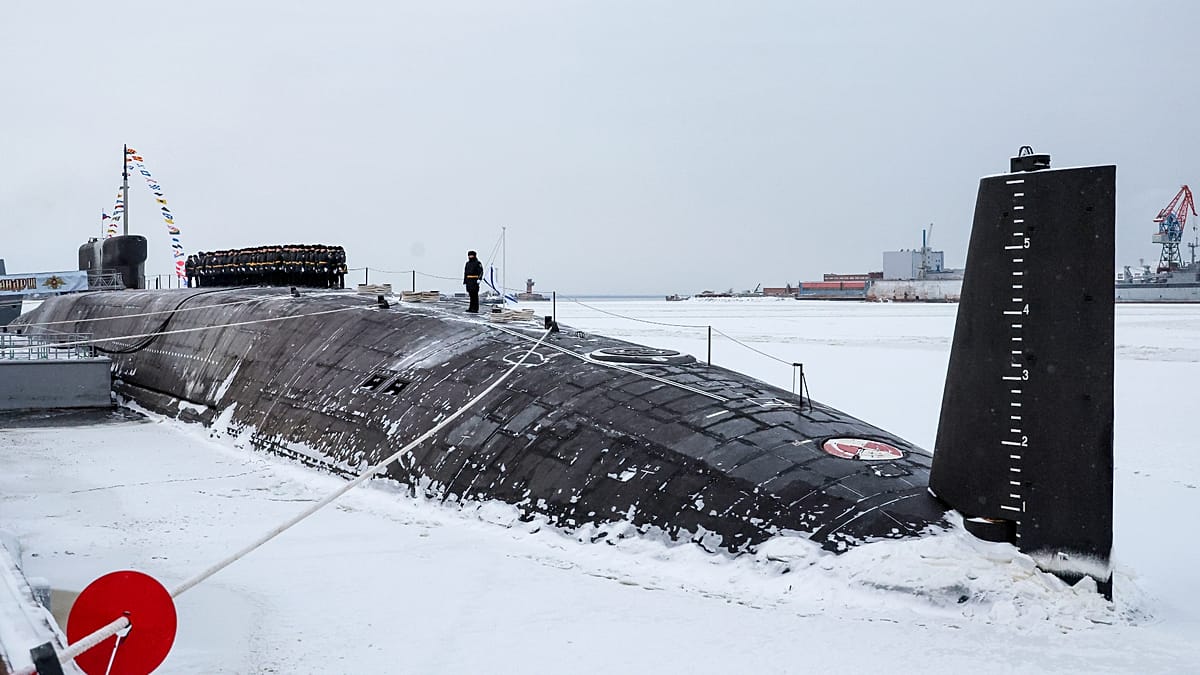
In a rare disclosure, Western officials have revealed that NATO allies successfully thwarted a clandestine Russian exercise aimed at disabling critical undersea data cables. The operation, conducted by Russia's highly secretive undersea warfare directorate (GUGI), took place in Arctic waters near Norway's Svalbard archipelago, according to two Western officials cited by Reuters.
The British military tracked and deterred three Russian submarines during what was described as a month-long covert mission near vital cables and pipelines connecting the Norwegian territory. The joint effort involved the United Kingdom, Norway, and the United States, which coordinated to monitor and divert the Russian vessels before they could complete their training.
A secret weapon with no trace
While no physical damage was inflicted on any cables, the Russian exercise was designed to simulate the deployment of a secret weapon that leaves no trace, officials told Reuters. The exact nature of the technology remains undisclosed, but its purpose is clear: to disable undersea infrastructure in the event of a conflict with NATO.
During the confrontations at sea, British and Norwegian officials confronted Moscow with their findings, aiming to deter any future use of the technology. Norway's Defence Minister Tore Sandvik emphasized the success of the operation, stating, "Through our joint operation, we sent a clear message to Russia that they cannot operate covertly." He added, "We have made it unequivocally clear to Russian authorities that any attempt to target our critical infrastructure will be detected and met with consequences. It is in no one's interest to escalate tensions in the High North."
The Russian Defence Ministry did not comment, and the Kremlin has consistently denied engaging in sabotage against NATO countries.
Undersea cables: the backbone of global connectivity
Undersea fiber-optic cables, roughly the thickness of a garden hose, carry nearly all of the world's internet traffic. They are essential for global communications and financial transactions, making them increasingly attractive targets for disruption. The incident underscores the vulnerability of this infrastructure and the growing threat posed by Russian activities.
Since the 2022 destruction of the Nord Stream pipelines, NATO allies have intensified their focus on protecting undersea critical infrastructure. Since 2023, there has been a noticeable increase in ships mapping undersea elements, including pipelines, power cables, and telecom cables. While such surveys are not illegal in international waters, experts warn they could be preparation for sabotage.
Bruce Jones, a senior fellow at the Brookings Institution, highlighted Europe's strategic neglect: "In the last 25 years, Europe did two things simultaneously. It dramatically expanded the extent to which it relies on seabed infrastructure, and it dramatically shrunk its capacity to protect that infrastructure. It's belatedly rebuilding now, in the face of a burgeoning Russian threat."
The successful interception near Svalbard is part of a broader pattern of heightened Russian activity in the region. As NATO continues to bolster its defenses, the incident serves as a reminder of the ongoing hybrid threats facing European security. For more on related security issues, see recent espionage cases and cyber threats from Russian actors.