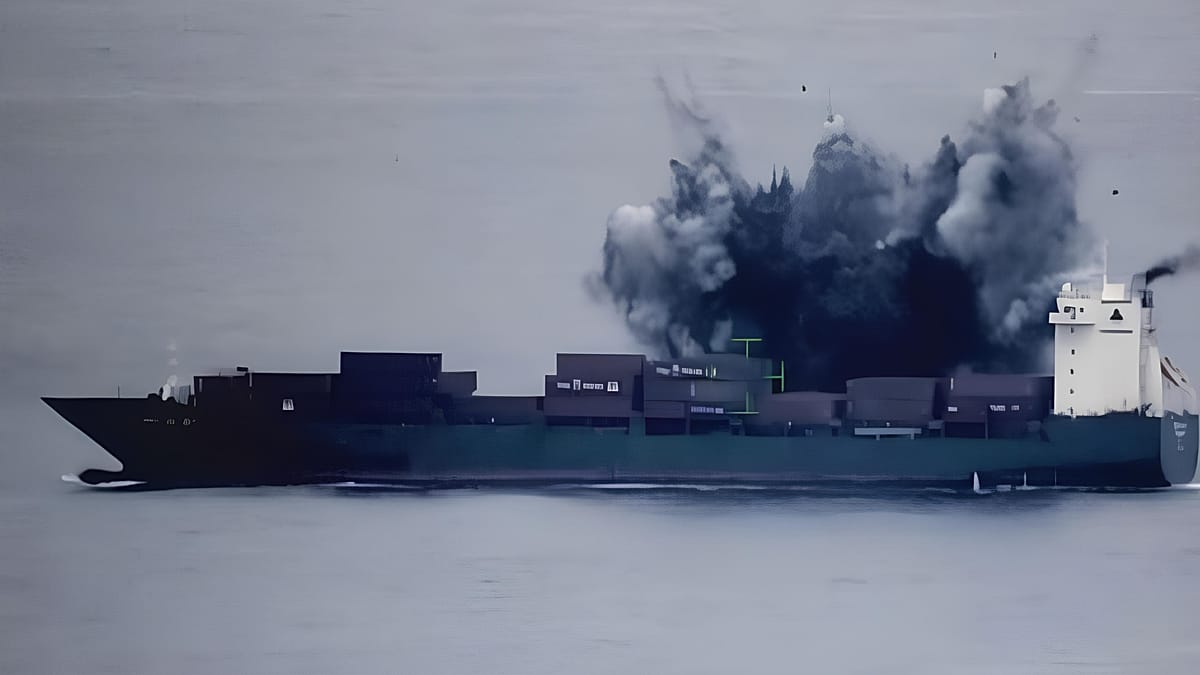
Fresh footage has emerged showing the moment a Greek-managed tanker was struck by maritime drones off Bulgaria's Black Sea coast, an attack that has intensified concerns about the security of commercial shipping in the region.
The Liberian-flagged Contship Jet was travelling from Haifa, Israel, to Constanța in Romania when it was hit by three unmanned vessels on 28 October. The incident took place within Bulgaria's exclusive economic zone, marking the fifth such drone attack recorded in the NATO member's waters last month.
All 18 crew members—14 Filipinos and four Ukrainians—were safely evacuated by Bulgarian naval and border police vessels and taken to the port city of Varna for medical checks. The Bulgarian Military District Prosecutor's Office has since opened a preliminary investigation into the attack.
Rising threat in the Black Sea
The attack comes amid a broader pattern of drone strikes targeting commercial vessels in the Black Sea, a region already tense due to Russia's full-scale invasion of Ukraine. While no group has claimed responsibility, suspicion has fallen on Moscow, which has previously targeted Ukrainian port infrastructure and grain shipments.
Bulgarian Prime Minister Rumen Radev acknowledged the difficulty of proving Russian involvement, telling parliament earlier this month: "The logic points in that direction … The problem is that we cannot prove it." His remarks reflect a growing unease among NATO members along the alliance's eastern flank.
The Contship Jet was carrying containers that included lithium-ion batteries, flammable liquids, gases, and other hazardous materials, according to the maritime.bg site. Bulgarian navy teams reported no signs of pollution after taking water samples from several locations in Bulgarian territorial waters.
NATO response and regional cooperation
The incident unfolded as defence ministers from Bulgaria, Romania, and Turkey met in Sofia to discuss Black Sea security. In a joint statement, the three NATO countries strongly condemned the strikes on vessels and called for an "immediate cessation of attacks that threaten commercial ships, maritime infrastructure and the safety of maritime activities."
They also agreed to enhance intelligence sharing, early warning capabilities, and coordination in the region. NATO Secretary-General Mark Rutte said on 15 October that the alliance had "strengthened" its "posture along the eastern flank including with increasing counter-drone capabilities."
The recent wave of incidents has prompted some alliance members to question whether Russian President Vladimir Putin is seeking to test their resolve in supporting Ukraine. As Ukraine's drone defenses improve, the vulnerability of commercial shipping remains a pressing concern.
For Bulgaria and Romania, the attacks underscore the fragility of maritime security in the Black Sea, a vital corridor for grain exports and energy supplies. The region's strategic importance has only grown since the start of the war, with Russian drone strikes elsewhere in Ukraine highlighting the broader threat.
While the investigation into the Contship Jet attack continues, the incident serves as a stark reminder of the risks facing commercial vessels in waters that have become a flashpoint in the conflict. As NATO bolsters its presence, the question of how to protect civilian shipping without escalating tensions remains a delicate balancing act.