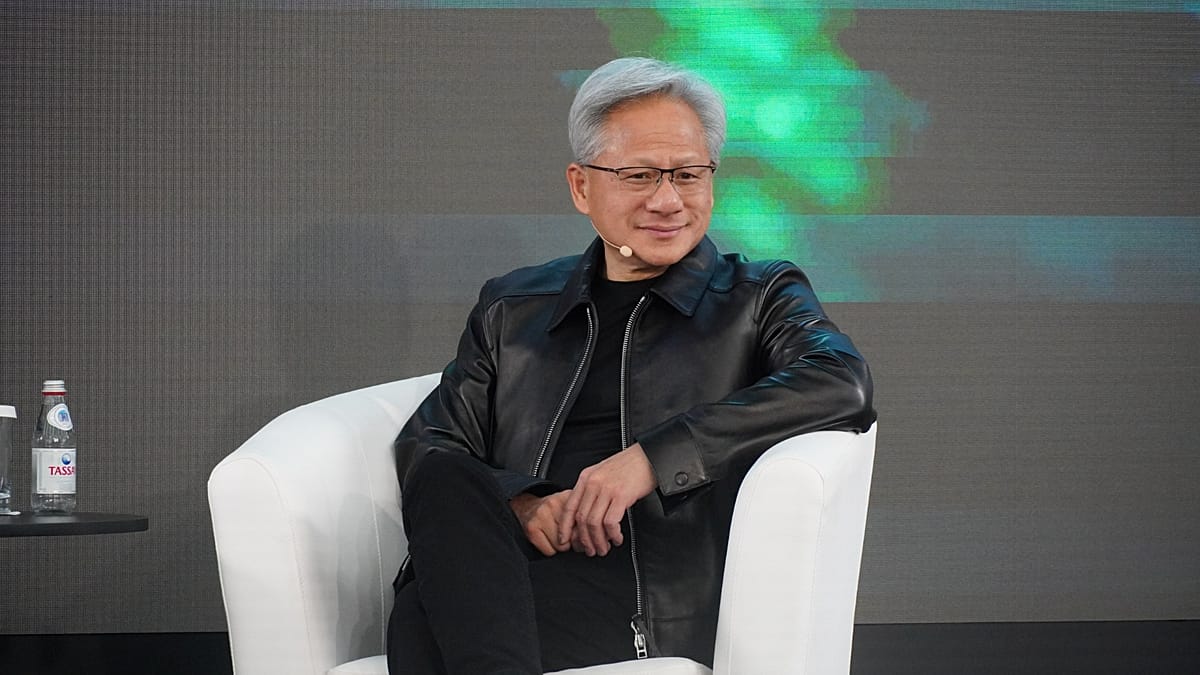
Nvidia's founder and chief executive, Jensen Huang, made his first trip to Kazakhstan this week, where he told officials in Astana that the Central Asian nation could become a pivotal artificial intelligence computing hub for Europe. Speaking at the Alem.ai International Artificial Intelligence Centre, Huang discussed the country's energy potential, sovereign AI ambitions, and the emerging field of Physical AI with Deputy Prime Minister Zhaslan Madiyev, who also serves as minister of artificial intelligence and digital development.
Kazakhstan is planning to nearly double its installed power capacity to more than 40 gigawatts by 2035, a move aimed at supporting the energy-hungry data centres that AI requires. One flagship project is the Data Center Valley in Ekibastuz, a major power-generating region. The first 50-megawatt phase is slated to come online in 2027, with the potential to scale up to one gigawatt of energy infrastructure.
Huang argued that Kazakhstan's abundant energy and vast territory give it a unique advantage in the AI economy. “Kazakhstan has a lot of real estate. It also has a lot of energy,” he said. “You're going to have a lot of compute right here in Kazakhstan. It's going to be a hub, a computing hub, an AI factory hub for all of Europe.”
He went further, suggesting that instead of merely exporting raw energy, Kazakhstan could convert it into intelligence. “You have so much energy, and instead of just exporting energy in the future, you could transform the energy into intelligence and export intelligence,” Huang said.
Sovereign AI and data control
Energy alone, however, is not sufficient. Huang stressed that countries must also retain control over their data and the AI infrastructure that serves their citizens. Madiyev noted that Kazakhstan is already developing Kazakh-language large language models based on open-source foundations, and asked whether the country should eventually build its own foundation model from scratch. Huang replied that doing so “makes complete sense,” framing it as a matter of national security.
“In the future, you will have your own electric grid, your own internet, your own telecommunications and your own intelligence grid,” Huang said, comparing AI infrastructure to other essential national utilities. This vision aligns with the concept of sovereign AI, which has gained traction among governments seeking to reduce dependence on foreign tech giants.
Physical AI and industrial applications
Beyond computing infrastructure, Kazakhstan is eyeing the field of Physical AI—systems that can interact with the physical world. Madiyev pointed to the country's strengths in mining, agriculture, transport, and logistics, asking whether Kazakhstan could become a hub for developing and training such models and robots. Huang called the idea “fantastic,” noting that these industries could be among the first to benefit.
“Physical AI is not just robotics,” Huang said. “It includes everything from seismic understanding to mapping mines and wells, to understanding geography and geology—where to mine, how best to mine—understanding material science, the processing of chemicals.” With the technology still nascent, Huang suggested Kazakhstan has an opportunity to help shape the industry.
Investment in local startups
The conversation also touched on Higgsfield AI, a Kazakh-founded generative video startup in which Nvidia has invested. Huang explained that the decision to back the company came down to its founders. “The first thing and the last thing is you invest in people, not companies,” he said, describing them as “visionary” and capable of competing globally. He also noted that Higgsfield's presence in both Kazakhstan and the United States could help bridge the two ecosystems.
Later in the day, Huang met with President Kassym-Jomart Tokayev, who called the development of AI and digitalisation a national priority. “This visit is very important for us in terms of giving a serious boost to cooperation with Nvidia,” Tokayev said. Huang welcomed Kazakhstan's ambition to become an “AI nation” and reiterated its potential to become a global hub for Physical AI.
Kazakhstan's push into AI comes as the country also accelerates its energy transition, including plans for rapid nuclear plant construction. The government's broader digital strategy is part of a wider trend across Europe, where nations are vying for leadership in AI infrastructure. For a region often overshadowed by the US and China, Kazakhstan's ambitions could offer a new frontier—one that Huang believes is ripe for development.