Oil prices retreated on Wednesday morning as renewed hopes for a diplomatic resolution to the US-Iran conflict buoyed global markets, with European equities opening sharply higher. The shift followed a statement from US President Donald Trump on Truth Social announcing a temporary pause of “Project Freedom”, the naval escort mission through the Strait of Hormuz, citing “great progress” in negotiations with Tehran.
“While the blockade will remain in full force and effect, Project Freedom (the movement of ships through the Strait of Hormuz) will be paused for a short period of time to see whether or not the agreement can be finalised and signed,” Trump wrote. The strait has been effectively closed since the conflict erupted on 28 February, disrupting roughly one-fifth of global oil and gas supplies and leaving over 20,000 people stranded aboard vessels in the Persian Gulf.
Crude futures declined late on Tuesday. International benchmark Brent crude for next-month delivery dropped 1.3% to $108.47 a barrel on Wednesday morning, while US benchmark West Texas Intermediate fell $1.37 to $100.90. Prices remain well above the pre-war level of around $70, reflecting persistent supply risks. US military officials have previously indicated a ceasefire with Iran was in effect, though uncertainty lingers.
European Markets Rally on AI Optimism
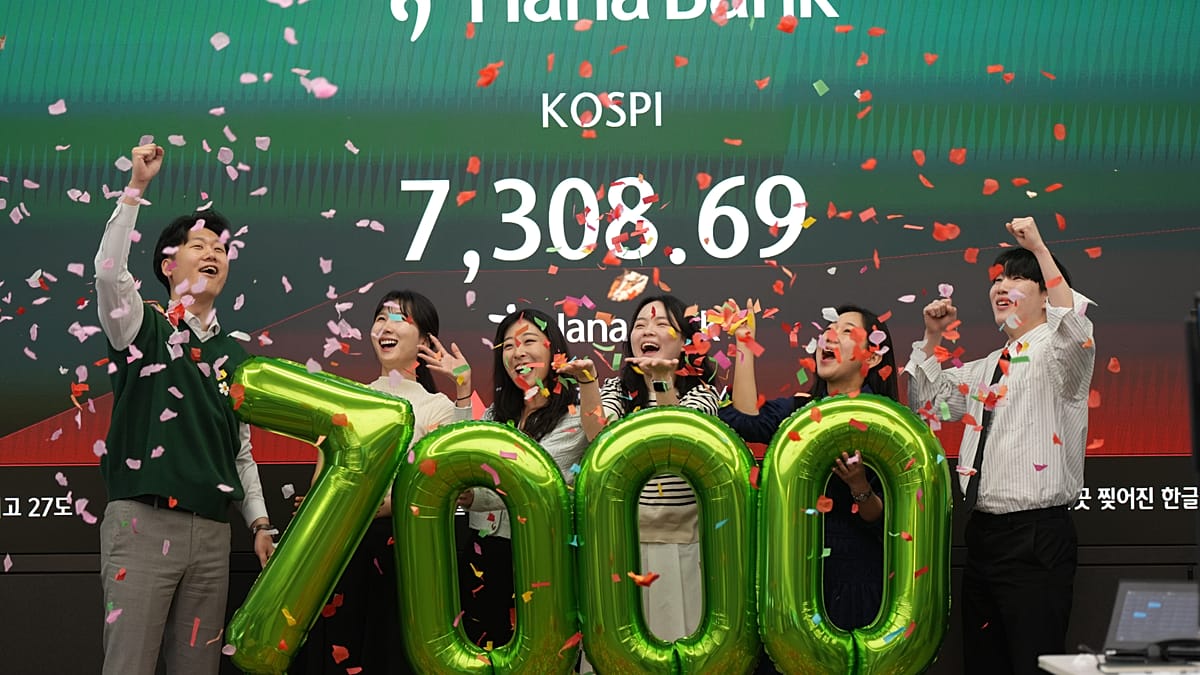
European stock indices climbed more than 1% in early trading, extending a global equity rally driven by investor enthusiasm for artificial intelligence and easing geopolitical tensions. London’s FTSE 100 gained 1.2%, Germany’s DAX rose 1.8%, and France’s CAC 40 advanced nearly 1.7%. The positive sentiment was mirrored across Asia, where South Korea’s Kospi surged 6.5% to a record high after a holiday closure.
The rally in Seoul was led by Samsung Electronics, whose shares jumped almost 13%, pushing the company’s market capitalisation above $1 trillion for the first time. Samsung, alongside rival SK Hynix, has become a key supplier of high-performance memory chips powering the global AI boom. SK Hynix shares also rose around 10% in early trade. In other Asian markets, Australia’s S&P/ASX 200 gained nearly 1%, Hong Kong’s Hang Seng added 0.7%, and Shanghai’s Composite index rose 1%. Japanese markets were closed for a public holiday.
US stocks closed higher on Tuesday, with the S&P 500 rising 0.8% to a fresh record, the Dow Jones Industrial Average up 0.7%, and the tech-heavy Nasdaq Composite advancing 1% to another all-time high. The rally was supported by hopes of progress in US-Iran talks, which helped ease concerns over energy supplies and global trade disruption. For a deeper look at how AI and short squeezes have driven markets amid the Iran conflict, see our analysis.
Economic data from the US presented a mixed picture: growth in the services sector slowed unexpectedly last month, while job openings were slightly stronger than forecast, signalling continued resilience in the labour market. Meanwhile, UK government borrowing costs climbed to their highest level in nearly three decades, with yields on 30-year gilts rising to 5.78%—their highest since 1998—and 10-year yields climbing above 5.10%, amid concerns over local elections and rising energy prices.
In currency markets, the dollar was little changed at 157.88 yen, while the euro edged higher to $1.1720. The broader market backdrop remains shaped by the interplay between geopolitical risk and technological disruption. As European banks navigate these currents, diverging fortunes are evident: HSBC reported profit slips due to Iran war charges, while UniCredit surged.
The AI-driven rally has also reignited debates about market regulation in Europe. The EU’s Digital Markets Act, now two years in, aims to curb Big Tech’s dominance, but its impact on European competitiveness remains contested. For more on this, read our assessment of the DMA’s record.