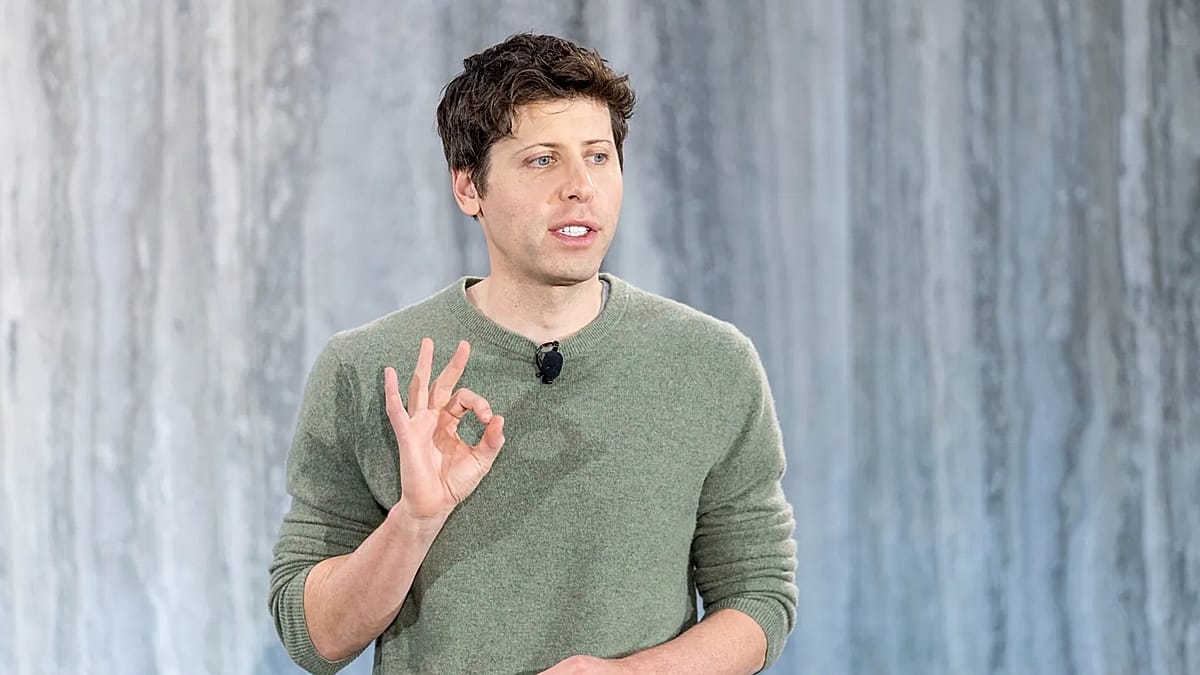
Sam Altman, the chief executive of OpenAI, acknowledged on Tuesday that the anticipated wave of job losses due to artificial intelligence has not materialised as he once feared. Speaking at a Commonwealth Bank of Australia conference in Sydney, Altman admitted that while his technological forecasts for AI were largely accurate, his predictions about its social and economic consequences were off.
Altman had previously warned that AI could compress the historical rate of job turnover—typically around 50% of roles changing every 75 years—into a much shorter timeframe. He also suggested that customer service positions would be among the first to disappear, stating he was “confident that a lot of current customer support that happens over a phone or computer, those people will lose their jobs.”
“I’m delighted to be wrong about this,” Altman told CBA Chief Executive Matt Comyn during the interview. “I thought there would have been more impact on entry-level white-collar jobs being eliminated by now than has actually happened. I now think I understand more about why it hasn't, and I'm obviously grateful but that is an area where my intuitions were just off.”
His remarks come amid a broader reassessment of AI’s impact on employment across Europe and beyond. While some technology companies, including Meta, have announced job cuts to refocus on AI, a report from Gartner indicates that most businesses see greater benefits from equipping staff with AI tools rather than replacing them. The data shows that 80% of executives have considered cutting staff to invest in AI, but those who have done so often find that productivity gains come from augmentation, not elimination.
European Labour Markets and AI
For European economies, where labour shortages are a persistent challenge—particularly in sectors like healthcare, logistics, and manufacturing—the findings offer a nuanced picture. Countries such as Germany, France, and Poland are grappling with aging workforces and skill gaps, making AI a potential tool for boosting productivity rather than a threat to jobs. The European Commission has been actively shaping AI regulation through the AI Act, aiming to balance innovation with worker protections.
Altman also highlighted the enduring value of human interaction in the workplace. He recounted an experiment where he used AI to respond to emails and Slack messages, signing off as “this is Sam's AI.” The result, he said, was a reminder that people care about genuine human connection. “It was an amazing example to me of we really do care about people,” he added.
Despite the current lack of a jobs apocalypse, Altman cautioned that the risk is not entirely gone. “People are like ‘oh you could have saved the world a lot of fear mongering and a lot of doom and gloom’ but at the time I was like ‘I see this is a real risk we should probably talk about it’ and it still may,” he said.
The debate over AI and employment remains central to European policy discussions. As the continent navigates the integration of AI into its diverse economies, the focus is shifting from fear of displacement to strategies for reskilling and adaptation. For investors, the trajectory of companies like OpenAI—which recently saw a record-breaking IPO—offers clues about where the technology is heading. Meanwhile, labour mobility initiatives, such as those exploring partnerships with Central Asia to address shortages, underscore the complexity of Europe’s workforce challenges.
Altman’s revised outlook suggests that the future of work may involve more collaboration between humans and machines than outright replacement—a message that resonates in boardrooms and parliaments from Berlin to Brussels.