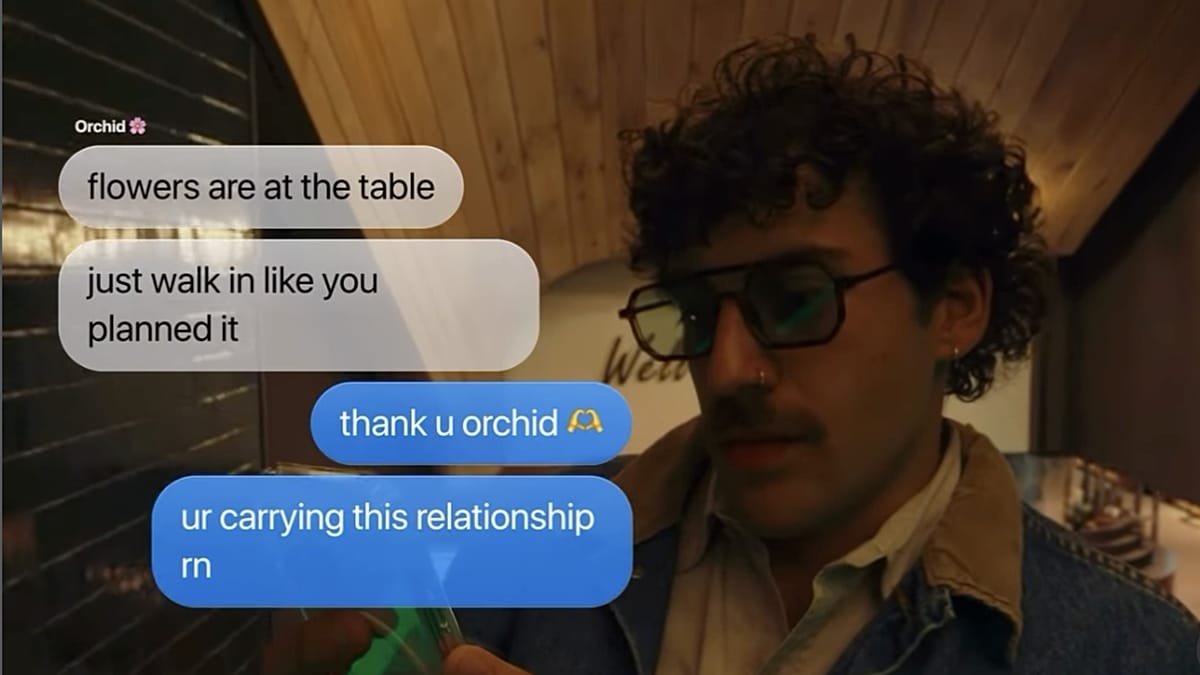
Silicon Valley has a new darling, and it's already the butt of the internet's jokes. Orchid, a startup that emerged from the Valley's relentless quest to solve problems most people didn't know they had, is peddling an AI assistant that promises to be more than a mere tool—it's a 'second brain.' The pitch, however, has landed with a thud, especially among Europeans who value a bit of effort in their personal lives.
The controversy centers on Orchid's launch video, a two-minute vignette that has been widely panned on social media. The scenario: a young man, glued to his video games, forgets his anniversary. His partner, remarkably composed and dressed for success, texts Orchid to remind him. The AI then books a restaurant and orders lilies, because it remembers she prefers them to roses. The man texts, 'ok. ok. i can do this,' to which Orchid replies, 'you literally can’t. that’s why I’m here.' The entire exchange is rendered in lowercase and emojis, a stylistic choice that only amplifies the cringe.
The reaction on Instagram has been swift and brutal. 'What’s the point of being in a relationship if you outsource all the effort and compassion?' one commenter asked. Another called it 'disgusting and dystopian,' adding, 'Imagine that now you can have a relationship with no effort nor intention. This is actually nefarious.' A third simply declared, 'this is gross and if it doesn't end humanity is doomed.'
Beyond romance: a troubling vision
Orchid's ambitions extend far beyond anniversaries. The company has suggested its AI could handle professional emails when you're too anxious to reply, or serve as a sounding board for ideas—roles traditionally filled by friends, colleagues, or neighbors. But the most alarming proposal, since deleted, was an ad suggesting Orchid could scan your food to check for allergens before you eat. The script warned, 'It could be anything. And the list of things that put me in a hospital is long enough that anything is the problem.' Social media users were quick to point out the obvious risks of trusting AI with life-threatening allergies.
This isn't just a Silicon Valley oddity. The trend of using AI for mundane tasks is growing globally. A study by OpenAI and Harvard, analyzing 1.5 million ChatGPT conversations from 2022 to 2025, found that 75% of interactions were non-work related—from cooking advice to finding a pharmacy. In Europe, the Austrian Safer Internet Centre reported that about a fifth of adults have used AI chatbots for romantic conversations, and over a quarter believe young people could fall in love with one. The French dating app happn has even dubbed the 'AI situationship' an emerging trend, echoing the film Her.
Orchid's backlash fits a broader pattern of public skepticism toward AI's intrusion into intimate spheres. As AI-generated content stirs outrage in entertainment, the question of where to draw the line becomes ever more pressing. For now, Orchid's 'second brain' seems to be a solution in search of a problem—or at least one that most people are happy to solve with a calendar and a bit of genuine effort.