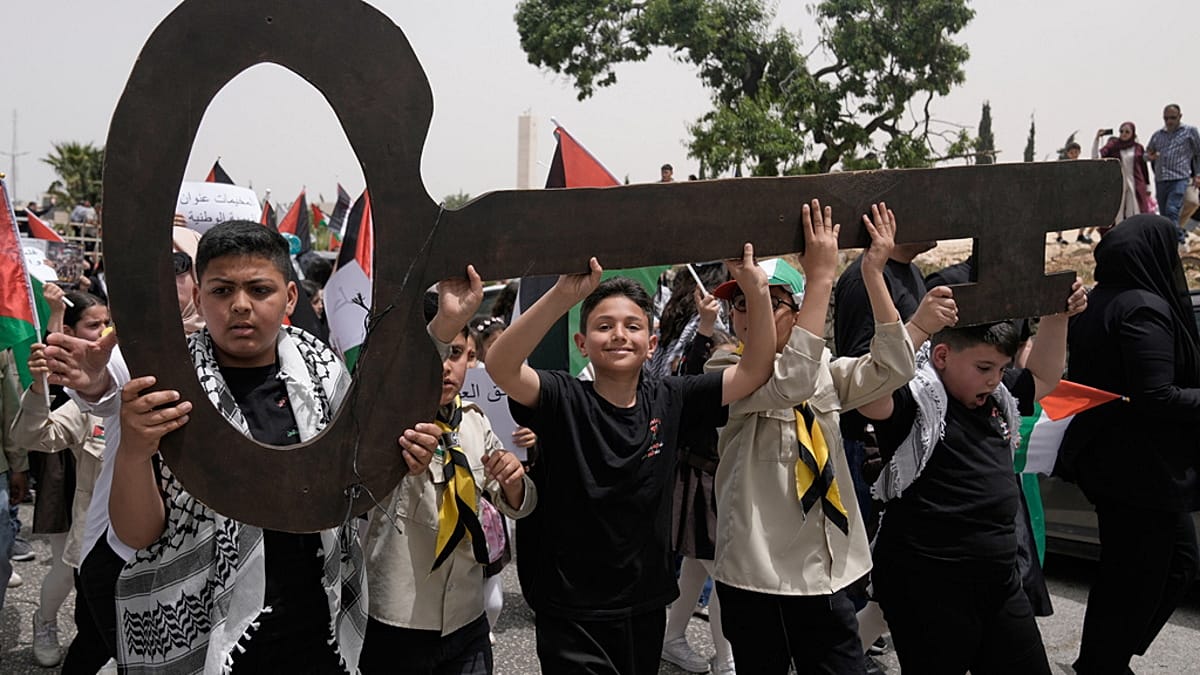
On 12 May 2026, thousands of Palestinians gathered in Ramallah and across the occupied West Bank and Gaza Strip to commemorate the 78th anniversary of the Nakba, the mass displacement that followed the creation of Israel in 1948. The events, organized annually, serve as a powerful reminder of a still-unresolved refugee crisis that affects millions across the Middle East and beyond.
In Ramallah, the de facto administrative capital of the Palestinian Authority, mosques sounded a 78-second siren at midday, symbolizing each year since the displacement. A large procession began at the mausoleum of former Palestinian President Yasser Arafat and wound through the city toward Manara Square. Participants waved Palestinian flags, beat drums, and played bagpipes, while scouts marched in formation. A giant key—a recurring symbol of the right of return—was carried through the streets, alongside banners demanding return to what participants called "historic Palestine."
An Open Wound
For many, the Nakba is not a distant historical event but a lived reality. Abdel Kareem Abu Arqoub, a participant in Ramallah, told the Associated Press: "This day first reminds us of a national tragedy that befell the Palestinian people many decades ago, and the right of return must be restored to its rightful owners, and justice must be achieved for the Palestinian people by returning to the homes from which they were displaced."
Another attendee, Jihad Dar Ali, directed his criticism at the United Kingdom, citing the 1917 Balfour Declaration as the root cause of Palestinian suffering. "On this day, we demand that Britain, which was the cause of our Nakba and our suffering, compensate us morally and materially for the years of loss and displacement it caused," he said. "The United Kingdom, a Western colonial power, gave our homeland, Palestine, the land of our ancestors, to the Jewish people."
The Balfour Declaration, issued by British Foreign Secretary Lord Arthur Balfour, pledged support for a "national home for the Jewish people" in Palestine, then part of the Ottoman Empire. After World War I, Britain administered the territory under a League of Nations mandate. In 1947, the United Nations proposed partitioning Palestine into Jewish and Arab states, a plan rejected by Arab leaders. When Israel declared independence in May 1948, violence erupted, leading to the displacement of an estimated 750,000 Palestinians and more than seventy documented massacres, including at Deir Yassin, Tantura, and Haifa.
Arab armies from Egypt, Syria, Jordan, Lebanon, Saudi Arabia, and Iraq intervened but were defeated, and Israel expanded its control beyond the partition boundaries. In December 1948, the UN General Assembly passed Resolution 194, affirming the right of Palestinian refugees to return to their homes and receive compensation for losses. That resolution has never been implemented, and Israel continues to block any large-scale return.
The right of return remains a cornerstone of Palestinian national identity, passed down through generations in refugee camps across the West Bank, Gaza, Jordan, Lebanon, and Syria. Nakba Day is also observed in diaspora communities worldwide, including in European cities such as Berlin, Paris, and London, where Palestinian and solidarity groups hold marches and vigils.
This year's commemoration comes amid heightened tensions in the region and a stalled peace process. The European Union has long supported a two-state solution and has funded UNRWA, the UN agency for Palestinian refugees, but member states remain divided on how to address the right of return. Some, like France and Sweden, have been more vocal in criticizing Israeli settlement expansion, while others, such as Hungary and Austria, have closer ties with the Israeli government.
For Palestinians, the Nakba is not merely a historical grievance but a present-day struggle for justice and recognition. As one elderly protester in Ramallah held a sign reading "We will not leave. Our roots are deeper than your destruction," the message was clear: the demand for return is not fading with time.