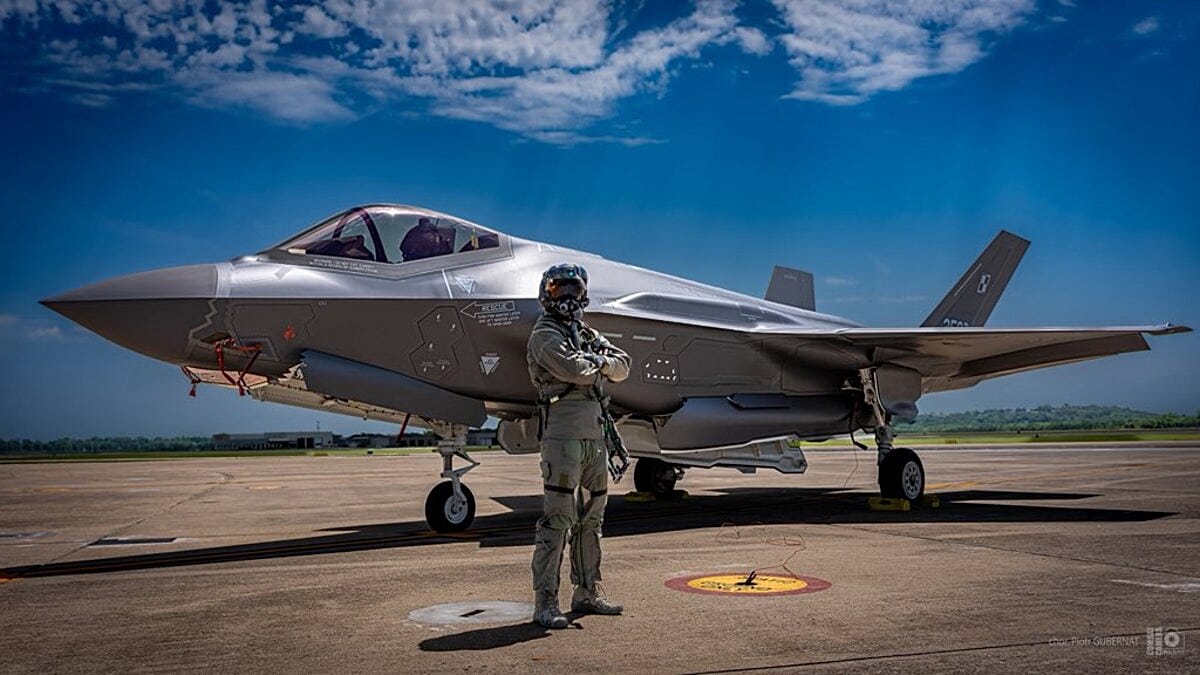
On a crisp morning in late May, the roar of F-35 engines echoed over four Polish cities as the country formally inducted its first three fifth-generation fighters, nicknamed 'Husarz' after the legendary winged cavalry. The ceremonial flypast, dubbed 'Welcome to Poland,' took the jets from the 32nd Tactical Air Base in Łask over Gdańsk, Warsaw, Kraków and Łódź, giving residents a rare close-up view of the most advanced combat aircraft in NATO's inventory.
Deputy Prime Minister and Defence Minister Władysław Kosiniak-Kamysz called the day historic. 'This is the day we have been waiting for for years! Today Poland welcomes its F-35 Husarz,' he wrote on social media. The flypast began at 9:45 am over the Westerplatte peninsula in Gdańsk, site of the first battle of World War II, before proceeding along the Vistula River in Warsaw, past Wawel Hill in Kraków, and over the Lviv Airmen Roundabout in Łódź. The flight also served as a training exercise, with the F-35s escorted by Polish F-16s.
A Technological Leap for Polish Air Power
The F-35, built by US defence contractor Lockheed Martin, is a fifth-generation stealth fighter designed to evade enemy radar and carry out a wide range of missions. Its sensor suite can gather, analyse and relay data to other units in the air, on land and at sea. The aircraft is armed with AIM-120 AMRAAM and AIM-9X Sidewinder air-to-air missiles, as well as long-range AGM-158 JASSM cruise missiles for striking ground targets. Military experts say the introduction of the F-35 marks a qualitative leap for the Polish armed forces and significantly strengthens NATO's eastern flank, particularly given Russia's ongoing war in neighbouring Ukraine.
Poland signed a contract in early 2020 to acquire 32 F-35s, along with a training package and additional engines, for a total of $4.6 billion—roughly $87 million per aircraft. The deal was signed by then-defence minister Mariusz Błaszczak, who attended the induction ceremony. President Karol Nawrocki described the moment as 'historic for the Polish Armed Forces and for our security,' adding that Poland is 'joining the elite group of countries that operate fifth-generation aircraft with unique combat capabilities.' He also highlighted the strong strategic alliance with the United States, especially symbolic in the year marking the 250th anniversary of US independence.
Prime Minister Donald Tusk, speaking at a separate event in Warsaw, noted that the Łask base will become a training centre for pilots of these state-of-the-art aircraft. 'The heroes of Top Gun could well envy our pilots,' he said, adding that one of the Polish pilots had described the F-35 as 'a Porsche next to a Fiat Tipo' compared with older machines.
The first three jets arrived in Łask at the end of May. Defence Minister Kosiniak-Kamysz announced that 11 more aircraft will be delivered in the coming months, with 12 additional jets next year and the remainder by 2029. The F-35s will eventually be based at the 32nd Tactical Air Base in Łask and the 21st Tactical Air Base in Świdwin, both of which are expanding infrastructure, including technical facilities and modern simulators. Full operational capability is expected around 2030, but the jets will gradually take over tasks such as protecting Polish and NATO airspace.
Poland joins a growing list of European nations operating the F-35, including the United Kingdom, Germany, Finland, Norway, the Netherlands, Belgium, Italy, Denmark and the Czech Republic. The aircraft is becoming the backbone of NATO's combat air power, with more than 3,000 delivered or on order worldwide. For Poland, the 'Husarz' represents not just a new weapon system but a strategic statement: a commitment to modernising its military and anchoring the defence of Europe's eastern frontier.