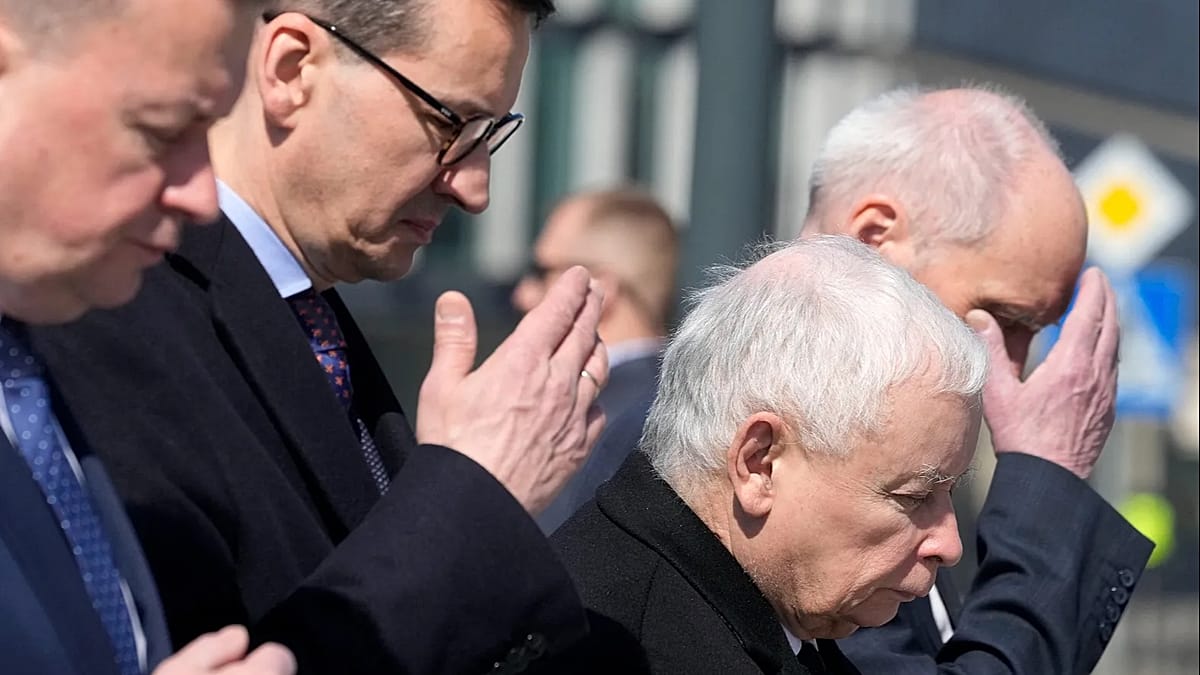
Poland's main opposition party, Law and Justice (PiS), has suffered its most significant internal rupture in over twenty years. Party leader Jarosław Kaczyński announced on Friday that more than 30 members of parliament have left the party, following an escalating power struggle with former Prime Minister Mateusz Morawiecki. The departures mark a decisive break in a party that has dominated the right-wing of Polish politics since its founding in 2001.
The conflict erupted after Kaczyński demanded the dissolution of Rozwój Plus, an internal association created by Morawiecki and his allies. Kaczyński ordered all PiS MPs to sign a declaration pledging not to belong to any internal factions. Morawiecki refused, calling it a “loyalty declaration” with negative historical echoes. He proposed a compromise—stepping down as one of the party's vice-presidents while remaining an ordinary member—but talks collapsed.
Speaking on Friday, Kaczyński confirmed that the final number of resignations was still being tallied. When asked whether Morawiecki himself had left, he replied only: “It's all over.”
Strategic Divergence
The split reflects a deeper disagreement over PiS's future direction after its narrow defeat in the 2023 parliamentary elections. Kaczyński has pushed the party toward a more conservative, nationalist stance, while Morawiecki and his allies argue that PiS should broaden its appeal to centrist and business-oriented voters to improve its chances of returning to power.
Recent opinion polls show PiS still commanding between 19% and just under 30% support, depending on the survey. None of the latest polls give the party enough backing to govern alone, meaning it would need coalition partners to form a government. The fracture could further complicate that calculus.
For Prime Minister Donald Tusk's governing coalition, the breakup of its main rival is a double-edged sword. On one hand, a divided opposition could weaken conservative voters' ability to mount a unified challenge. On the other, a new political force led by Morawiecki could emerge as a powerful centrist-right alternative, potentially reshaping Poland's political landscape into a three-way contest.
Analysts note that Morawiecki's camp, if it forms a separate party, could attract moderate conservatives and business leaders disillusioned with Kaczyński's hardline approach. That would not necessarily benefit Tusk's coalition, as it could siphon votes from PiS without automatically transferring them to the government.
EU Relations Under Scrutiny
The internal crisis comes as Poland's right wing adopts an increasingly confrontational stance toward the European Union. PiS officially denies any desire to leave the bloc, but its leading figures have opposed several flagship EU policies, particularly the European Green Deal and the Emissions Trading System (ETS).
Przemysław Czarnek, a prominent PiS figure and potential candidate for prime minister, has argued that Poland should withdraw from the ETS, claiming the carbon market undermines the country's economic competitiveness. President Karol Nawrocki, who is backed by PiS, has renewed calls for a referendum on EU climate policy. The presidential office says the initiative aims to give voters a direct say, but critics in Tusk's coalition warn it risks fueling anti-EU sentiment and laying the groundwork for a future debate on Poland's membership.
These tensions are unfolding against a backdrop of broader European challenges. Poland's public debt has surpassed €500 billion, as borrowing accelerates to fund social programs and infrastructure. Meanwhile, the country's relationship with the EU remains complex, with ongoing disputes over rule of law and judicial independence.
The PiS split is likely to dominate Polish politics in the run-up to the 2027 parliamentary elections. Whether it weakens the opposition or creates a new dynamic on the right, the fracture signals a period of realignment that could have lasting implications for Poland's political future and its role within the European Union.



