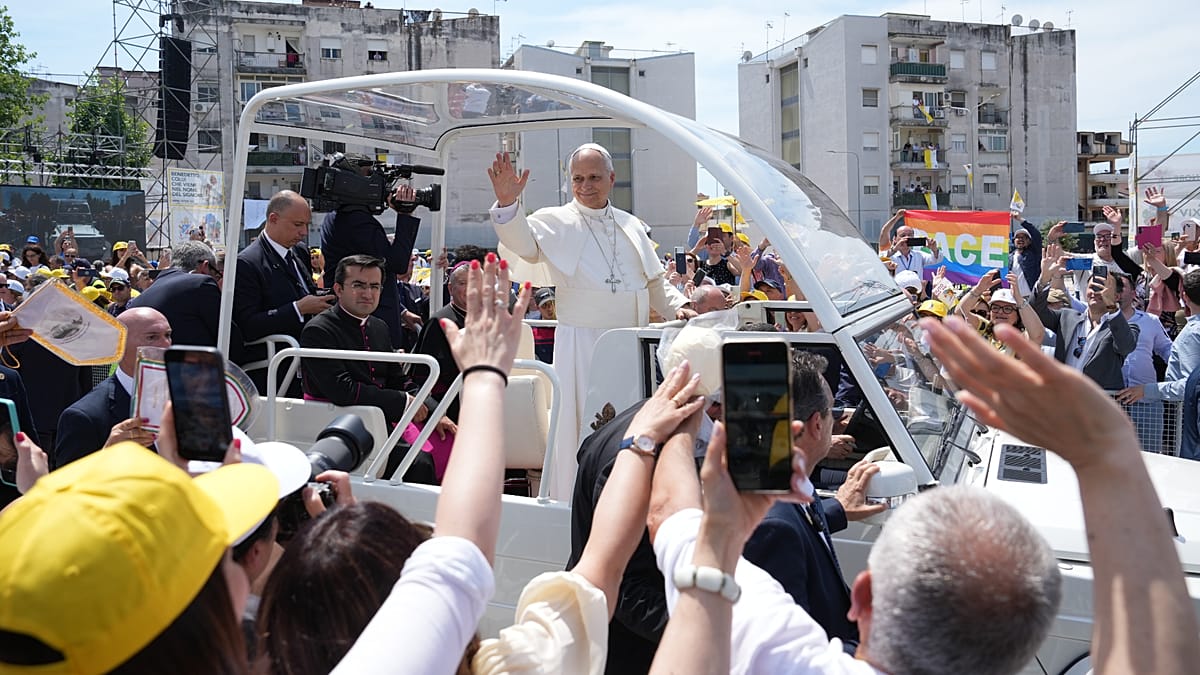
On Saturday, Pope Leo XIV made a pastoral visit to Acerra, a town in the Campania region of southern Italy, to offer comfort to communities living in the Terra dei Fuochi—the 'Land of Fires.' The area, spanning dozens of municipalities near Naples, has been devastated by decades of illegal dumping, burying, and burning of industrial and household waste, leading to severe environmental degradation and public health crises.
Around 15,000 people gathered in Piazza Calipari to welcome the pontiff, who was greeted upon arrival by Undersecretary to the Prime Minister’s Office Alfredo Mantovano. Before entering the Cathedral of Acerra, the Pope spent time with those unable to find space inside due to overcrowding, a gesture that underscored his focus on the marginalized.
A Message of Solidarity and Justice
Inside the cathedral, Pope Leo met with relatives of people who have died from illnesses linked to pollution in the region, where cancer rates and groundwater contamination have risen sharply. He later remarked, “A short while ago, in the cathedral, I met some relatives of the victims of the pollution which, in recent decades, has sadly made this area known as the ‘Terra dei Fuochi’: an expression that does not do justice to the good that exists and endures, but which has certainly helped foster broad awareness of the seriousness of the criminal activity and the indifference that has left room for these crimes.”
The Pope called for a fundamental rethinking of economic and social models, urging a rediscovery of values centered on solidarity and respect for the land. “Let us learn, then, to be rich in a different way: more attentive to relationships, more intent on fostering the common good, more attached to the local area, more grateful in welcoming and integrating those who come to live among us,” he said.
He also addressed the issue of social marginalization, noting that the name Terra dei Fuochi refers to “the fires lit on the edges of cities, sometimes by small, rejected and marginalised minorities of brothers and sisters whom few know or value.” He added, “Marginalisation always breeds insecurity: the steep path is to combat marginalisation, not the marginalised, to break the entire chain, not strike only its last link. You know this well.”
Local Leaders and Civic Resistance
After the cathedral visit, the Pope proceeded to Piazza Calipari, where he was joined by mayors from 90 municipalities in the Terra dei Fuochi, along with thousands of citizens and representatives of environmental civic committees. He expressed hope that the region's “fires” could be transformed into spiritual and social energy. “No longer a fire that destroys, but a fire that revives and warms, the fire of the Spirit that ignites the hearts and minds of thousands and thousands of men and women, of children and of the elderly, and inspires care, consolation, attentiveness and genuine love,” he said.
The bishop of Acerra, Monsignor Antonio Di Donna, recounted the territory’s long ordeal, noting with bitterness that law enforcement had recently uncovered yet another illegal dumping of toxic waste in the Caserta area. The mayor of Acerra, Tito d'Errico, speaking on behalf of all mayors present, highlighted the population’s determination to reclaim their future and thanked national and regional authorities for their efforts. “Ours is a complex territory, with deep wounds inflicted by wrongdoers who have served profit. We endure the suffering of pollution, the tragedy of the fires, and the pain of families. Wounds that call for justice, truth and care. Yet this is not a land of resignation, but of civic resistance and moral redemption, thirsting for profound change,” D'Errico said.
The visit comes amid broader European discussions on environmental justice and the role of communities in combating illegal waste trafficking. Italy has been at the forefront of efforts to address such crimes, with recent initiatives like calls for EU sanctions on related issues, though the focus remains on domestic accountability. The Terra dei Fuochi crisis also echoes challenges faced by other European regions, such as the Mediterranean migration routes, where environmental and human costs intersect.
Pope Leo’s visit underscores the Vatican’s growing engagement with environmental and social issues, aligning with the broader European push for sustainable development and the protection of vulnerable communities. As the region continues to grapple with the legacy of illegal dumping, the Pope’s message of hope and action resonates beyond Italy, highlighting the need for collective responsibility across the continent.