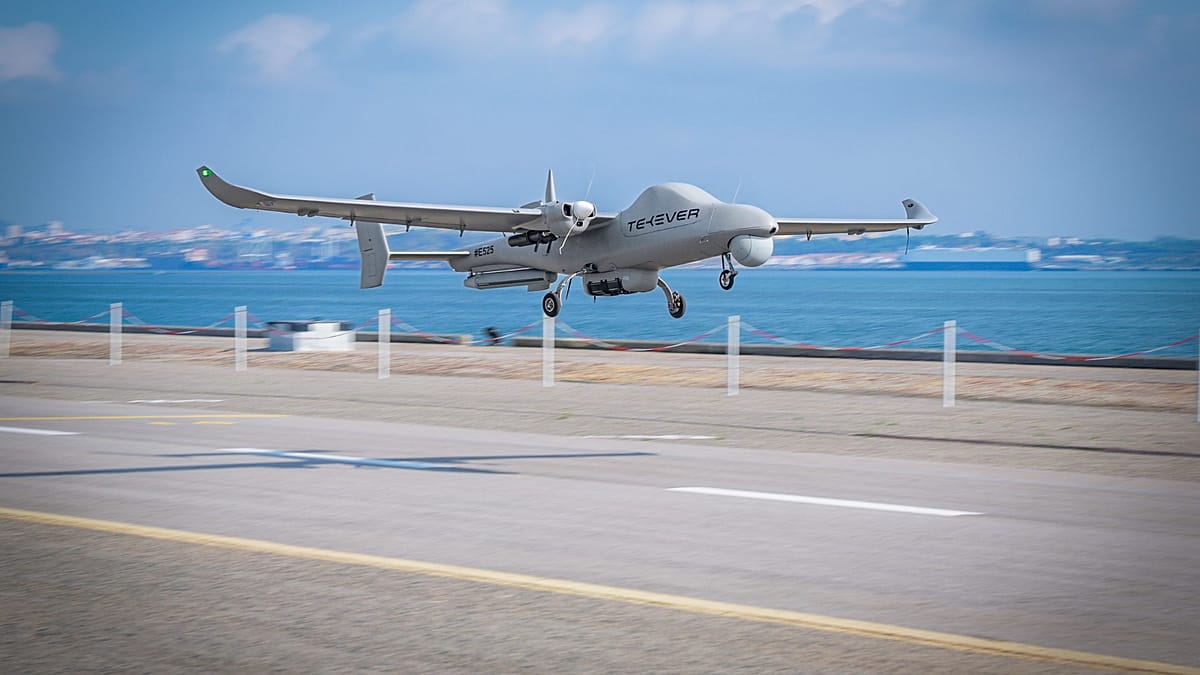
Portugal is strengthening its maritime surveillance capabilities with the acquisition of long-range drones developed and produced domestically. The Portuguese Air Force (FAP) has signed a contract with Tekever, a Lisbon-based technology firm, for the delivery of AR5 unmanned aerial systems, scheduled for early September.
The agreement, announced by Tekever, includes not only the aircraft but also operator training, a Ground Control Station, and the ATLAS mission system. The AR5, with a wingspan of nearly eight metres and a take-off weight close to 200 kilogrammes, is designed for maritime operations, offering robustness and the ability to operate at higher altitudes. This will enable the FAP to extend its operational reach on long-range missions, including maritime surveillance, security and defence, monitoring of Portugal's Exclusive Economic Zone (EEZ), and support for public-interest missions such as the Special Rural Firefighting Device (DECIR), coastal security, and environmental protection.
Training and operational readiness
In the first phase, Tekever will train Air Force personnel until September to ensure they can operate the systems immediately upon delivery. A second phase of training will follow from October, aimed at consolidating full operational readiness and developing new skills within the operating teams.
The financial details of the contract have not been disclosed by Tekever. However, a Ministry of Defence order from November last year authorised the Air Force to procure an unmanned aerial system for maritime patrol with a maximum budget of just over €7.79 million, funded through the Military Programming Law.
Lieutenant Colonel Luís Henriques, Operational Coordinator of the AR5 Working Group of the Portuguese Air Force, said in a statement that "the integration of the AR5 system represents a significant improvement in the operational capabilities of the Portuguese Air Force." He added that the platform "meets current surveillance, security and defence requirements, offering greater range, endurance and operational flexibility," and that its integration "will strengthen the nation's ability to monitor the Exclusive Economic Zone and support a wide range of missions in the public interest, contributing to an Air Force better prepared to respond to current and future challenges."
Pedro Petiz, Director of Strategic Development at Tekever, highlighted the national dimension of the deal: "This contract puts an autonomous capability developed and produced in Portugal to work protecting the country's airspace and maritime territory." He also noted that beyond supplying the aircraft, Tekever will collaborate with the Air Force to consolidate its own operational capability, "which will strengthen national autonomy, readiness and responsiveness."
The AR5 is described by Tekever as a fixed-wing unmanned aerial system, medium-altitude and long-endurance, designed for information-gathering missions over large areas. With a flight endurance of up to 20 hours and a payload capacity of up to 50 kilogrammes, the system incorporates satellite communications (SATCOM), enabling operations beyond radio line-of-sight (BRLOS).
Tekever's systems have accumulated thousands of flight hours in coastal patrols, persistent surveillance, border protection, detection of suspicious activities, environmental protection, and search-and-rescue missions. The company has secured contracts with various national and international entities, including the UK Home Office and the European Maritime Safety Agency (EMSA). Its drones are also currently deployed in Ukraine, where they conduct surveillance and reconnaissance missions in an operational environment.
This procurement underscores a broader trend among European nations to invest in indigenous unmanned capabilities, reducing reliance on foreign suppliers. For Portugal, the AR5 acquisition not only enhances its ability to monitor its vast maritime domain but also supports the domestic high-tech sector, aligning with EU efforts to bolster strategic autonomy in defence and security.