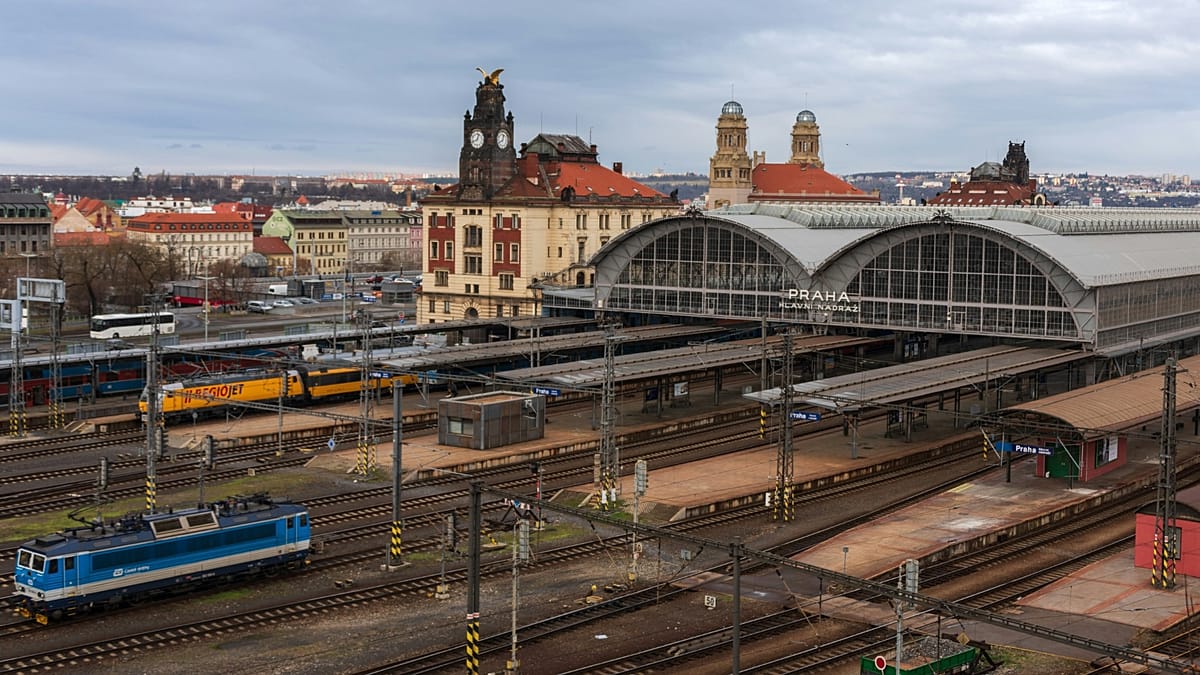
After more than a decade without a direct connection, travellers can once again board a train in Prague and ride all the way to Copenhagen without changing trains. The new service, launched on 1 May, links the Czech capital with Hamburg and the Danish capital via Berlin and Dresden, offering a seamless alternative to flying between three of Europe’s most visited cities.
Czech Railways (ČD) is operating two daily return services from Prague’s Hlavní Nádraží to Hamburg. One of those services continues onward to Copenhagen, making the full journey in just over 13 hours. The trains reach speeds of up to 230 km/h, keeping travel times competitive with air travel when factoring in airport transfers and security checks.
Year-round and seasonal departures
Trains depart Prague at 6:30 and 10:30 year-round. During the summer season, an additional 4:30 pm departure will be added, giving tourists and business travellers more flexibility. The route is jointly operated by ČD, Deutsche Bahn (DB), and Denmark’s Danske Statsbaner (DSB). Its launch was made possible by the completion of overhaul work on the Berlin–Hamburg line.
The new link is among the first ten pilot projects backed by the European Commission, which aims to promote new cross-border train routes, improve international mobility, and address long-standing issues such as infrastructure bottlenecks and market barriers. Apostolos Tzitzikostas, the EU’s commissioner for sustainable transport and tourism, called the Prague–Copenhagen connection “a strong example of progress” toward a more connected and greener Europe.
ComfortJet trains raise the bar
ČD’s recently launched ComfortJet trains can carry up to 555 passengers and come equipped with an on-board restaurant, Wi-Fi, bicycle storage, and a children’s cinema. They also feature wheelchair lifts and radio-transparent windows that improve mobile connectivity for passengers. The Prague–Hamburg leg takes six hours and 41 minutes.
“Rail is bringing Europe closer and closer together,” said Michael Peterson, DB’s board member for long-distance passenger transport. “Journey times of over four hours are popular with our passengers in international long-distance transport, and we are offering additional attractive services to meet the growing demand.”
The new route follows the recent launch of DB and SNCF’s Berlin–Paris service and precedes a Munich–Milan–Rome itinerary scheduled for December. For travellers seeking to explore Europe by rail, the Prague–Copenhagen connection adds a convenient option that avoids the hassle of airports. For those interested in other scenic train journeys, new vintage luxury train routes across Europe for 2026 offer another way to see the continent in style. And for nature lovers, four European national parks accessible by train provide easy access to Alpine peaks and coastal creeks.
The revival of this direct link underscores a broader trend: European rail networks are slowly but steadily knitting the continent closer together, one cross-border route at a time.