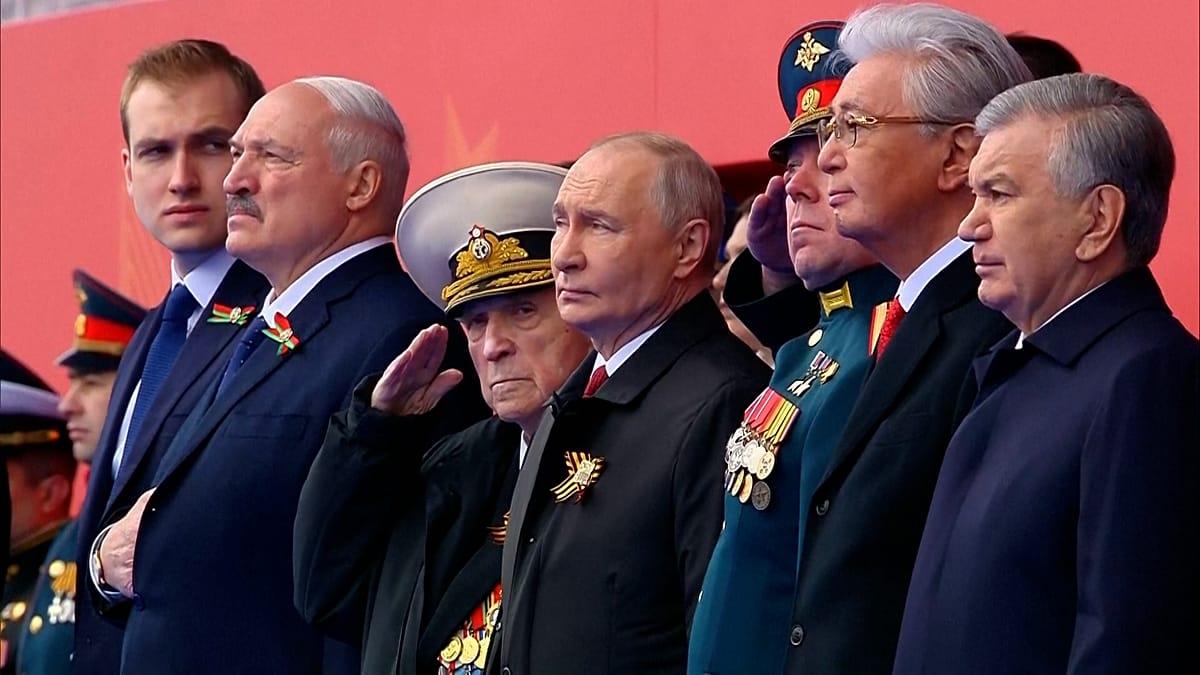
On 9 May, Russian President Vladimir Putin presided over the annual Victory Day military parade in Moscow's Red Square, an event that commemorates the Soviet Union's defeat of Nazi Germany in 1945. This year's parade took place under notably tight security, reflecting the heightened tensions surrounding Russia's full-scale invasion of Ukraine, now in its third year.
The ceremony kicked off shortly after 10:00 am local time with a formation of soldiers carrying the Russian flag into the square, followed by a display of military hardware and a flyover by Russian aircraft. Putin, who has used previous Victory Day speeches to frame the war in Ukraine as a continuation of the struggle against Nazism, delivered remarks that were closely watched for any signals on the conflict's trajectory.
While the Kremlin portrays the event as a unifying national celebration, it has become a focal point for criticism from European capitals and human rights groups. The European Union has repeatedly condemned Russia's actions in Ukraine, and the parade occurs against a backdrop of ongoing EU sanctions and diplomatic isolation of Moscow. In recent months, the EU has targeted Russian officials over the forced deportation of Ukrainian children, a policy that has drawn widespread international condemnation.
Security and Symbolism in Central Moscow
Moscow authorities implemented extensive security measures for the parade, including restrictions on public gatherings and heightened police presence across the city. These precautions are partly a response to drone attacks on Russian soil, including a recent Russian drone barrage that hit a residential area in Kharkiv, underscoring the war's reach beyond the front lines.
The parade also serves as a platform for Russia to project military strength, though analysts note that the display of hardware has been scaled back compared to pre-2022 years, partly due to equipment losses in Ukraine. The event was broadcast live on state television, with patriotic music and commentary framing it as a moment of national pride.
For European observers, Victory Day carries complex connotations. While many EU member states also commemorate the end of World War II on 8 May, Russia's celebration on the 9th has become increasingly politicised since the invasion of Ukraine. The war has deepened divisions between Russia and Europe, with countries like Sweden and Finland joining NATO, and the EU remaining divided over direct talks with Moscow on a peace settlement.
Outside Russia, the parade has prompted protests and counter-events. In Venice, activists from Pussy Riot and FEMEN recently protested Russia's return to the Venice Biennale, highlighting the cultural fallout of the war. Meanwhile, the EU continues to impose sanctions on Russian officials and entities linked to the conflict, though enforcement remains a challenge, as seen in the recent arrest of two individuals in Sweden suspected of exporting industrial goods to Russia's military sector.
Putin's address at the parade did not announce any major policy shifts, but it reinforced the Kremlin's narrative that Russia is defending itself against Western aggression. This framing has little traction in European capitals, where leaders view the war as an unprovoked act of aggression. The parade thus remains a stark reminder of the chasm between Russia's self-image and its perception abroad.