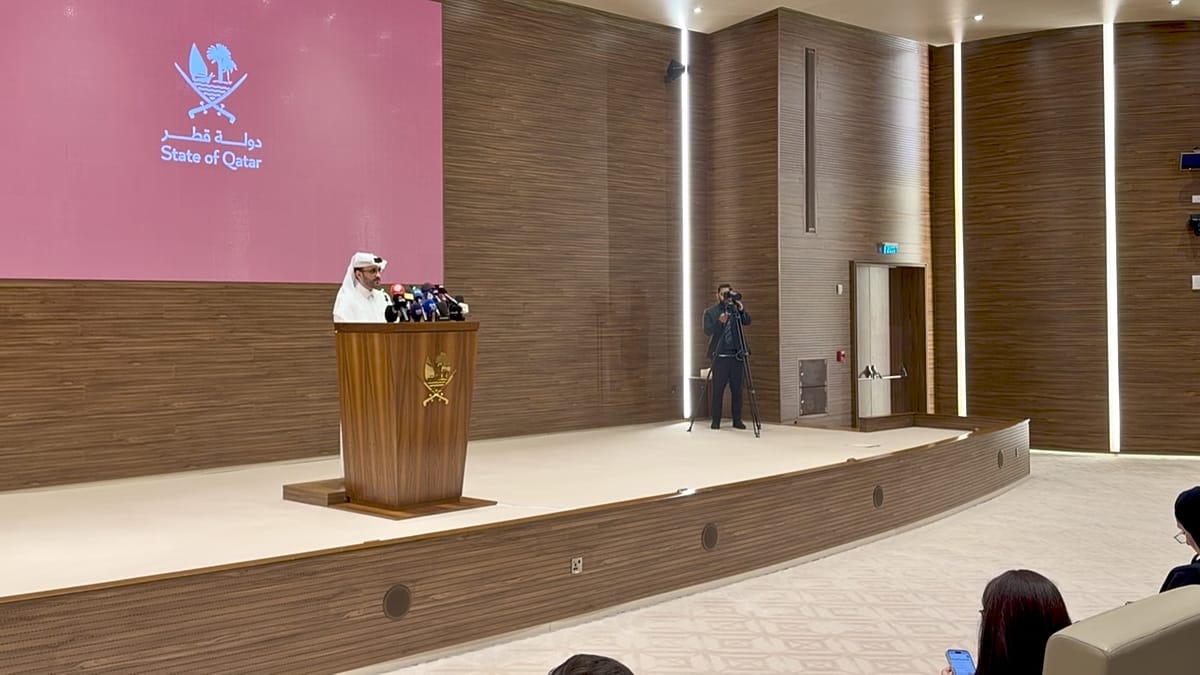
Qatar has expressed cautious optimism about the framework agreement between the United States and Iran, set to be signed in Geneva on Friday, but stressed that it marks only an initial step toward regional stability rather than a comprehensive settlement. Speaking at his weekly briefing in Doha on Tuesday, foreign ministry spokesperson Dr Majed Al Ansari said the deal should be viewed as a foundation for further negotiations, not a final resolution.
“We are cautiously optimistic,” Al Ansari told reporters. “We are on the right track towards regional security. Obviously, there are a lot of challenges coming ahead, but let’s take this as a moment to enjoy some optimism.”
The framework deal, announced by both sides on Sunday, is expected to include the reopening of the Strait of Hormuz, a critical chokepoint for global energy supplies that has been disrupted for months. Al Ansari confirmed that normal navigation through the waterway would resume, allowing Qatar to continue supplying liquefied natural gas (LNG) and easing pressure on international energy markets. However, he cautioned that a return to “business as usual” in the Gulf region is not imminent.
“Regarding business as usual, I don’t think there’s anything that can be described as usual in the region post this conflict,” Al Ansari said. “These are issues that have plagued the region for decades. They will not be resolved in mere days.”
Trust and the Long Road Ahead
The spokesperson emphasized that the real work begins after the signing ceremony. “We have to find the new norm, which will include a lot of rebuilding of trust, rebuilding of communication channels, and understanding exactly how the post-war region will look,” he explained. Qatar’s caution is rooted in recent experience: Tehran has targeted Qatar and other Gulf states with missile and drone attacks following the initial US-Israeli strikes on Iran in February. Although a ceasefire was reached on 8 April, Iran has continued sporadic bombardments against its neighbours.
Doha has positioned itself as a key mediator in the conflict, a role that has drawn praise from Washington. During a bilateral meeting with Qatar’s Emir, Sheikh Tamim bin Hamad Al Thani, on the sidelines of the G7 summit in Évian-les-Bains on Tuesday, US President Donald Trump lauded Qatar’s efforts. “We are very, very impressed with Qatar and the way they handled things,” Trump said, opening the meeting by telling the emir, “You’ll always be my friend.” Sheikh Tamim thanked Trump for his leadership but cautioned that the ceasefire agreement, while “a very important deal,” still requires substantial follow-through.
Al Ansari affirmed Qatar’s commitment to supporting the peacemaking process led by Pakistan, which has played a central role in facilitating talks between Washington and Tehran. “In Qatar we don’t take lightly our responsibility towards regional security,” he said, pledging continued efforts to prevent further hostilities.
The framework deal comes at a time of heightened diplomatic activity, with the G7 leaders gathering in Évian to discuss the agreement and its implications for global stability. For European observers, the reopening of the Strait of Hormuz is particularly significant, as it directly affects energy supplies to the continent. Qatar’s LNG exports, which flow through the strait, are a vital component of Europe’s energy diversification strategy, especially after the disruption of Russian gas supplies.
Despite the cautious optimism, Al Ansari warned that the path to lasting peace remains fraught with obstacles. “We have to find the new norm,” he reiterated, underscoring the need for sustained dialogue and confidence-building measures. The signing on Friday will be a milestone, but as Qatar’s experience shows, it is only the beginning of a long and uncertain journey.