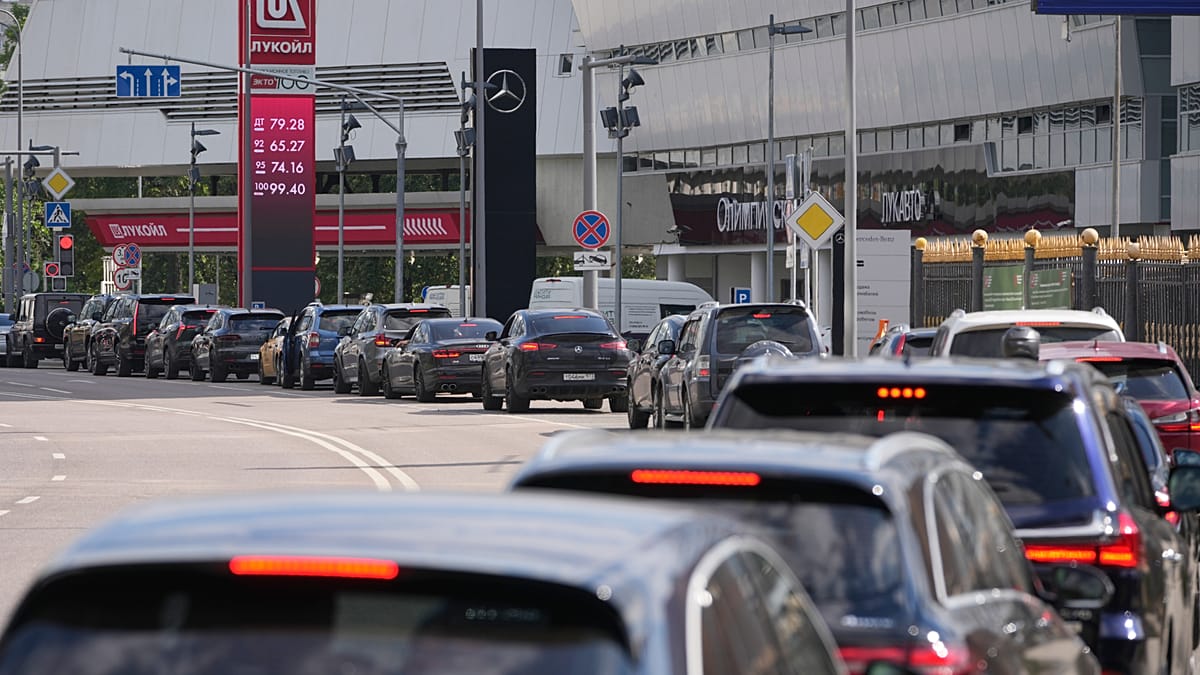
Russia has introduced a ban on diesel exports as the Kremlin scrambles to contain a deepening fuel crisis at home, largely driven by sustained Ukrainian attacks on its oil infrastructure. The measure, announced by Deputy Prime Minister Alexander Novak during a government meeting with President Vladimir Putin on Wednesday, aims to redirect supplies to the domestic market.
“A ban on diesel fuel exports has been introduced today,” Novak said. “This will enable us to increase supplies to the domestic market in July.” The ban is set to remain in force until 31 July, though the Kremlin later clarified that it does not apply to diesel exported under existing international government agreements.
The crisis stems from a series of Ukrainian drone and missile strikes targeting Russian oil refineries, depots, and terminals. Kyiv has intensified these operations in recent months, seeking to disrupt the logistical backbone of Russia’s war effort. The attacks have caused fuel shortages and sharp price increases in several regions, with motorists in parts of Russia and Russian-occupied territories queuing for hours at petrol stations.
Novak described the situation as “challenging” and acknowledged that the petrol station issue was “causing concern” among locals. To stabilise the market, he said the government has also ordered existing refineries to operate at maximum capacity and has shortened or rescheduled maintenance work.
Ukrainian Strikes Deepen Pressure on Russian Energy Sector
On Wednesday, Ukrainian President Volodymyr Zelenskyy posted video footage on social media showing the aftermath of a strike on the Saratov oil refinery in southwestern Russia. Ukraine’s Main Directorate of Intelligence confirmed it carried out the attack alongside security services and border guards, stating that “the facility is listed among the aggressor state’s key oil refineries and continuously supplies the Russian army with fuel.”
This is not an isolated incident. In recent weeks, Ukraine has hit refineries as far east as Omsk, over 2,500 kilometres from the border, demonstrating a growing reach. The cumulative effect has been a significant reduction in Russia’s refining capacity, forcing Moscow to prioritise domestic consumption over lucrative export markets.
The diesel export ban is a blunt instrument that underscores the severity of the supply crunch. European markets, which have already weaned themselves off Russian diesel since the full-scale invasion of Ukraine in 2022, are unlikely to feel immediate pain. However, the move could tighten global diesel supplies, particularly if Russia diverts volumes that would otherwise have gone to Africa, Asia, or the Middle East.
Meanwhile, the war continues to inflict reciprocal damage. On Thursday, Russian strikes left parts of the southern Ukrainian port city of Kherson without electricity, according to local authorities. The blackout is a reminder that both sides are locked in a cycle of energy infrastructure attacks that exact a heavy toll on civilians.
The European Union has watched these developments with concern. While the bloc has largely eliminated its dependence on Russian oil and diesel, the broader implications for global energy markets and the stability of Europe’s eastern neighbourhood remain significant. The EU has already taken steps to tighten sanctions on Russia’s energy sector, though internal divisions have sometimes slowed progress. For instance, EU Scales Back Visa Ban for Russian Combatants After French and Italian Objections highlights the delicate balancing act between collective resolve and national interests.
As the war grinds on, the diesel ban is likely to be a temporary fix rather than a lasting solution. Russia’s refining capacity is under sustained pressure, and the Kremlin’s ability to maintain fuel supplies for both its military and civilian population will depend on how effectively it can protect remaining infrastructure and repair damaged facilities. For now, the queues at Russian petrol stations are a stark symbol of how the conflict is increasingly hitting home.