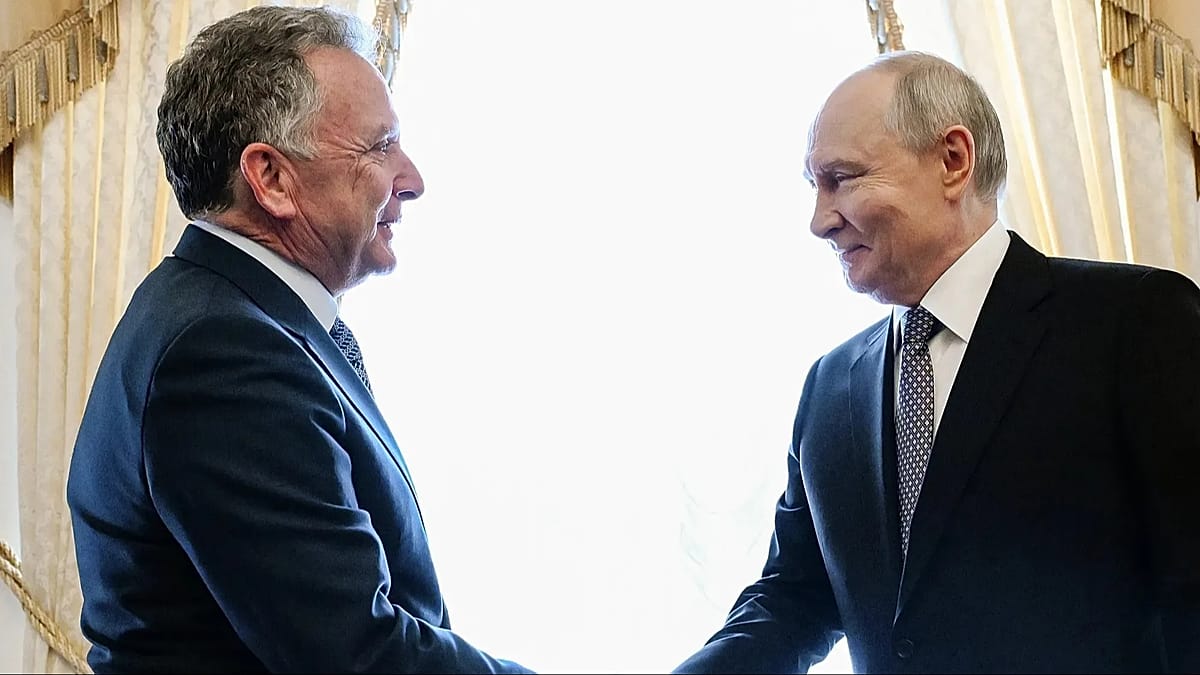
Russia released retired American teacher Stephen Hubbard on Wednesday, days after US President Donald Trump said he had urged President Vladimir Putin to free him. The release came during a visit by US envoy Steve Witkoff to St. Petersburg, where he met Putin and thanked him directly: “Because of you, he's going home to his family.”
Hubbard, a 72-year-old from Michigan, had been held since 2022 on charges that he fought as a mercenary alongside Ukrainian forces after Moscow's full-scale invasion. He was sentenced to nearly seven years in prison following a closed-door trial in 2024. Hostage Aid Worldwide, a group that advocates for detained Americans, has called the charges bogus.
The White House said that, unlike in previous releases, the US did not have to give up anyone in return. Hubbard is the second American released by Russia in roughly two months, following the August release of former US Marine Robert Gilman, who had been seriously ill and was jailed on contested charges of assaulting a police officer.
According to the Foley Foundation, a hostage advocacy group, around two dozen Americans are still being held in Russian prisons for various reasons. The release coincided with Witkoff's visit, which came as Trump has taken several steps favourable to Moscow, amid growing tensions between Washington and Kyiv.
A pattern of releases and unresolved cases
The release of Hubbard fits a pattern of occasional US-Russian prisoner swaps, often brokered during high-level visits. Witkoff, who has made multiple unsuccessful trips to Russia to negotiate a settlement in the war in Ukraine, was in St. Petersburg for talks with Putin. His visit followed a meeting with Ukrainian President Volodymyr Zelenskyy, which he described as “positive.”
While the release was welcomed by Hubbard's family and supporters, it also highlights the precarious situation of other Americans detained in Russia. The Foley Foundation's count includes journalists, businesspeople, and tourists, some of whom have been held for years on charges that Washington and human rights groups say are politically motivated.
The Biden administration had classified Hubbard as wrongfully detained, a designation that signals the US government's view that his imprisonment was not based on legitimate legal grounds. That classification has been maintained by the Trump administration, according to officials.
Hubbard's case drew attention because of his age and his background as a teacher who had lived in Ukraine for years. His family said he had remained in the country after the invasion, and they denied he had ever taken up arms.
The release comes at a delicate moment in transatlantic relations. Trump's overtures to Moscow have alarmed European allies, who fear that Washington may be willing to make concessions on Ukraine that would undermine European security. A former US general recently argued that Trump is siding with Russia against Ukraine, a view echoed by several European diplomats.
Meanwhile, the EU has been stepping up its own engagement in the region, including a new Arctic strategy that shifts focus to security amid Russian and Chinese activity. The release of Hubbard, while a humanitarian gesture, does little to ease the broader tensions between Moscow and the West.
For now, Hubbard's family is celebrating his release, but the fate of other Americans remains uncertain. The Foley Foundation continues to press for their return, and Witkoff's visit may have opened a channel for further negotiations. However, as long as the war in Ukraine grinds on, the prospects for a broader rapprochement remain slim.