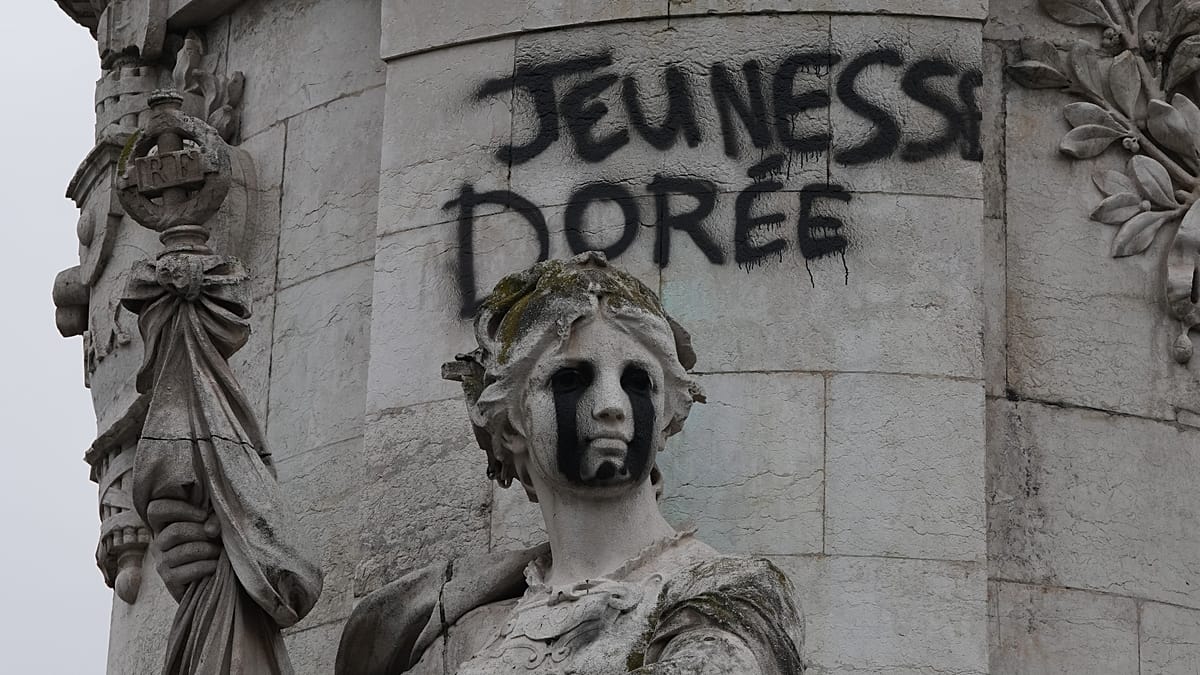
French and Italian ministers have accused foreign powers of using social media to fuel riots across Europe, but the European Commission says there is no conclusive evidence to back up those claims. The accusations have put Brussels in a difficult position, as national governments press for action against suspected disinformation campaigns while the EU executive insists on proof.
At an OECD-hosted conference last week, French Foreign Minister Jean-Noël Barrot said that "the battleground for democracy has expanded into new areas via social media," and that "forces seeking to undermine democracy now dominate the information landscape, deploying tactics designed to polarise public debate." He specifically mentioned that the high school student protests in France were "exploited by hostile narratives emanating from Russia, China, Iran, and the MAGA community," adding: "We see them, we denounce them, and we respond."
Italian Defence Minister Guido Crosetto echoed that sentiment at a conference on Tuesday, describing the unrest in Milan and elsewhere as "profoundly different from those experienced in other eras" and the result of a "hybrid war" waged by unnamed adversaries using "unconventional tools such as TikTok, social media, YouTube."
But behind the scenes, EU officials are more cautious. One official with direct knowledge of the matter told Euronews on condition of anonymity: "We don't have any information or definitively not final confirmation that foreign information manipulation is behind the events in France and elsewhere."
Brussels holds back
The European Commission has so far resisted calls to launch a formal investigation under the Digital Services Act (DSA), despite pressure from national regulators like Arcom in France and AGCOM in Italy. Those regulators have an extensive toolbox to tackle disinformation, and they coordinate closely with the Commission, which last met them on Tuesday. But the EU executive says there is insufficient evidence to justify a formal probe.
Commission spokesperson Thomas Regnier said: "It is a situation that is happening at national level, and the Commission is definitely ready to assist and to support the national authorities. Let first the French authorities carry out their work. We are ready to assist where we can assist."
The DSA also includes a crisis response mechanism that could be triggered in the event of a serious threat to public security or public health, giving the Commission emergency powers over online platforms. So far, there has been no move to activate it.
The gap between public accusations and available evidence is widening. While ministers in Paris and Rome speak of foreign manipulation, law enforcement agencies are focusing on identifying those involved in the vandalism and looting. In France, looters have tried to sell stolen goods on second-hand marketplace Vinted, and police have asked the platform to help identify the perpetrators.
There is evidence that Russia-linked disinformation networks, including those behind Operation Overload and Doppelgänger, have seized on the violence to amplify their online campaigns. However, unlike in the Ceuta migration crisis this summer, when there was extensive evidence that thousands of people were mobilised by false information circulated online, the protests in France, Italy, and elsewhere appear so far to have been exploited by foreign manipulators rather than driven by them.
As the unrest continues, the question remains whether national governments are too quick to blame foreign disinformation for protests rooted in domestic political grievances. The deployment of 500 troops to Milan and plans to deploy soldiers in France suggest that authorities are taking the situation seriously, but the evidence for foreign orchestration is still lacking.
In the meantime, the European Commission is treading carefully, balancing the need to support member states with the obligation to act only on solid evidence. As one EU official put it, the situation is being monitored, but no formal action is imminent.