Russia's parliament approved a sweeping new law on Wednesday that freezes bank accounts, seizes property, and blocks consular services—including passport renewals—for Russian citizens living abroad who are evading criminal prosecution at home. Legal experts say the cumulative effect amounts to a de facto revocation of citizenship for political exiles.
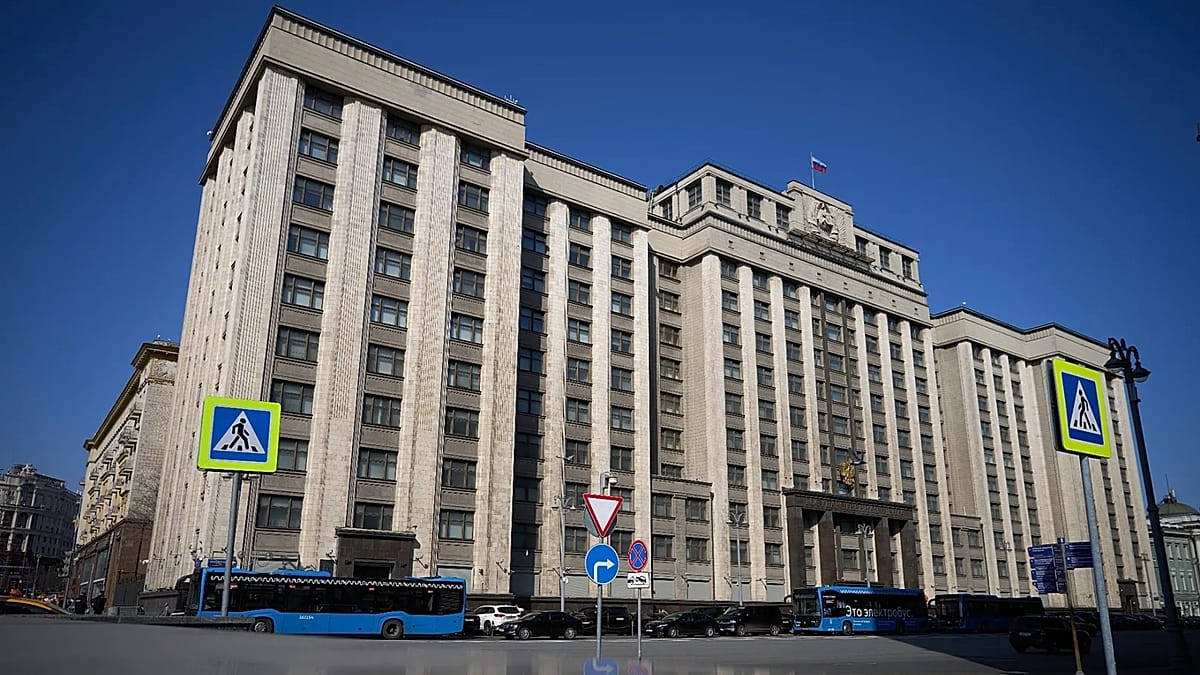
The State Duma passed the bill in its second and third readings in a single session. Speaker Vyacheslav Volodin made no effort to conceal the law's intended targets. "We are talking about those who harm our country," he said before the vote. "About extremists, traitors to our homeland. Those who for years have tried to do everything to destroy our state."
Under the legislation, Russians abroad who are evading prosecution will face a cascade of restrictions inside Russia: bank accounts will be frozen, property and vehicles cannot be sold, licences and accreditations will be suspended, banking app access will be blocked, and state and consular services—including the right to obtain an international passport or have documents such as wills and powers of attorney certified—will be refused.
The law also applies to Russians who have already been sanctioned administratively for violations of Russia's foreign agents law, for calling for sanctions against Russia, for calls to violate Russian territorial integrity, for discrediting the armed forces, or for involvement in organisations Russia has designated as undesirable. The law takes effect upon official publication with no transition period.
De facto loss of citizenship
Lawyers from the First Department, an open community of Russian legal professionals and human rights defenders, said the cumulative effect amounted to "de facto deprivation of citizenship." "A person who left for political reasons and has been recognised as 'evading' acquires the status of an internally 'cancelled citizen'," the group said in an analysis. "Everything connected with the Russian Federation—property, accounts, business, consular services—can be used against them, while they themselves are practically deprived of any opportunity to use this in their own interests."
Independent human rights media project OVD-Info said those at greatest risk included people on Russia's foreign agents register, defendants in criminal or politically motivated administrative cases, political activists, journalists, lawyers, and participants in projects or organisations that the Kremlin has labelled as "extremist," "undesirable," or "terrorist."
From the full-scale invasion of Ukraine in February 2022 to September 2025, at least 692 people faced criminal prosecution under the "false information" and "discreditation" laws alone, according to OVD-Info. Russia's communications regulator simultaneously ordered media outlets to stop using the words "war," "invasion" or "assault," a directive that prompted the closure or self-imposed suspension of most remaining independent Russian media.
Estimates of the number of Russians who left the country in the first year after the full-scale invasion range from 500,000 to over 1 million. Wednesday's law is designed to extend the state's reach into that population, many of whom now reside in EU member states such as Germany, Poland, the Baltic states, and the Czech Republic, as well as in the UK, Switzerland, and the Balkans.
The law is the latest in a sustained expansion of Russia's legal toolkit for suppressing dissent that began before the full-scale invasion but has dramatically accelerated since February 2022. In the first week of the war, the State Duma passed two key laws: one criminalising the spread of "knowingly false information" about the armed forces, carrying a sentence of up to 15 years, and another making "discrediting" the army a criminal offence, with penalties rising to five years for first-time offenders.
Russia's foreign agents law, originally passed in 2012, has been repeatedly amended since 2022 to allow authorities to designate individuals, not just organisations, as foreign agents, which carries wide-ranging restrictions on public life, banking and travel. Russian authorities had blocked more than 25,000 websites by mid-2025, a figure that represents only a fraction of the total content removed since February 2022.
The European Union has responded to Russia's crackdown with successive sanctions packages, most recently the 21st package, which faced delays over Greek objections to LNG imports. The EU has also imposed sanctions on individuals involved in the repression of dissent, including judges and prosecutors. For more on the EU's response, see EU Adopts 21st Russia Sanctions Package After Greece Wins LNG Exemption.
As the Kremlin tightens its grip on dissent both at home and abroad, the new law effectively creates a category of "cancelled citizens"—Russians who, while still holding passports, are stripped of the rights that citizenship normally confers. For the hundreds of thousands of Russians now living in Europe, the law signals that Moscow's reach extends far beyond its borders.