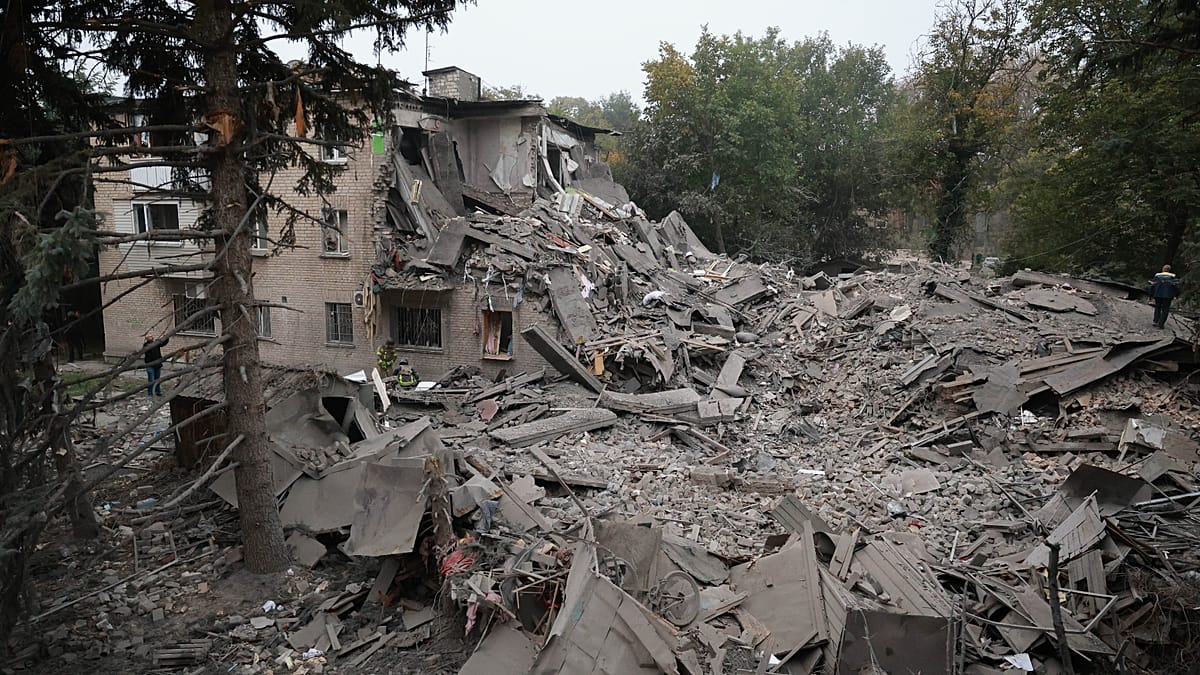
At least eight people, among them three children, were killed on Saturday when Russian guided bombs struck residential districts of the southeastern Ukrainian city of Zaporizhzhia, according to local authorities. The attack, which unfolded in the early hours, also left 16 people wounded and triggered an ongoing search-and-rescue operation.
Ivan Fedorov, the regional governor, said in a Telegram post that two of the injured were in critical condition, while most others were in a moderate state. “Medical staff are doing everything they can to help everyone,” he wrote, adding that 12 people remain unaccounted for.
Ukraine’s national police reported that Russian forces launched five guided aerial bombs at the city, with two of them slamming into apartment blocks. The State Emergency Service said one bomb “completely destroyed the entrance to a three-storey block of flats” and damaged surrounding buildings and private homes. Firefighters extinguished the ensuing blaze and continued to clear rubble through the day in the hope of finding survivors.
Overnight drone barrage across Ukraine
The assault on Zaporizhzhia came as part of a broader Russian campaign. Ukraine’s air force said Moscow launched 160 drones overnight, targeting multiple regions. By 9:00 am, air defences had shot down or neutralised 117 UAVs, including Shahed-type drones, Gerber drones, and other models, with strikes recorded at 14 locations across the country.
The renewed aerial pressure follows a pattern of escalating Russian attacks on Ukrainian cities and infrastructure, raising concerns about the sustainability of Western support. As the conflict grinds on, European capitals are wrestling with how to balance military aid, economic sanctions, and diplomatic efforts. A recent analysis highlights the limits of EU support as Russia intensifies its assault.
Zelenskyy hits out at US diesel deal
The strikes came on the same day that Ukrainian President Volodymyr Zelenskyy sharply criticised a US announcement of a deal to purchase Russian diesel. US President Donald Trump said on Friday that he had “concluded a highly successful discussion with President Vladimir Putin” and that Russia would “immediately supply over 300,000 tons of diesel fuel to the American and global marketplace,” with more to follow.
Zelenskyy responded on X, warning that “gifts to Putin will not bring peace or any benefit to the civilized world.” He argued that “allowing Russia to sell petroleum products is an investment in a war that must be ended, not prolonged,” and called for “real de-escalation with Russia on a reciprocal basis.”
The deal has drawn criticism from European officials and analysts who see it as undermining the sanctions regime and providing Moscow with much-needed revenue. The US decision to import Russian diesel is likely to complicate transatlantic unity on Ukraine policy, especially as the EU has pledged to phase out Russian energy imports. Recent data shows that the bloc still spent €7.9 billion on Russian Arctic LNG despite its phase-out pledge, underscoring the challenges of decoupling.
Meanwhile, diplomatic efforts to broker a ceasefire have shown little progress. Talks in Miami aimed at a partial truce have stalled, with Ukraine bracing for a difficult winter. The Miami talks have yet to yield concrete results, and the latest strikes suggest Moscow is not inclined to de-escalate.
As rescue workers in Zaporizhzhia sift through the debris, the human cost of the war continues to mount. For many Ukrainians, the promise of Western support rings hollow when faced with nightly bombardments. The international community, and Europe in particular, faces a stark choice: to stand firm against Russian aggression or to accept a creeping normalisation of violence.



