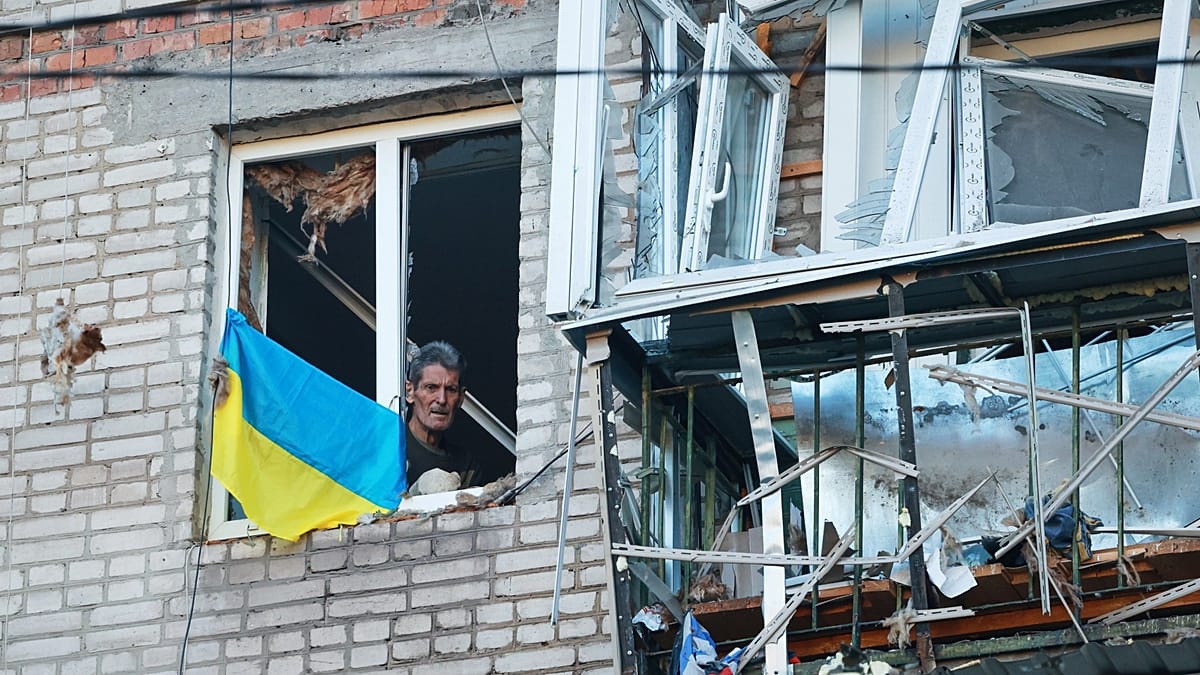
Brussels is waking up to an uncomfortable reality: its multibillion-euro support for Ukraine, however generous, may no longer be enough. Russia's recent escalation—an unrelenting barrage of ballistic missiles and drones—has crippled Ukrainian infrastructure, drained air defences, and pushed the country's finances to the brink.
“This war will last longer than we thought,” a European diplomat admitted, speaking on condition of anonymity. “There's a realisation that needs will continue to present themselves, but it's not yet clear how this will be addressed.” Another diplomat insisted that the EU must “send a clear message that the EU won't change its position and will double down on its support for Ukraine and pressure on Russia.”
The scale of destruction is staggering. In recent days, Russian strikes have hit railways, bridges, cargo vessels, power stations, data centres, warehouses, medical centres, schools, and kindergartens. Even the National Academy of Sciences has not been spared. A glide bomb attack on Kramatorsk killed more than 30 people as two public buses caught fire. On Thursday, Kyiv was plunged into darkness—a grim preview of what may be the harshest winter of the war.
Ukrainian President Volodymyr Zelenskyy called it “terror against people and life. And it is important that leaders do not ignore what is happening.” European Commission President Ursula von der Leyen condemned the attacks as “pure and simple: these are war crimes.”
The economic toll is equally severe. The endless drone waves disrupt daily life, force businesses to close, raise material costs, and erode profits. Russia's Black Sea blockade prevents Ukrainian farmers from exporting grain, cutting off a vital revenue stream. As deadly strikes continue in Donetsk, the country's war-battered economy is buckling under the strain.
A funding gap that keeps growing
The deterioration raises serious questions about the viability of the EU's support programmes, notably the €90 billion loan agreed last year to cover two-thirds of Ukraine's needs for 2026 and 2027. That loan was designed on the assumption that the war would end sometime this year. Russia's escalation all but guarantees it will not.
Ukraine's Finance Minister Sergii Marchenko has warned that the 2027 budget will be the most complicated since the full-scale invasion began. He has urged international donors to fill a staggering $78 billion (€70 billion) gap. The European Commission has refrained from endorsing that headline figure, which vastly exceeds the €45 billion it plans to provide next year under the support loan. Instead, it has promised to speed up disbursements, contingent on internal reforms.
“For 2027, the picture is indeed more challenging,” Economy Commissioner Valdis Dombrovskis said after a meeting of finance ministers. “It's clear that we are facing a sizeable funding gap. The exact quantification is still a work in progress.”
Brussels has not formally reopened the debate on new support, as member states are embroiled in bitter negotiations over the next EU budget. But officials and diplomats privately admit it is only a matter of time before leaders are compelled to address the matter—a topic that has become increasingly contentious amid rising debt, stagnant growth, and far-right opposition. The total absence of US aid, once a key provider of weapons, compounds the equation.
A group of EU countries has tried to revive the debate on immobilised Russian assets, arguing that the €90 billion loan “will not be enough.” But Belgium, the main custodian of those assets, has pushed back. France and Italy, two key votes, remain reluctant to go down that uncharted avenue. “On the assets, there's still some interest, but we still remember very clearly what happened in December,” a senior diplomat said, referring to the dramatic summit where an asset-backed proposal fell apart. The loan was then set up as Plan B. “As of now, there's nothing new or substantial on the table.”
The option of issuing more joint debt, as done with the €90 billion, has become politically unattractive amid spiralling borrowing costs. Meanwhile, ramping up bilateral contributions—a more straightforward path—risks placing the burden on a few wealthy countries, namely Germany, the Netherlands, and the Nordics. With no easy solutions, Brussels is asking other allies, such as the UK, Canada, and Japan, to step up. As diplomatic efforts for a partial ceasefire continue, the EU's own resolve will be tested in the months ahead.