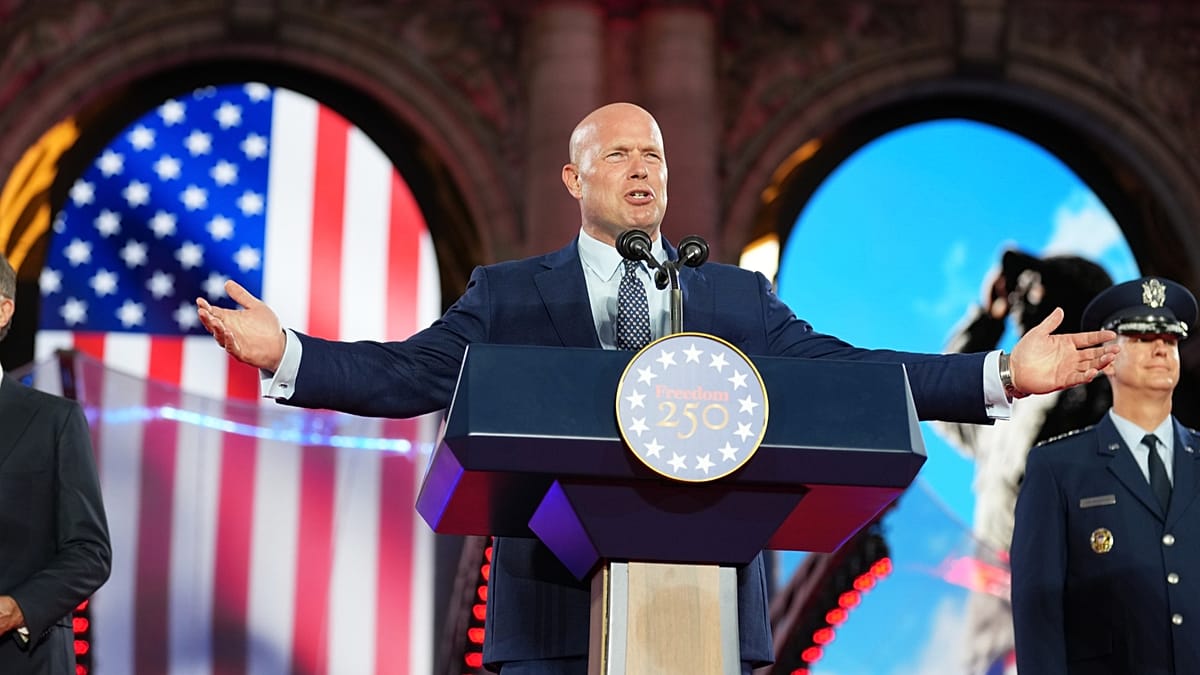
America's ambassador to NATO sought to calm European anxieties this week, insisting that Washington is not walking away from the continent even as the Pentagon prepares to shrink its military footprint here. Speaking at the Warsaw Security Forum on Monday, Matthew Whitaker told an audience in the Polish capital that the transatlantic bond remains intact. "We still love you," he said, addressing European allies directly.
Whitaker's remarks were aimed at a continent that has watched with growing unease as the Trump administration redirects military resources towards the Indo-Pacific and presses European capitals to shoulder more of their own defence. His interlocutor on the panel, European Commissioner for Defence Andrius Kubilius, framed the shift not as abandonment but as a necessary rebalancing.
A Europeanised alliance, not an absent America
The model under discussion in Warsaw — dubbed NATO 3.0 — envisions European members taking the lead on conventional territorial defence while US forces draw down and pivot elsewhere. Kubilius rejected the notion that this amounts to Washington saying, "We don't love you anymore, Europeans, so you should do your own job." Instead, he argued, Europe must build the capabilities to deter aggression on its own soil. "Europe needs to take responsibility in our hands," he said.
The commissioner has previously put a price tag on replacing American strategic assets: as much as €500 billion. Military analysts have suggested Europe could need an additional 300,000 troops to defend itself against Russia in a scenario where Washington keeps pulling back. Those figures underline the scale of the task facing the EU's defence industrial base, which Brussels aims to strengthen substantially by 2030.
"I keep telling our European allies… the United States isn't stepping back." — Matthew Whitaker, US Ambassador to NATO
Whitaker declined to preview the conclusions of the Pentagon's ongoing review of its European deployments, saying the assessment "is not ready". The findings are expected by December and will be presented to US Defence Secretary Pete Hegseth. But reductions are already under way: in May, the Pentagon ordered roughly 5,000 troops out of Germany and cancelled a planned deployment of a long-range fires battalion.
Poland as the model ally
The ambassador pointed to Poland as evidence that Washington's push for a more European NATO is bearing fruit. Warsaw spends 4.7% of its GDP on core defence, the highest share among large allies, and has become a linchpin of the alliance's eastern flank. "The proof is in where we're sitting today, here in Poland," Whitaker said, praising the country for "leading really the alliance to a stronger, more capable military".
At the 2025 NATO summit in The Hague, allies agreed to raise the core defence spending target from 2% to 3.5% of GDP by 2035, with an additional 1.5% earmarked for broader security and defence needs — a combined 5% goal that Washington has made a benchmark for all members. "That is what the United States is expecting from all of its allies," Whitaker said.
The spending push coincides with mounting warnings from European intelligence agencies that Russia could pose a more direct threat to NATO territory within a few years. That assessment has lent urgency to efforts in Brussels and national capitals to rebuild stockpiles, expand production lines and improve military mobility across the continent. For countries on the eastern flank, from the Baltic states to Romania, the question is not whether Europe should do more but how quickly it can.
Whitaker's reassurance may soothe some nerves in European capitals, but the December review will be the real test of how far Washington intends to go. For now, the message from Warsaw is that the alliance is changing shape — and that Europe is expected to hold the line.



