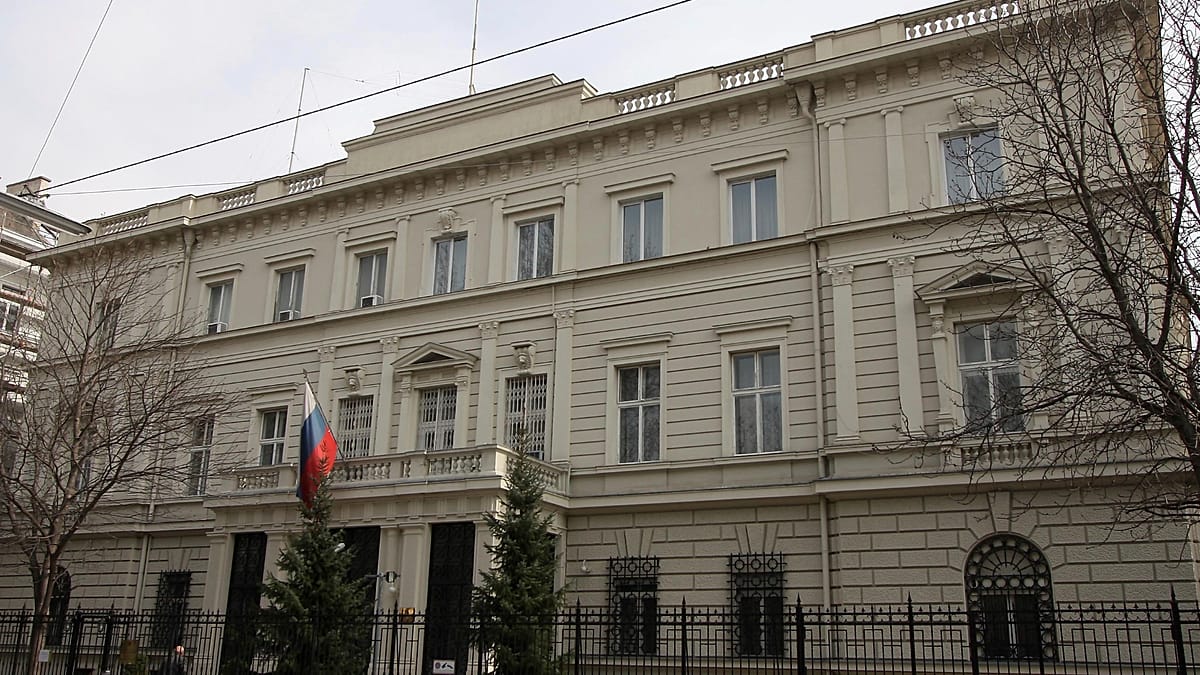
Last week, Austria expelled three Russian diplomats accused of using their diplomatic cover to conduct espionage in Vienna. Foreign Minister Beate Meinl-Reisinger described the move as part of a tougher stance on spying, calling it a “security issue” for the country. She specifically referenced the “antenna forest” at the Russian representation, stating that using diplomatic immunity for espionage is unacceptable.
The remark drew attention to a growing concern across Europe: the proliferation of large antenna systems and satellite dishes on Russian diplomatic buildings. While embassies routinely use such equipment for secure communications under Article 27 of the Vienna Convention on Diplomatic Relations, the consent of the host state is required for wireless transmitters. Investigators and former intelligence officials argue that the scale and behaviour of these installations go beyond normal diplomatic needs.
An investigation published in March by the Financial Times, citing officials and analysts monitoring the sites, reported that satellite dishes on Russian buildings in Vienna appear to move and reposition frequently. Analysts say this is unusual for systems used solely for diplomatic communication. Erich Möchel, an Austrian investigative journalist working with a group of senior technologists and electronics engineers called Nomen Nescio, told Euronews that one antenna on Russia’s embassy buildings in Vienna’s third district “points far to the west,” which he said was “not usual embassy communication.” Instead, it points toward commercial satellites carrying communications traffic between Europe and Africa, rather than toward satellites linked to Moscow.
According to Möchel, a Russian diplomatic building in Vienna’s 22nd district appears to function as a “pure signals intelligence station,” with several dishes aimed at satellites handling traffic between Europe and Africa. Nomen Nescio has observed one dish that is regularly repositioned and then returned to its normal orientation, suggesting it is “used for searching,” possibly for specific channels on other satellites. The group also identified unusual rooftop structures made from lightweight materials such as wood and plastic, which Möchel said resemble radomes—weatherproof enclosures designed to protect antennas and obscure their direction.
Diplomatic rooftops under scrutiny across Europe
Allegations of rooftop surveillance are not new. In 2013, Der Spiegel reported, based on documents leaked by former NSA contractor Edward Snowden, that the US embassy in Berlin housed rooftop surveillance equipment for signals intelligence. That same year, Germany summoned the British ambassador over allegations of a covert listening post on the embassy roof. Russia has also faced similar accusations. A 2023 investigation by Central European outlet VSquare, citing multiple former intelligence officials, reported that specialised equipment on embassy roofs from Warsaw to Brussels could intercept electronic communications in host countries.
Sergei Jirnov, a former KGB officer, told Euronews that antennas on diplomatic buildings could serve “two purposes: communications with Moscow and espionage activities in the host country.” Claude Moniquet, a former agent for France’s DGSE, added that some diplomatic antennas could theoretically be used for “the interception of radio waves, microwave links, satellite communications, unencrypted internet traffic, and the collection of mobile identifiers and metadata through IMSI-catcher-type devices.” He noted that Chinese and Russian services use similar methods, and described Brussels, Vienna, and Geneva as major hubs for such activity, given their concentration of international bodies.
Vienna has long been associated with espionage due to the presence of the United Nations, the International Atomic Energy Agency, the OSCE, and OPEC. The recent expulsions and the antenna controversy have reignited debates about diplomatic immunity and security. Austria’s move is part of a broader European trend: the EU has imposed 20 rounds of sanctions on Russia, and member states are increasingly vigilant about Russian intelligence activities. The incident also echoes concerns about Russian drones crossing into NATO airspace, highlighting the multifaceted nature of the security challenge.
As European capitals reassess the risks posed by diplomatic installations, the antenna systems in Vienna serve as a stark reminder that espionage remains a persistent threat. The question now is whether other governments will follow Austria’s lead in tightening oversight of Russian diplomatic missions.