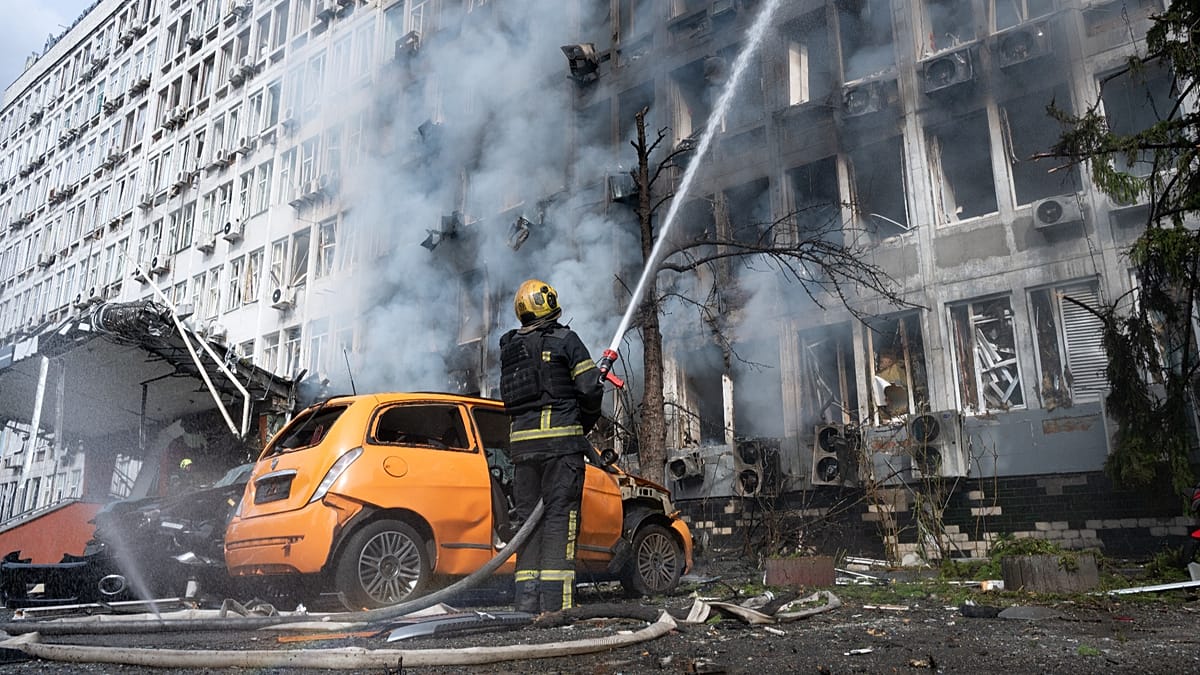
Russian forces launched a wave of drone attacks on Kyiv on Wednesday, killing two people and wounding 23 others, just hours before President Volodymyr Zelenskyy was set to address the United Nations General Assembly in New York. The daylight strikes sent plumes of black smoke over the Ukrainian capital, adding to the daily toll of a conflict that shows no sign of abating.
The attacks, which also targeted other regions, set off fires and damaged buildings across the country, according to Ukrainian authorities. In Kyiv, the central railway station came under fire, prompting Ukrainian Railways chief Oleksandr Pertsovsky to urge passengers to exercise "maximum" vigilance. The station, a key transit hub for civilians and military supplies, has been a recurring target.
Strikes hit civilian infrastructure and shipping
In the southeastern city of Zaporizhzhia, two men aged 37 and 39 were wounded when a strike ignited a massive fire at a shopping mall. Emergency services reported that the blaze spread across roughly 6,000 square meters before being brought under control.
Further south, in the Black Sea port of Odesa, a Ukrainian cargo ship captain was killed in a Russian attack. The vessel, sailing under the flag of Antigua and Barbuda, was part of a broader pattern of strikes on commercial shipping that have disrupted Ukraine's vital grain exports. According to Turkey's IMEAK chamber of shipping, at least 226 civilian and commercial vessels have been hit in the Black Sea since the start of the full-scale invasion, with around 70% of those attacks occurring in the first eight months of this year.
Turkish President Recep Tayyip Erdoğan, whose country has increasingly seen its vessels caught in the crossfire, condemned the attacks during his own address to the UN General Assembly on Tuesday. "The recent attacks on commercial vessels in the Black Sea are unacceptable, regardless of who is responsible," he said. Ankara has proposed a plan to both Moscow and Kyiv to halt strikes on civilian ships, but so far neither side has acted on it.
Zelenskyy's diplomatic push
Zelenskyy's presence in New York is part of a concerted effort to shore up and expand international support for Ukraine's gruelling fight. On Tuesday, he met with US President Donald Trump, who has expressed frustration over the lack of progress in peace talks and the escalating aerial exchanges. Trump, who has shown impatience with the war's duration, has been pressing for a negotiated settlement, but Kyiv remains wary of any deal that would cede territory or compromise its security.
Zelenskyy said at the start of his US visit that he had proposals to make regarding possible de-escalation. Key priorities for Kyiv include halting Russian strikes on Ukraine's power grid, which have caused widespread blackouts, and ensuring that Ukrainian grain can continue to reach world markets despite the Black Sea blockade. Ukraine is also urgently seeking more US-made Patriot air defence systems to counter Russian ballistic missiles, but these are in short supply following the outbreak of the war in Iran.
Russian President Vladimir Putin, who is accused by NATO and European governments of orchestrating sabotage and hybrid attacks across the continent, is not scheduled to attend the General Assembly this year. Meanwhile, Ukraine has retaliated by targeting Russian oil refineries, a key pillar of Moscow's war economy. The Russian Defence Ministry claimed its forces struck Ukrainian military-industrial and energy facilities, logistics centres, and sea vessels overnight, while also intercepting more than 500 Ukrainian drones over Russian territory and the annexed Crimean peninsula.
As the war grinds on, European leaders are watching closely. The EU recently renewed its sanctions on Russia for another 36 months, though a controversial decision to drop oligarchs Alisher Usmanov and Petr Avedisyan from the list has drawn sharp criticism from Latvia, which warned that the move 'normalises' Russia. Zelenskyy himself has urged the EU to keep the sanctions in place, arguing that any softening sends the wrong signal to Moscow.
The drone attacks on Kyiv are a stark reminder that the war remains as deadly as ever, even as diplomatic efforts continue. For the people of Ukraine, the daily threat of aerial bombardment has become a grim reality, and the international community's response will be crucial in shaping the conflict's outcome.